Physical Address
304 North Cardinal St.
Dorchester Center, MA 02124
Physical Address
304 North Cardinal St.
Dorchester Center, MA 02124

There are some festivals that arrive with music, flowers, prayers, and bright colors, while others seem to bring a quieter kind of light. Saraswati Puja 2027 belongs to the second kind.
It is a day when students open their books with a little more respect, artists remember where their creativity comes from, and families pray for the wisdom to use knowledge in the right way.
In Hindu tradition, Goddess Saraswati is revered as the goddess of knowledge, wisdom, learning, speech, music, and the arts. Her festival is especially meaningful for students, teachers, writers, musicians, artists, and anyone who values education. The celebration is commonly associated with Basant Panchami, also called Basant Panchmi and Sri Panchmi.
In 2027, this sacred occasion falls in February. For many devotees, it is not simply another date on the Hindu calendar. It feels more like an annual reminder that knowledge becomes truly beautiful when it is combined with humility, discipline, and good intentions.
According to the supplied Panchang details, Saraswati Puja 2027 will be observed on 11 February 2027, Thursday, in New Delhi, India. The festival falls during Magha Shukla Panchami, the fifth day of the Shukla Paksha in the Hindu month of Magha.
The Saraswati Puja Muhurat is given as 07:03:11 AM to 12:35:36 PM, providing approximately 5 hours and 32 minutes for the auspicious worship period.
For devotees searching for the Saraswati Puja date 2027, this date is therefore especially important. Local Panchang calculations can sometimes vary by location, so people outside New Delhi should check the timings applicable to their own city before beginning the ceremony.
The day is also widely known as Basant Panchami 2027. The arrival of Basant, or spring, gives the festival an additional sense of freshness. It is almost as if nature itself is changing its handwriting, slowly moving from winter toward color and warmth.
The central purpose of Saraswati worship is to seek divine blessings for knowledge, wisdom, learning, speech, music, and creative ability.
Unlike festivals centered primarily around material prosperity, this celebration places the mind and intellect at the heart of devotion. Students may pray for concentration, teachers for the ability to guide others, and artists for creativity that can be used meaningfully.
Goddess Saraswati is traditionally regarded as the Goddess of knowledge and the Goddess of wisdom. Her blessings are therefore associated not merely with collecting information, but with understanding what knowledge means and how it should be used.
A person may know thousands of facts and still lack wisdom. Saraswati Puja gently points toward that difference. Knowledge fills the mind, while wisdom teaches the mind where to walk.
The connection between Saraswati Puja 2027 and Basant Panchami 2027 is one of the most important things to understand about the festival.
Basant Panchami occurs on the Panchami Tithi of the Shukla Paksha in the month of Magha. It is associated with the beginning of the spring season in many Indian traditions, and Saraswati worship is an important part of the day for numerous Hindu communities.
The festival is also called Sri Panchmi or Saraswati Jayanti in different contexts. Names and customs can differ between regions, but the underlying devotion remains closely connected with learning and the divine feminine.
Schools, colleges, temples, and households may organize celebrations. In some places, students place books and educational materials near the image of Saraswati before offering prayers. It creates a lovely little scene: the things used for learning become part of the worship itself.
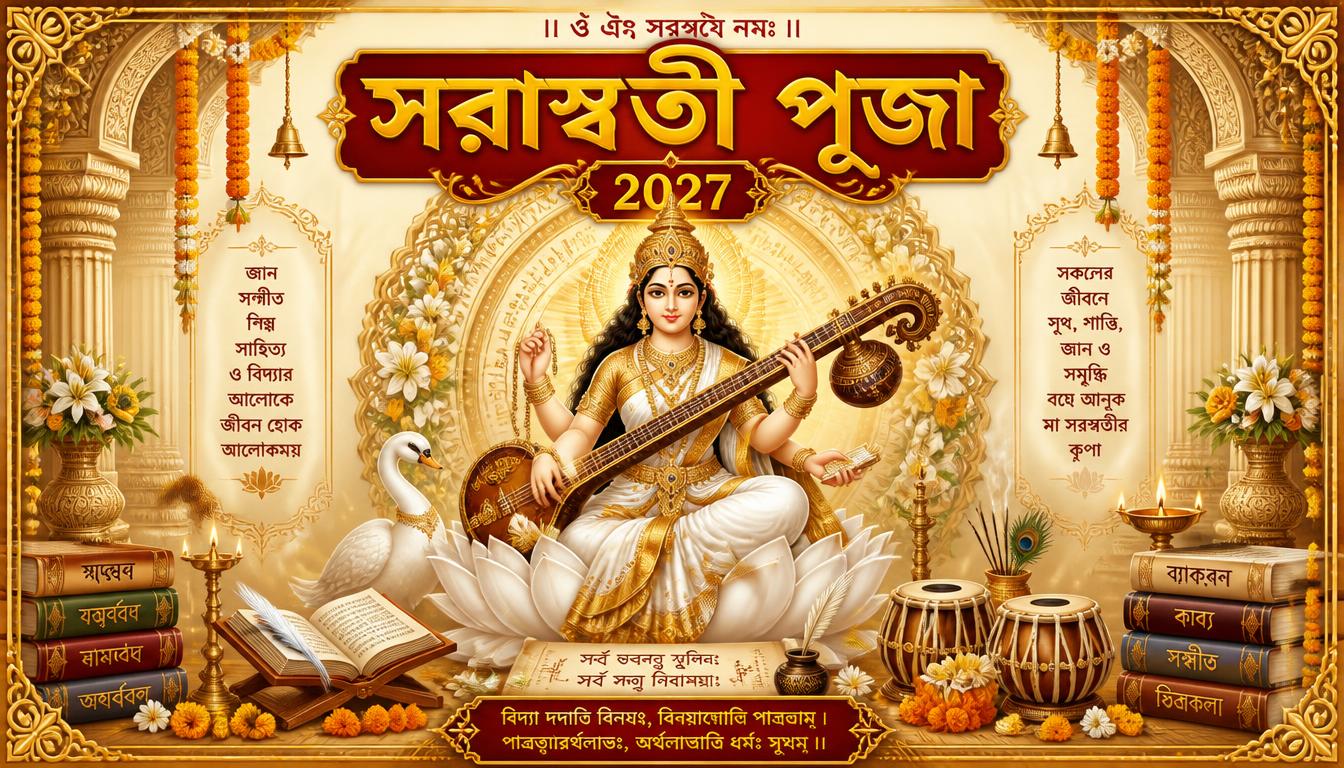
Goddess Saraswati has a distinctive visual identity in Hindu iconography. She is commonly depicted wearing white clothing and seated near or upon a lotus.
Her white clothing is traditionally associated with purity and clarity. The white lotus similarly carries associations with spiritual purity and awakened knowledge.
She is often shown holding a Veena, a traditional Indian string instrument. The Veena represents music, harmony, creativity, and refined expression. This is why Saraswati is not regarded only as a goddess of academic learning.
She is also associated with the arts, music, speech, literature, culture, and creative expression.
Her symbolism almost tells a complete story without speaking a single word: knowledge should be pure, speech should have value, creativity should have discipline, and wisdom should bring harmony.
The exact Saraswati Puja Vidhi can vary according to family tradition, region, community, and the form of worship being followed.
Still, a simple household puja generally begins by cleaning the worship area and preparing an image or idol of Saraswati. Devotees may arrange flowers, a Kalash, offerings, books, musical instruments, and other objects connected with education or creative work.
The worship may include Lord Ganesha first, followed by prayers to Saraswati.
A simple sequence can include:
The important thing is not to make the ritual unnecessarily complicated. Devotion, sincerity, cleanliness, and respect are central to a meaningful household observance.
Students have a particularly natural connection with this festival because education sits at the center of Saraswati’s traditional significance.
On Saraswati Puja 2027, students may keep their textbooks, notebooks, pens, musical instruments, or other learning materials near the deity during worship.
Some traditions encourage devotees to avoid ordinary study for a period while the books are being worshipped. Customs vary, so families generally follow the practice passed down through their own tradition.
A student might also use the occasion to make a small personal promise: study honestly, respect teachers, avoid wasting opportunities, and use education for something constructive.
That kind of promise can be more valuable than an elaborate decoration, honestly.
For people searching specifically for Saraswati Puja Muhurat New Delhi, the supplied Panchang information gives the following details for 11 February 2027:
This period is the stated auspicious window for Saraswati worship in New Delhi.
Because Hindu calendar calculations are location-sensitive, devotees in Mumbai, Kolkata, Bengaluru, Delhi, or other places should use their local Panchang for exact timings rather than assuming that one city’s Muhurat automatically applies everywhere.
Abujha Muhurat refers to an especially auspicious period in Hindu tradition during which certain activities may be undertaken without the need for selecting a separate detailed Muhurat.
Basant Panchami is sometimes associated with this concept in popular Hindu practice. However, specific customs and interpretations differ among communities and traditions.
For Saraswati worship, the important point is that devotees should understand their own family or regional practice rather than treating every Muhurat rule as identical everywhere.
A festival can be spiritually meaningful without becoming a race against the clock. The timing matters, but the intention behind the worship matters too.
Reciting a Saraswati Mantra is a common part of Saraswati worship. One widely known prayer is:
Ya Kundendu Tusharahara Dhavala
Ya Shubhra Vastravrita
Ya Veena Varadanda Manditakara
Ya Shweta Padmasana
The verse praises Saraswati through imagery of whiteness, purity, the Veena, and the lotus.
Devotees may also recite a shorter Saraswati prayer according to their tradition. The purpose is not simply to pronounce Sanskrit words correctly for appearance’s sake. Prayer becomes more meaningful when the devotee understands that it is an expression of humility before knowledge.
A Saraswati Stotra may be recited during the puja as part of devotional practice. Stotras generally praise the deity through multiple names, attributes, and qualities.
A Dhyan Mantra can similarly be used for meditation and visualization before or during worship.
The exact text selected can differ depending on the tradition being followed. Families may use a prayer book, temple tradition, guru-given practice, or established devotional text.
For someone performing a simple home puja, even a short sincere prayer can create a meaningful atmosphere. Length does not automatically equal devotion.
The symbolism surrounding Saraswati is one of the reasons the festival has such a distinctive character.
The Veena represents music, artistic expression, harmony, and refined creativity. It reminds devotees that knowledge does not live only inside classrooms.
The lotus, particularly the white lotus, is connected with purity and spiritual awakening. It grows in muddy surroundings yet rises above them, which makes it a powerful symbol in Indian religious imagery.
Her white clothing is traditionally connected with purity, clarity, and simplicity.
The overall image is remarkably peaceful. There is no need for excessive grandeur. Saraswati’s traditional appearance itself communicates a quieter message: seek clarity before pride.
Hindu traditions contain different accounts and interpretations concerning Saraswati and Brahma.
In many traditions, Saraswati is associated with Lord Brahma, the creator within the Hindu Trinity. She is connected with speech, knowledge, creativity, and the powers needed for creation.
Some traditions describe Saraswati as Brahma’s consort, while theological and regional interpretations can differ.
These stories are part of a much larger Hindu mythological world involving Lord Vishnu, Lord Shankar, Lakshmi, Parvati, and other Hindu deities.
The deeper symbolism remains especially interesting: creation itself requires knowledge, expression, and intelligence. Without these qualities, creation would be incomplete.
Saraswati, Lakshmi, and Parvati are often discussed together when people explore the divine feminine in Hindu traditions.
Saraswati is strongly associated with knowledge and wisdom, Lakshmi with prosperity and abundance, and Parvati with divine power and aspects of Shakti.
These associations should not be reduced to a simplistic formula because Hindu traditions contain many layers of symbolism and regional interpretations.
Still, the comparison helps explain why Saraswati Puja feels different from festivals primarily focused on wealth or power. Its central emotional language is learning, creativity, understanding, and refined expression.
The Kalash is commonly used in many Hindu puja traditions as an important sacred symbol.
During a Saraswati ceremony, devotees following a traditional household Vidhi may prepare and place a Kalash in the designated worship area before beginning the main prayers.
The exact preparation and placement vary by tradition, so there is no single universal household method that every family follows.
For a simple puja, the safest approach is to follow the instructions of your family tradition, temple, priest, or trusted Panchang rather than mixing several different ritual systems together.
In many Hindu worship traditions, Lord Ganesha is invoked before beginning a major puja.
This practice is connected with seeking blessings for the removal of obstacles and the successful completion of the worship.
Therefore, families performing Saraswati Puja may begin with Ganesha worship before proceeding toward Saraswati’s invocation.
The pairing feels particularly meaningful for students. One prayer asks for obstacles to be cleared, while the other seeks knowledge and wisdom to move forward.
Educational institutions often give Saraswati Puja a special character because the festival naturally connects with teachers, students, books, music, and learning.
Students may participate in prayers, cultural programs, music performances, floral offerings, and traditional ceremonies.
In some communities, children are introduced to writing or learning through ceremonies connected with Saraswati worship. The details differ by region and institution, but the common theme remains the same: education is worthy of respect.
For a child, such a ceremony can become a memorable moment. A notebook that normally feels like homework suddenly becomes something placed respectfully before a deity. That small change in atmosphere can stay in memory for years.
The Saraswati goddess of music tradition is especially meaningful to musicians and performers.
Students of classical music, singers, instrumentalists, dancers, writers, painters, and other artists may seek Saraswati’s blessings because creativity and expression are traditionally associated with her.
The Veena in her hands reinforces this connection.
For an artist, Saraswati Puja can therefore become more than a religious observance. It can be a moment to remember that talent is not merely something to show people; it is something to develop responsibly.
Speech is another important aspect of Saraswati’s symbolism.
As the goddess associated with speech and sound, Saraswati is traditionally connected with language, communication, literature, and expression.
Writers may use the day to reflect on how words affect people. Teachers can think about how explanations shape young minds. Speakers can remember that powerful language should not become careless language.
Words are strange things. They weigh almost nothing physically, yet one sentence can stay inside a person’s heart for twenty years.
The connection between Basant Panchmi and spring gives the celebration a special atmosphere.
Yellow is commonly associated with Basant celebrations in many parts of India, reflecting the season and the mustard fields that become vibrant during this period.
However, Saraswati’s traditional imagery is strongly connected with white, especially her white garments and lotus.
This creates a beautiful contrast in the broader festival: the world outside may become bright with spring colors while the deity herself represents the quiet clarity of knowledge.
Saraswati is not worshipped only on Basant Panchami.
Different Hindu traditions also include forms of Navratri Saraswati Puja, educational worship, and Diwali Sharda Puja in certain regions and communities.
These observances can have different ritual details and theological contexts.
The common thread is reverence for knowledge, learning, speech, artistic ability, and intellectual clarity.
A household that wants to observe Saraswati Puja 2027 without an elaborate arrangement can keep the ceremony simple.
Clean a peaceful space and place an image or idol of Saraswati. Arrange flowers and a Kalash if that is part of your family practice.
Place books, notebooks, musical instruments, or writing materials nearby. Invoke Lord Ganesha if that follows your tradition, then offer prayers to Saraswati.
Recite a Saraswati Mantra, Saraswati Stotra, or another familiar prayer. End by asking for wisdom, concentration, humility, creativity, and the ability to use knowledge responsibly.
A small sincere puja is still a puja. It does not need to look like a television ceremony to have personal meaning.
The easiest way to make the day meaningful is to connect the prayer with a real intention.
A student might promise to study consistently. A teacher might promise to remain patient with learners. A musician might decide to practice every day. A writer might commit to using words honestly.
Parents can encourage children to understand why books and learning materials are placed before Saraswati.
Instead of simply saying, “Today we worship the goddess of knowledge,” explain what knowledge can do when it is joined with kindness. That conversation may become one of the most valuable parts of the festival.
At its heart, Saraswati Puja 2027 is a celebration of gratitude.
We often notice success but forget the people and opportunities that helped create it. A teacher’s patience, a parent’s sacrifice, a book’s lessons, a friend’s explanation, or even one difficult mistake can contribute to learning.
Saraswati worship creates a pause in the busy routine.
It asks people to respect knowledge before they use it, to value education before they measure its financial return, and to remember that wisdom grows slowly.
That is perhaps why the festival remains meaningful across generations.
Saraswati Puja 2027 is observed on 11 February 2027, Thursday, according to the supplied New Delhi, India Panchang details.
The Saraswati Puja 2027 date is 11 February 2027. It falls on Panchami Tithi during Shukla Paksha in the Hindu month of Magha.
For New Delhi, the supplied Saraswati Puja Muhurat 2027 is from 07:03:11 AM to 12:35:36 PM on 11 February 2027.
Yes. Basant Panchami is one of the principal occasions associated with Saraswati worship. The festival is also known as Basant Panchmi and Sri Panchmi in different traditions.
Goddess Saraswati is traditionally associated with knowledge, wisdom, learning, speech, music, art, culture, and creative expression.
Students may place books, notebooks, pens, musical instruments, or other educational materials near the deity according to their family or community tradition.
Devotees may recite traditional Saraswati Mantra, Saraswati Stotra, Dhyan Mantra, or other prayers dedicated to the goddess. The exact practice varies between traditions.
The Veena symbolizes music, artistic expression, harmony, and creativity, reflecting Saraswati’s association with music and the arts.
Her white clothing is traditionally associated with purity, clarity, wisdom, and spiritual knowledge.
Saraswati Puja 2026 was observed on January 23, 2026, on the auspicious occasion of Vasant Panchami.
Saraswati Puja 2027 will be celebrated on February 11, 2027, which falls on Thursday and coincides with Vasant Panchami.
In 2026, Saraswati Puja was celebrated on January 23. Devotees worshipped Goddess Saraswati, the Hindu goddess of knowledge, wisdom, music, and arts.
The Saraswati Puja time varies by location, so the exact Muhurat depends on the city and local Panchang calculations.
The Saraswati Puja Muhurat in 2026 depended on the location, with devotees generally performing the worship during the auspicious Panchami period.
Read more: https://templetimingsdaily.com/new-delhi-india
Saraswati Puja 2027 offers something beautifully simple: a chance to stop for a moment and remember the value of learning.
On 11 February 2027, students, teachers, artists, musicians, writers, families, and devotees can turn their attention toward the qualities traditionally represented by Goddess Saraswati—knowledge, wisdom, purity, creativity, speech, and understanding.
Whether the celebration takes place in a large temple, a school courtyard, or a small corner of a family home, the heart of the festival remains the same.
May the blessings of Goddess Saraswati inspire clearer thinking, honest speech, creative courage, and a lifelong love of learning. And may every book opened on this sacred occasion become not merely a source of information, but a doorway toward greater wisdom.