Physical Address
304 North Cardinal St.
Dorchester Center, MA 02124
Physical Address
304 North Cardinal St.
Dorchester Center, MA 02124

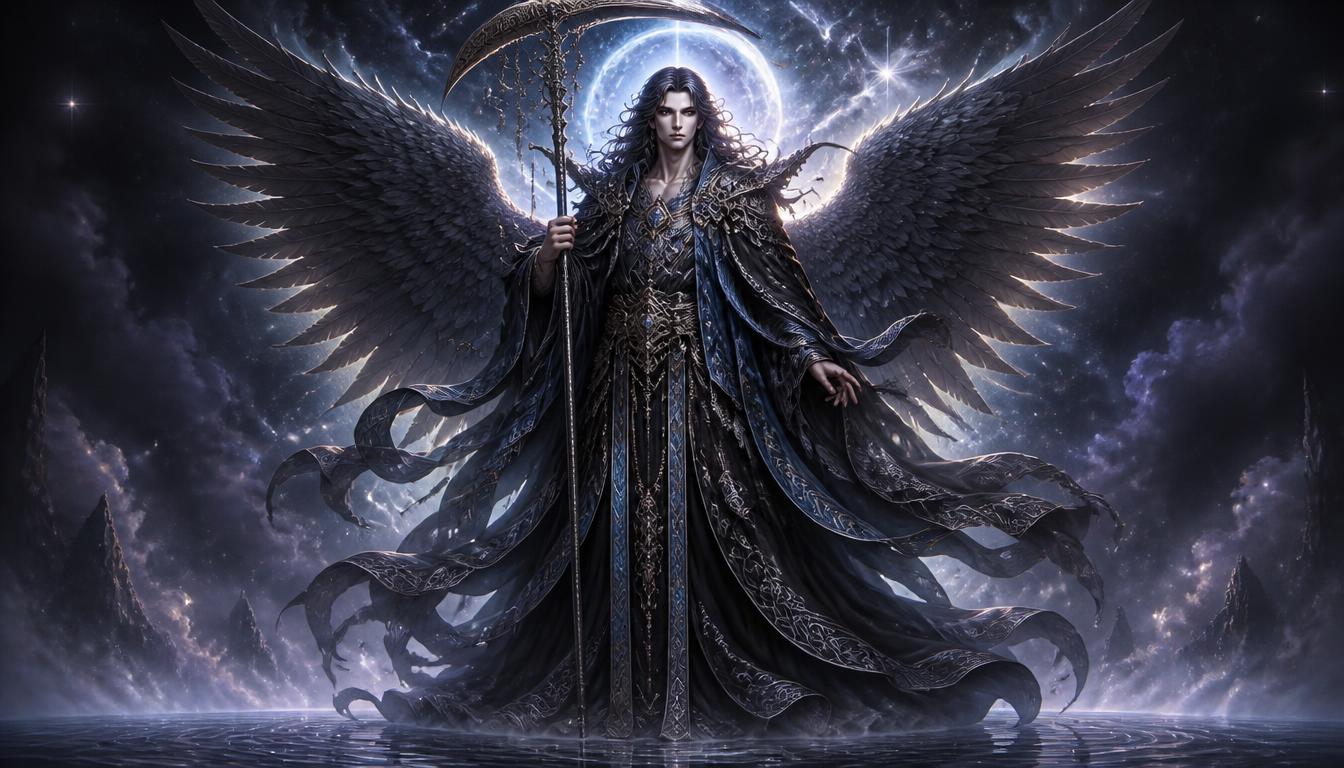
There are some figures in mythology who arrive carrying thunder, some who arrive carrying a sword, and then there is Azrael, a name that seems to enter the room quietly. He is one of those supernatural figures whose story has grown at the meeting point of religion, folklore, theology, and later imagination. The familiar title Angel of Death makes him sound frightening, but the older traditions surrounding him are more complicated than a simple monster of the grave.
Across different sources, Azrael appears under several names and spellings, including Azrail, Azraaiyl, Azra’eil, and Ezrā’ël. In Islamic tradition, the figure is commonly associated with Malak al-Maut, the angel entrusted with taking souls at the appointed time. The Qur’an itself refers to the “Angel of Death,” but does not give him the personal name Azrael. Quranic Arabic Corpus
That distinction matters because mythology has a habit of sewing together threads from different centuries. A name found in one tradition may later become attached to a figure in another, and suddenly a theological concept has a personality, a face, wings, a cloak, and sometimes even a scythe. Thats where the fascinating story of Azrael really begins.
Azrael is best known as the Angel of Death, or in some descriptions the Archangel of Death. His central role is connected with mortality, the separation of the soul from the body, and the passage toward the afterlife.
The image is not necessarily that of an evil being. In many religious interpretations, death occurs through divine command, and the angel acts as a servant rather than an independent force deciding who lives or dies. The distinction is important: Azrael does not become “death” itself simply because he is associated with the moment of death.
The name also appears in numerous forms. Azra’el, Azrail, Azraaiyl, Azra’eil, Azra, Azazīl, Azizil, Uzayzīl, and ʿÁzarʾēl have all appeared in different linguistic or folkloric contexts, though they should not automatically be treated as identical names with identical histories.
In Arabic, the familiar form is عزرائيل, generally transliterated as ʿAzrāʾīl. The Hebrew form often given is עֲזַרְאֵל, while discussions of the name connect it with an expression meaning something like “God has helped.” The linguistic history, however, is more complicated than a single neat translation would suggest.
The phrase Angel of Death existed as a broader religious idea long before modern fantasy gave death angels enormous black wings and silver weapons.
A death angel can function as a psychopomp, a supernatural being associated with the transition between life and the next realm. The soul leaves the familiar world, and the spiritual messenger represents the boundary it must cross.
This is why Azrael mythology is less about killing in the ordinary sense and more about the unavoidable moment of mortality. His story touches questions humans have asked forever: Where does the soul go? Can destiny be escaped? What happens when life reaches its final breath?
The popular phrase “soul collector” captures this folklore in a dramatic way, although religious descriptions can be considerably more restrained. Taking souls is not presented as personal cruelty. It is an assigned function within a divine order.
That makes Azrael and death an unusual relationship. Death is terrifying to humans because it represents the unknown, while Azrael, in the traditions that associate him with it, represents the servant standing at that threshold.
The strongest popular association of Azrael in Islam is with Malak al-Maut, literally the Angel of Death. Qur’an 32:11 says that the Angel of Death is entrusted with taking people, after which they return to their Lord. The verse does not actually name the angel Azrael, which is an important point often lost in simplified internet descriptions. Quranic Arabic Corpus
Later Islamic literature and popular tradition identify the Angel of Death as Azra’il or ʿAzrāʾīl. In this understanding, he belongs among the great angels of Islam, alongside figures such as Jibrāʾīl, Mīkāʾīl, and Isrāfīl.
These four are sometimes described together in popular accounts as the four angels of Islam, although the exact classifications and descriptions depend upon the source and theological tradition being consulted.
The important idea is that an angel does not operate independently of Allah. The angel performs a divinely assigned responsibility. Therefore, describing Azrael as an evil “death god” would seriously distort the Islamic theological picture.
The expression Malak al-Maut is particularly important because it describes a role rather than necessarily functioning as a personal name.
In Islamic theology, death is part of the created order, and the Angel of Death is entrusted with the task of receiving souls at their appointed time. The popular expression Azrael soul collector therefore has a folkloric basis, but “collector” can sound much more sinister in English than the underlying theological concept actually is.
The moment is also tied to fate, destiny, and mortality. A person may fear death, bargain against it, or wish for more time, but the traditions emphasize that human beings do not ultimately control their appointed end.
This theme becomes especially vivid in stories where someone attempts to escape his destiny only to discover that the attempt itself leads him directly toward the place where death was already destined to find him.
One of the most memorable stories connected with the Angel of Death mythology concerns the creation of Adam.
In folklore associated with the Islamic world, angels are sometimes sent to gather clay from the Earth for the creation of Adam. Different versions tell the story differently, so it is better understood as folklore rather than a straightforward Qur’anic narrative.
One tradition recorded in Palestinian folklore tells of angels approaching the Earth to gather its dust. The Earth reacts with fear, and one messenger returns without completing the task. Another angel eventually performs the duty. Wikisource
The symbolism is rather striking. Clay, Earth, humanity, mortality, and creation all become connected in one story. Humans are formed from the Earth and eventually return to it, while the angel associated with death becomes part of the wider imaginative cycle from creation to soul collection.
So when people search for Azrael and Adam, they are often encountering a much older meditation on where humanity comes from and where humanity ultimately goes.
The subject of Azrael in Judaism requires some caution.
The Hebrew Bible does not name an angel Azrael, and the figure is not presented in the Talmud or Midrash as a canonical angel of death under that name. Later Jewish mystical traditions contain related angelic names, including Azriel, but that should not be casually treated as proof that the biblical or rabbinic tradition contains “Azrael the Angel of Death.” Wikipedia
This is where Jewish mythology, Jewish angelology, and later folklore can become tangled together.
The Kabbalah and texts such as the Zohar contributed enormously to later Jewish discussions of angels, divine realms, souls, and spiritual beings. Yet the modern popular image of Azrael cannot simply be placed into ancient Judaism as though every later story were part of the original tradition.
Some evidence also shows similar forms of the name in older Jewish magical material, but the existence of a name alone does not establish the same identity or function as the later Angel of Death. Thats a small distinction, but an important one.
The Zohar occupies an important place in Jewish mystical history, especially in discussions surrounding Kabbalah.
Kabbalistic traditions developed elaborate ideas about divine emanations, angels, souls, spiritual realms, and the relationship between the visible world and the unseen one. Later writers sometimes connected various angelic names and functions with death and the movement of souls.
Still, saying “the Zohar proves Azrael is the Jewish Angel of Death” would be an oversimplification.
The history is much messier, and honestly that messiness is part of what makes Azrael religious traditions interesting. Names migrate between languages, stories cross cultural borders, and later folklore sometimes gives a familiar name to an older supernatural function.
The story of Azrael in Christianity is similarly complicated.
Azrael is not one of the principal named angels of the canonical Christian Bible. Michael, Gabriel, and other angelic figures have much stronger canonical foundations, while Azrael appears mainly in extra-biblical, apocryphal, later mystical, and folkloric material.
Some Christian and apocryphal traditions associate the name Ezrā’ël with an angelic figure. The Apocalypse of Peter, for example, contains an angel named in a form resembling Ezra’el, although the role and context are different from the familiar modern picture of Azrael. Wikipedia
This is why Christian apocrypha should be distinguished from official biblical canon. An apocryphal story can be historically important without being accepted as scripture by every Christian tradition.
Popular articles sometimes place Azrael, Michael, Satan, and Lucifer into one giant angelic family tree.
That can be misleading.
Michael is a prominent archangel in Christian and Jewish traditions, while Satan represents an adversarial figure in particular theological contexts. Lucifer, meanwhile, developed a complicated history through biblical interpretation and later Christian tradition.
Azrael’s role is different. He is primarily associated with death, souls, and the passage toward the afterlife rather than rebellion against God.
So calling Satan or Lucifer his “enemy” in a literal scriptural sense would be too strong. Such relationships belong more comfortably to later folklore, fantasy, occult tradition, or modern storytelling than to a single unified religious source.
One of the most colorful chapters in Azrael folklore comes from the Dictionnaire Infernal.
The Dictionnaire Infernal, associated with Jacques Auguste Simon Collin de Plancy, was first published in 1818 and became an influential work of European demonology and occult literature. Later editions changed and expanded its contents. Wikipedia
In its entry for Azraël or Azraïl, the book presents him as the Angel of Death and preserves a striking story involving Solomon.
The tale says that Azrael appears visibly near Solomon and looks intently at a man. The frightened man asks Solomon to have the wind carry him to India. After the man is transported there, Azrael explains that he had been ordered to take the man’s soul in India and was surprised to find him in Palestine. The story therefore becomes a lesson about unavoidable destiny. Wikisource
Its moral is almost unsettling in its simplicity: running away from fate may merely take you toward it.
The story of Solomon and Azrael is one of the best-known pieces of folklore attached to the name.
Solomon, famous in Jewish, Christian, and Islamic traditions for wisdom, becomes the human observer in the story. The man’s attempt to escape death creates the central dramatic twist.
He believes distance can defeat destiny.
But Azrael already knows where he must go.
The story is not really about Azrael being cruel. It is about the impossibility of bargaining with mortality. The soul, the appointed moment, and the destination all exist beyond ordinary human control.
That is why the tale has survived so well in folklore. It speaks to a fear that doesn’t belong to one religion or one century.
The Solomon story has also been associated in later literature with Muhammad, who is said in the Dictionnaire Infernal entry to have cited the tale in connection with destiny. Wikisource
This should be treated carefully because a claim made by a nineteenth-century European occult dictionary is not automatically evidence about what Islamic scripture or early Islamic scholarship actually says.
This distinction between source types is crucial when studying Azrael Islamic theology. Qur’anic material, hadith literature, medieval folklore, European demonology, and modern fantasy may all discuss the same name while doing very different things with it.
The word psychopomp describes a being associated with guiding or accompanying souls after death.
Azrael is often interpreted through this concept because his popular role involves the separation of soul and body and the transition toward the afterlife.
Other cultures have their own psychopomp figures. Greek mythology has Thanatos, while Roman mythology has Mors. Neither is simply “the Greek Azrael” or “the Roman Azrael,” though comparison can be useful.
Thanatos is a personification of death in Greek mythology, while Mors fills a comparable role in Roman tradition. Azrael, by contrast, belongs primarily to Abrahamic religious and folkloric frameworks.
The resemblance comes from a shared human question: who, or what, stands at the doorway between life and death?
Comparative mythology makes the differences even more interesting.
Thanatos is strongly personified as death itself in Greek tradition. Mors represents death within Roman mythology. Azrael is generally understood as an angel, meaning a servant or messenger within a monotheistic religious framework.
That distinction changes everything.
A deity or personification may embody death, while an angel performs a task under divine authority. Therefore, calling Azrael a “god of death” is usually inaccurate.
The comparison is still useful, though, because it shows how different civilizations turned an invisible experience into a figure humans could imagine.
The famous Azrael scythe is largely a product of artistic and popular imagination rather than a defining feature of Islamic theology.
The scythe became a powerful symbol of death in European art and folklore. It was especially associated with the personification of Death, often imagined as a skeletal figure harvesting human lives.
Once artists and storytellers began portraying Azrael as the Angel of Death, those visual symbols naturally migrated toward him.
But there is no reason to assume that every depiction of Azrael carrying a scythe comes from an ancient religious source. Sometimes an artist simply needs one powerful object to communicate “death” instantly.
The same goes for enormous black wings, skeletal faces, dark robes, and glowing weapons. They belong mostly to the visual language of Angel of Death imagery.
There is no single universally accepted physical description of Azrael.
Depending on the source, folklore may imagine him as an immense angel, a winged spiritual being, a mysterious traveler, a solemn figure in robes, or something far more dramatic.
Some artistic traditions emphasize thousands of eyes, vast wings, or supernatural scale. Other depictions are surprisingly restrained.
This variation tells us something important about mythology: the figure is shaped by the imagination of the culture telling the story.
The theological idea may be stable while the artwork keeps changing.
Popular Islamic angelology often places Jibrāʾīl, Mīkāʾīl, Isrāfīl, and the Angel of Death within a group of especially important angels.
Jibrāʾīl is associated with revelation, particularly his role in delivering revelation to prophets. Mīkāʾīl is traditionally associated with provision and natural phenomena. Isrāfīl is associated with the trumpet of the final resurrection. The Angel of Death is associated with taking souls.
This creates a fascinating symbolic structure.
One angel is connected with revelation, another with provision, another with the final trumpet, and another with mortality. They represent different dimensions of the unseen order.
Still, these classifications come from Islamic tradition and later angelological literature rather than a single simple list in the Qur’an. Precision matters when discussing Islamic angels.
The deeper meaning of Azrael is not simply “death.”
He can symbolize the boundary between existence and disappearance, the unavoidable nature of mortality, the limits of human control, and the belief that death occurs within a larger divine order.
That makes Azrael mythology and folklore surprisingly philosophical.
A frightening figure becomes a reminder that every life has an ending. A story about an angel becomes a story about human fear. A tale about escaping death becomes a meditation on destiny.
Perhaps thats why Azrael keeps returning in books, paintings, legends, films, games, and modern fantasy.
Modern culture has transformed Azrael into many different things.
Sometimes he is a terrifying executioner. Sometimes a quiet guide. Sometimes a misunderstood angel who feels almost compassionate. In fantasy fiction, he may become a warrior, ruler, guardian, or supernatural antihero.
These portrayals should not be confused with religious doctrine.
Folklore is allowed to be messy. It borrows a name, changes a personality, adds a weapon, gives someone a tragic childhood, and suddenly the old theological figure is walking through a fantasy novel wearing armor.
That creative freedom explains why Azrael folklore continues to evolve.
One common misconception is that Azrael is explicitly named in the Qur’an. He is not. The Qur’an refers to the Angel of Death, while the name Azrael comes from later Islamic tradition. Quranic Arabic Corpus
Another misconception is that Azrael is a demon. In the Islamic understanding, he is an angel serving Allah, not an evil spirit.
A third mistake is treating Jewish, Christian, Islamic, and occult descriptions as though they were all one tradition. They are not.
And finally, Azrael should not be confused automatically with Azazel or Azazīl. Similar sounds do not prove identical identities. Names in ancient religious literature can travel through languages and change shape rather dramatically.
Perhaps the reason Archangel Azrael remains so compelling is that nobody can completely remove themselves from the subject he represents.
Every culture has stories about death.
Some use a skeleton. Some use a god. Some use a ferryman. Some use an angel. Some use a mysterious woman walking at dusk. The costume changes, but the question underneath remains stubbornly the same.
What happens when the soul leaves?
Azrael gives that question a face.
He turns an abstract idea into a character who can enter a story, look at a human being, receive a divine command, and stand at the border between this world and the next.
Azrael is widely known as an angel associated with death and the transition of souls from earthly life to the afterlife.
Archangel Azrael is traditionally described as a powerful heavenly being who carries out divine duties connected with death and souls.
Angel Azrael is a figure found in Islamic, Jewish, and later folklore traditions, where he is commonly associated with death and the departing soul.
Azrael is often called an archangel of death, although descriptions of his rank and role differ across religious and folklore traditions.
The Archangel of Death is a supernatural figure believed to guide or collect human souls at the end of life, with Azrael being one of the best-known names associated with this role.
Read articuL: https://templetimingsdaily.com/norse-creatures/
Azrael is much more than a dramatic name attached to the phrase Angel of Death. He is a figure shaped by Islamic theology, Jewish mystical traditions, Christian apocrypha, folklore, European occult literature, and modern imagination.
In Islam, the Angel of Death is a servant entrusted with taking souls, while the personal name Azrael belongs more clearly to later tradition than to the Qur’anic text itself. In Jewish and Christian contexts, the history is more fragmented, with related names and figures appearing in mystical and extra-biblical sources rather than as a universally canonical Angel of Death. Quranic Arabic Corpus
His later appearance in the Dictionnaire Infernal adds another fascinating layer, especially through the story of Solomon and the man who tries to escape his destiny by traveling to India. Wikisource
Perhaps the most meaningful way to understand Azrael and death is not as a horror story, but as an old reflection on mortality. He represents the moment nobody can negotiate away, the mysterious passage of the soul, and the belief that life and death exist within a larger order.
The scythe may be folklore. The dark wings may belong to artists. The terrifying face may belong to modern cinema.
But the question Azrael represents is far older than all of them: what lies beyond the final breath?
And that question, quietly waiting at the edge of every human story, is exactly why the legend of Azrael refuses to disappear.