Physical Address
304 North Cardinal St.
Dorchester Center, MA 02124
Physical Address
304 North Cardinal St.
Dorchester Center, MA 02124

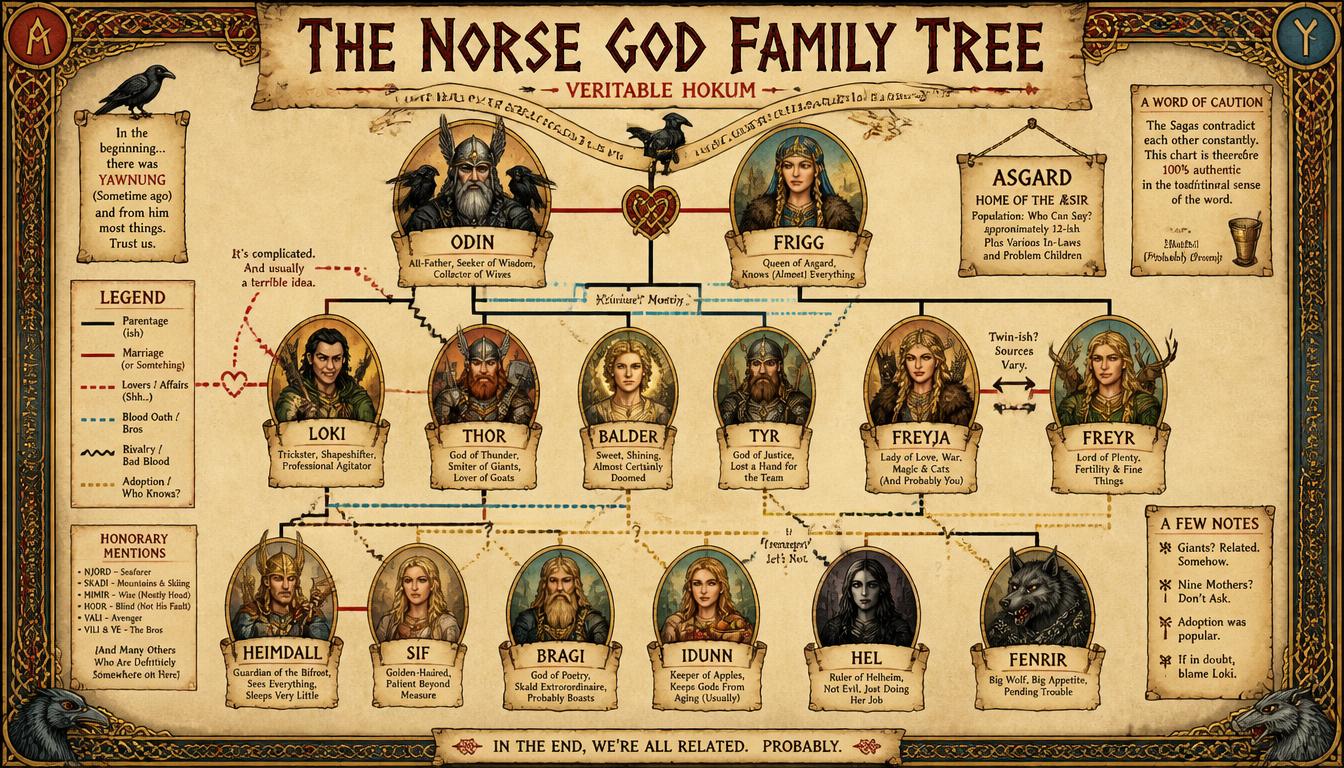
Trying to draw a neat Norse god family tree is a bit like trying to untangle a ball of wool after a very enthusiastic cat has discovered it.
At first, everything looks wonderfully organized: Odin is here, Thor is there, Loki is somewhere in the middle making trouble, and the giants are apparently related to half the universe. Then you look closer and the whole thing starts arguing with itself.
That is the strange beauty of Norse mythology. Unlike a modern family genealogy, the surviving stories were not written as one perfectly coordinated mythology handbook.
They came through poems, oral traditions, later manuscripts, and different regional memories of Old Norse religion. So when somebody presents a completely tidy Norse mythology family tree, a little skepticism is healthy.
The surviving traditions still give us an extraordinary picture of Norse gods and goddesses, giants, monsters, primordial beings, and complicated divine relationships. But some connections are certain, others are probable, and a few are basically mythology wearing a fake moustache and pretending to be genealogy.
The word “hokum” is useful here because a family tree can create an illusion of certainty that the original mythology simply does not possess. We can identify important relationships, but we cannot always arrange every deity into one unquestionable genealogy.
Much of what modern readers know comes from sources associated with Snorri Sturluson, especially the Prose Edda, alongside older poetic material such as the Poetic Edda. These sources preserve invaluable information, but they do not necessarily represent one single, universally agreed version of Norse religion.
The people of medieval Scandinavia did not have a giant laminated chart hanging in the village hall saying, “Here is your complete family tree, please update it after Ragnarok.” Their religious traditions were diverse, changing, and transmitted for generations.
So the best Norse god genealogy is not really a straight line. It is more like a web, with branches disappearing into older traditions, crossing between gods and giants, and occasionally ending in a question mark.
Before Odin and Thor become household names, the Norse creation myth begins in a far stranger place.
The primordial world contains opposing forces associated with fire and ice, and from the meeting of these extremes comes Ymir, a primordial giant. Ymir is not simply another giant who lives down the street. He belongs to the earliest layer of the cosmic story.
Alongside Ymir appears Auðumbla, the primeval cow. She nourishes Ymir while licking salty ice and revealing Búri, an ancient ancestor of the gods. It’s one of those details that makes Norse mythology instantly recognizable: the beginning of the universe involves ice, a giant, and a cosmic cow, because apparently ordinary creation stories were not dramatic enough.
Búri has a son named Borr, and Borr later marries Bestla, who becomes the mother of Odin, Vili, and Vé.
That gives us one of the most important early branches of the Norse mythology genealogy:
Búri → Borr + Bestla → Odin, Vili, Vé
But even here, the genealogy is not completely straightforward. Ymir belongs to the primordial generation, while Búri represents an ancestral line leading toward the gods. The story is less like a modern birth certificate and more like a mythic explanation of how cosmic order emerges from chaos.
Odin is perhaps the most important figure for understanding the Norse gods family tree. He is an Aesir god associated with wisdom, knowledge, magic, war, poetry, prophecy, and sacrifice.
His brothers Vili and Vé are especially important in the creation tradition. Together, the three brothers kill Ymir and use his enormous body to construct the cosmos.
His flesh becomes the earth, his blood becomes the sea, his bones become mountains, and his skull becomes the sky. It is an impressively grim construction project, and certainly not something any modern building inspector would approve.
The three brothers therefore occupy a fascinating position in Norse creation story traditions. They are not simply children in a divine family; they are agents of cosmic transformation, turning primordial chaos into something resembling order and civilization.
This also reveals an important idea behind Viking mythology. Creation and destruction are not always opposites. Sometimes destruction is the raw material from which a new world is made.
The Odin family tree becomes much larger once we move into the better-known generations.
Odin is strongly associated with Frigg, one of the most important goddesses in the Aesir tradition. Frigg is connected with marriage, motherhood, foreknowledge, and the household, although the surviving traditions do not always give her the same role.
Their most famous son is Baldr, the radiant and beloved god whose death becomes one of the great tragedies of Norse mythology.
Baldr is married to Nanna, and their story forms another branch of the divine family. Baldr’s death, involving the blind Höðr and the mistletoe, becomes deeply connected with the approach of Ragnarok.
Odin also has other children and relationships across the myths. This is where the neat diagram starts to become decidedly messy. Divine parentage can vary according to the source, and modern family trees sometimes turn uncertain relationships into hard facts.
That is why an honest Norse god genealogy should show uncertainty rather than hide it.
Then comes Thor, probably the most recognizable of the Norse gods after Odin.
Thor is the thunder god, associated with strength, protection, storms, giants, and the famous hammer Mjölnir. His mother is Jörð, a personification of the earth, while Odin is traditionally presented as his father.
So one major branch of the Thor family tree looks like this:
Odin + Jörð → Thor
Thor’s relationships add several more branches. He is associated with Sif, famous for her golden hair, and he also has a relationship with the giantess Jarnsaxa in the surviving tradition.
Thor’s children include Magni, Móði, and Þrúðr, although the surviving sources do not treat every family connection with equal detail. Magni becomes especially notable for his strength and his role in the aftermath of Ragnarok.
And then there is Mjölnir, Thor’s magical hammer, which is more than a weapon. It represents protection, strength, sacred power, and the ability to defend the divine world against the giants.
If the Norse god family tree had a warning label, Loki’s branch would probably say, “Do not attempt without supervision.”
Loki is one of the most complicated figures in Norse mythology. He is associated with the Jotnar, or giants, through his parentage, yet he spends much of his mythological life among the Aesir gods.
His father is Fárbauti, while his mother is Laufey or Nál in different traditions. Loki’s own children make his branch particularly important.
With the giantess Angrboða, Loki fathers three terrifying figures:
That gives the Loki family a remarkable structure:
Loki + Angrboða → Fenrir, Jörmungandr, Hel
Loki is also the father of Sleipnir, Odin’s extraordinary eight-legged horse. Sleipnir is born after Loki changes form and becomes involved with the stallion Svaðilfari.
Yes, this is exactly the point where a conventional genealogy quietly leaves the room.
Loki’s children are not random monsters inserted into the stories merely to make things spooky. They are deeply connected with the destiny of the gods.
Fenrir grows into an enormous wolf whose strength frightens the Aesir. The gods eventually bind him with the magical chain Gleipnir, but the prophecy says that Fenrir will eventually break free.
Jörmungandr, also called the Midgard Serpent, is thrown into the ocean surrounding the world. There it grows until it can encircle the earth and grasp its own tail.
Hel becomes ruler of a realm associated with the dead, often described in connection with Helheim and the broader Norse conception of the underworld.
These three children become central to Ragnarok mythology, where old relationships become violent confrontations. Fenrir faces Odin, Jörmungandr faces Thor, and Loki ultimately stands against the gods.
The family tree, rather awkwardly, becomes a battlefield.
The Aesir are one of the two major divine groups in the surviving Norse tradition.
Odin, Thor, Frigg, Tyr, Heimdall, Baldr, Bragi, Idunn, and Forseti are among the figures associated with the Aesir. Their domains vary, and not every deity receives the same amount of attention in the surviving sources.
Tyr is associated with law, courage, oaths, and warfare. His famous sacrifice involves placing his hand in Fenrir’s mouth while the gods bind the wolf.
Heimdall guards the divine realm and possesses the Gjallarhorn, whose sound becomes associated with the coming of Ragnarok.
Bragi is associated with poetry and eloquence, while Idunn is associated with the golden apples that help preserve the gods’ youth.
This illustrates why the Norse pantheon family tree should not be treated merely as a list of parents and children. The gods are also connected through functions, alliances, marriages, rivalries, oaths, and cosmic responsibilities.
The second major divine group is the Vanir.
The Vanir include Njord, Freyr, and Freyja, and they are strongly associated with fertility, prosperity, wealth, peace, love, and the natural abundance of the world.
The distinction between Aesir and Vanir is one of the most important features of the Norse pantheon.
The two groups famously become involved in the Aesir-Vanir War. The conflict eventually ends through an exchange of hostages, creating relationships between the two divine communities.
Njord becomes associated with the Aesir, while his children Freyr and Freyja become major figures in the wider mythology.
This means the Norse gods relationships cannot be understood as one family alone. The divine world includes multiple groups whose histories overlap.
Njord is associated with the sea, wealth, prosperity, and favorable winds. His children, Freyr and Freyja, become two of the best-known Vanir deities.
Freyr is connected with fertility, peace, prosperity, and abundance. He falls in love with the giantess Gerðr, creating another important connection between the gods and the Jotnar.
Freyja, meanwhile, is associated with love, beauty, fertility, magic, and seidr, a form of magic or divination. She is also connected with the collection of fallen warriors and possesses the famous necklace Brísingamen in the broader mythological tradition.
Freyja’s husband is Óðr, although the surviving traditions surrounding their relationship are brief and sometimes mysterious.
There are also scholarly discussions concerning similarities between Freyja and Frigg, but similarity does not automatically mean they were originally one goddess. This is another place where a family tree can become misleading if modern assumptions are presented as ancient fact.
The Jotnar, or Jötunn, are often translated as giants, but “giant” can be misleading if it makes us imagine that every Jotunn was simply enormous.
The Jotnar represent forces frequently associated with wilderness, chaos, nature, mountains, sea, and opposition to the ordered world of the gods. Yet the boundary between gods and giants is surprisingly porous.
Odin himself has a giantess mother, Bestla. Thor’s mother, Jörð, is connected with the earth and giant ancestry. Loki is also associated with the Jotnar.
So the supposed enemy family is already sitting at the dinner table.
Other giant figures include Þjazi, father of Skaði, as well as Ægir and Rán, who are associated with the sea. Skaði later becomes the wife of Njord, creating yet another marriage between divine and giant lineages.
The Norse mythology giants therefore cannot simply be placed on the “bad guys” side of a family chart. Their relationships with the gods are much more complicated than that.
The relationship between Skaði and Njord is a particularly useful example of how mythology refuses to behave like a tidy genealogy textbook.
Skaði is a giantess associated with mountains, winter, hunting, and skiing. Njord belongs to the Vanir and is strongly associated with the sea.
Their marriage brings two radically different environments together: mountain and ocean, winter wilderness and maritime prosperity.
The marriage ultimately does not work.
Njord prefers the coast, while Skaði prefers the mountains. Their contrasting lifestyles become a humorous but meaningful mythological detail. Even gods and giantesses, it seems, can discover that loving somebody does not necessarily mean enjoying the same postcode.
The story of Baldr is one of the emotional centers of Norse mythology.
Baldr is often described as radiant, beautiful, and beloved among the gods. His mother, Frigg, becomes concerned after he dreams of his death.
Frigg attempts to secure Baldr’s safety by obtaining promises from things throughout the world that they will not harm him. Yet mistletoe is overlooked.
Loki discovers the weakness and gives the blind god Höðr the mistletoe projectile. Baldr dies, and the event becomes one of the steps leading toward Ragnarok.
Baldr’s wife Nanna is another member of this tragic branch. Her relationship with Baldr shows again that the Norse mythology family relationships are not simply genealogical facts. They are narrative connections carrying themes of love, grief, fate, death, and possible renewal.
Not every important relationship in the Norse god family tree is a parent-child relationship.
Mímir is associated with wisdom and knowledge, particularly through Mímir’s well. Odin sacrifices an eye in exchange for access to profound knowledge.
That famous sacrifice says something important about Odin’s position in the mythology. He is not wise because wisdom magically arrives in his pocket. He seeks it, pays for it, and sometimes pays painfully.
Mímir is also connected with Hœnir, another figure involved in the aftermath of the Aesir-Vanir conflict.
These connections remind us that Norse mythology is concerned with relationships of knowledge and exchange as much as biological ancestry.
Eventually, nearly every major branch of the mythology bends toward Ragnarok, the great catastrophe involving the gods, giants, monsters, and cosmic forces.
Heimdall sounds the Gjallarhorn. The gods prepare for battle. Fenrir breaks free. Jörmungandr emerges from the sea. Loki turns against the gods, and the old order begins collapsing.
Thor fights Jörmungandr and succeeds in killing the serpent, but the serpent’s venom kills Thor soon afterward.
Odin faces Fenrir and is killed by the wolf. Fenrir is then killed by Vidar.
Loki and Heimdall also meet in battle, and both die.
It is destruction on an enormous scale, but Ragnarok is not simply an apocalypse where everything ends forever. The surviving mythology also contains ideas of renewal, survival, and a world emerging after destruction.
That cyclical movement from chaos to order and back toward renewal is one reason the family relationships matter so much. The gods are not isolated characters. Their descendants and enemies carry the mythology forward.
If we simplify the surviving traditions while clearly marking uncertainty, a useful overview looks something like this:
Búri
→ Borr + Bestla
→ Odin, Vili, Vé
Odin
→ associated with Frigg
→ Baldr
→ Baldr + Nanna
Odin + Jörð
→ Thor
Thor
→ associated with Sif
→ associated with Jarnsaxa
→ Magni, Móði, Þrúðr
Loki + Angrboða
→ Fenrir
→ Jörmungandr
→ Hel
Loki
→ Sleipnir through his unusual connection with Svaðilfari
Njord
→ Freyr
→ Freyja
Freyr + Gerðr
→ their relationship forms another god-and-giant connection
Njord + Skaði
→ marriage connecting Vanir and Jotunn traditions
This is not a complete genealogy, and it certainly isn’t the final word. It is better understood as a simplified map of some of the most important relationships preserved in the sources.
If you compare several Norse gods family tree charts online, you may notice that they disagree.
That isn’t necessarily because somebody made a mistake.
The surviving mythology developed in a pre-Christian society where stories were transmitted orally before being written down. Different poets, regions, periods, and traditions could preserve different details.
The medieval writers who recorded these stories also had their own literary purposes. As a result, scholars have to compare sources carefully rather than assuming every detail fits perfectly.
This is particularly important with names, parentage, marriages, and relationships involving the giants. Some traditions are explicit, while others are reconstructed from scattered references.
So if one chart says one thing and another chart says something slightly different, the answer is not always “one website is wrong.” Sometimes the ancient evidence itself is inconsistent.
The fascination with a Norse mythology family tree goes beyond simply knowing who fathered whom.
These relationships represent larger mythological ideas.
Odin represents the relentless pursuit of wisdom. Thor represents strength and protection. Loki represents instability, cleverness, transformation, and disruption. Freyja embodies love, beauty, fertility, and magic. The Jotnar represent forces that challenge divine order, yet those same forces are woven into the ancestry of the gods.
The family structure therefore mirrors the mythology’s larger tension between order and chaos.
The gods need the giants. The gods fear the giants. The gods marry giants. The gods fight giants. And sometimes, rather inconveniently, a god’s mother is connected to the very world his people are fighting against.
That is not bad genealogy.
It is very good mythology.
Bilkul — main H3 headings ko exactly same rakh raha hoon, sirf har heading ke neeche 1–2 line ka English answer de raha hoon.
The Norse mythology family tree shows the relationships between major gods, goddesses, giants, and other beings, including Odin, Thor, Loki, and their families.
The Norse god family tree explains how major Norse deities are connected through birth, marriage, and other relationships, especially among the Aesir, Vanir, and Jotnar.
The Norse family tree includes important figures such as Odin, Thor, Loki, Freya, Freyr, and the giants, although some relationships vary between surviving Norse sources.
Odin’s family tree includes his parents Bestla and Borr, his brothers Vili and Vé, and his descendants and relationships with figures such as Thor and Baldr.
The Norse mythology gods family tree organizes the major deities and their relationships, including the Aesir and Vanir gods and their connections to the Jotnar.
Read ARticul: https://templetimingsdaily.com/the-hindu-god-family-tree/
The biggest mistake we can make with the Norse god family tree is expecting it to behave like a modern family database.
It isn’t one.
It is a surviving patchwork of Norse mythology, Old Norse poetry, medieval writing, oral tradition, religious memory, and stories shaped by generations of storytellers. Some relationships are remarkably clear, while others remain uncertain or contradictory.
Odin stands among the central Aesir. Thor extends the divine family through Jörð and his own descendants. Loki connects the gods with some of the most terrifying creatures in the mythology.
The Vanir add another divine tradition through Njord, Freyr, and Freyja. The Jotnar repeatedly cross the supposed boundary between “outsider” and “family.”
And then there is Ragnarok, waiting at the end of the chart like somebody has set the family tree on fire.
So perhaps the most truthful Norse god genealogy is not a perfectly straight diagram at all. It is a tangled mythological network showing gods, giants, ancestors, spouses, children, enemies, and cosmic forces repeatedly colliding.
The contradictions are not merely an inconvenience. They are part of what makes the tradition fascinating.
If you’re studying Norse gods and goddesses, the best approach is to keep the major relationships in mind while remembering that the surviving sources do not give us one official family tree. In Norse mythology, certainty has limits and honestly, that’s where the fun begins.
If you’d like, I can also turn this into a more SEO-focused 2,000–2,500 word version with a stronger keyword distribution, FAQ section, and a clean text-based family-tree chart.