Physical Address
304 North Cardinal St.
Dorchester Center, MA 02124
Physical Address
304 North Cardinal St.
Dorchester Center, MA 02124

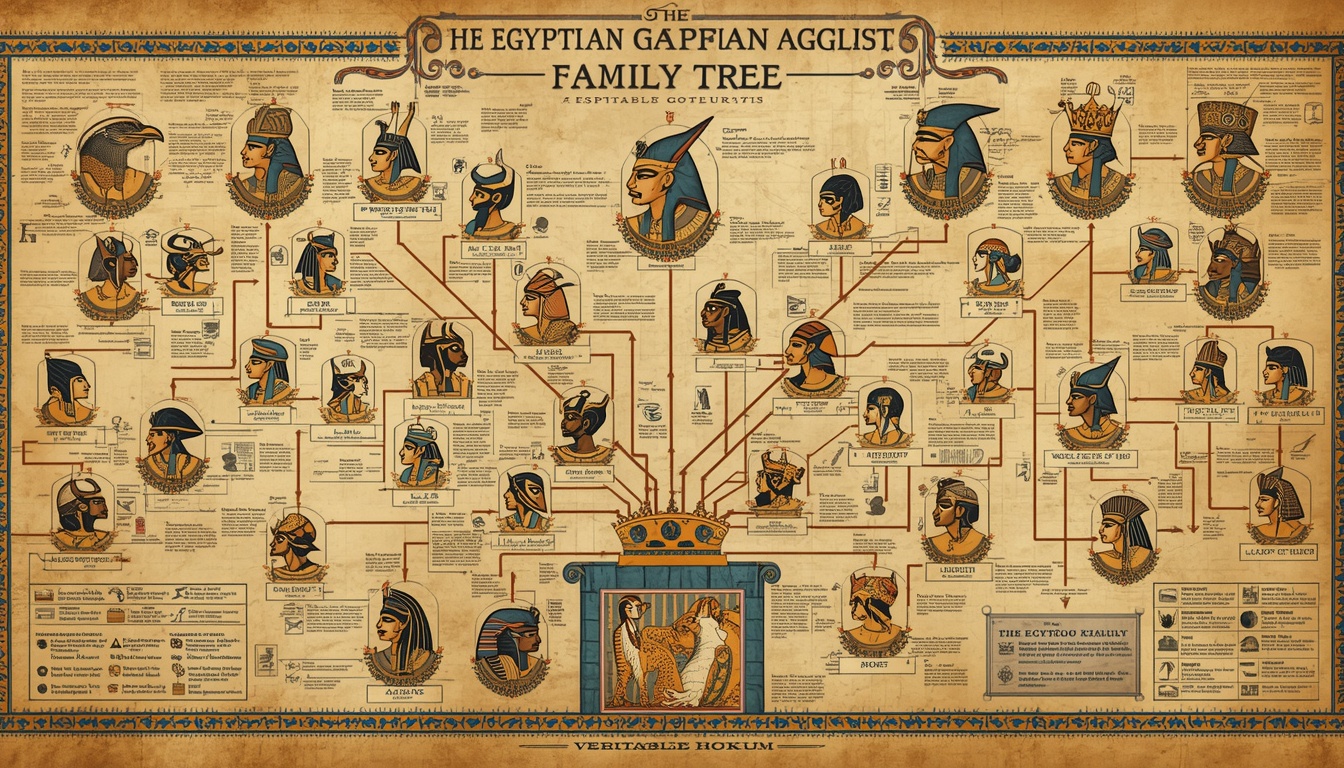
Trying to draw the Egyptian god family tree is a little like trying to draw a family tree for an enormous family where every uncle belongs to three different families, some cousins change jobs depending on the century, and everybody has a different story about who came first. It looks simple at first. Then Egyptian mythology starts doing its usual wonderfully complicated thing.
Ancient Egyptians worshipped hundreds of gods and goddesses, and their relationships were not always fixed. A deity could become more important when a particular city became powerful, while another god could merge with an older deity or take on a new form. So, the familiar charts of Egyptian gods family tree are useful guides, but they should not be treated as one official genealogy carved in stone.
Still, there is a fascinating structure hiding inside the confusion. From the primordial waters of Nun to Ra, Atum, Geb, Nut, Osiris, Isis, Set, and Horus, the divine family of ancient Egypt connects creation, kingship, death, rebirth, and the endless struggle between order and chaos.
The biggest mistake is assuming that ancient Egypt had one standardized pantheon with one universally accepted family tree. It did not. Different cities developed their own religious traditions, and priests sometimes explained creation and divine relationships in very different ways.
The major traditions included Heliopolitan, Hermopolitan, Memphite, and Theban theology. Each tradition placed particular gods at the center of the cosmos. That means an Egyptian mythology family tree is really a collection of overlapping genealogies rather than a single family photograph.
For example, Atum is the great creator god in the Heliopolitan tradition, while Ptah has an important creative role in Memphis. At Thebes, Amun eventually became enormously important and was associated with Ra as Amun-Ra. The family tree keeps shifting its furniture around, basically.
Before the recognizable world existed, Egyptian creation traditions often imagined a vast watery abyss called Nun. Nun was not simply a god who sat somewhere waiting for the universe to happen. He represented the primordial waters that existed before ordered creation.
Naunet, the feminine counterpart of Nun, is associated with the same primordial watery condition. Together they belong to the Ogdoad of Hermopolis, a group of eight primordial deities representing fundamental aspects of the pre-creation cosmos.
This is where the Egyptian creation myth becomes wonderfully strange. There was no ordinary family dinner, no grandparents explaining the old stories. Instead, the universe begins with abstract cosmic forces, darkness, water, infinity, and hidden potential.
From this primordial condition, different Egyptian traditions describe the emergence of the creator and the ordered cosmos in their own ways.
The Heliopolitan tradition provides one of the clearest structures for an Egyptian god genealogy. At the center stands Atum, a self-created creator deity associated with Heliopolis.
Atum emerges from the primordial waters and begins the process of generating the divine family. He is sometimes connected closely with Ra, and later traditions can treat Atum-Ra as a combined solar creator figure.
Atum’s descendants form one of the most important branches in the Egyptian pantheon family tree:
That last generation is especially important because it leads directly into the famous stories surrounding the Egyptian throne, death, resurrection, and divine kingship.
Shu represents air and the atmosphere, while Tefnut is associated with moisture. Their importance goes beyond simply giving the family tree two more names.
In Egyptian cosmology, Shu separates Geb, the earth, from Nut, the sky. Their separation creates the space in which the ordered world can exist. Without this cosmic separation, the universe would be a divine pile-up, and ancient Egyptian mythology apparently had no interest in that sort of mess.
Shu and Tefnut therefore belong to the foundational generation of the ancient Egyptian gods. Their children, Geb and Nut, continue the movement from abstract cosmic principles toward recognizable gods with family relationships.
Geb is the god of earth, fertility, and kingship, while Nut is the goddess of the sky and heavens. Their relationship is one of the most visually memorable parts of Egyptian religious art.
Nut is often represented arching over the earth, while Shu holds her apart from Geb. The image captures the basic Egyptian understanding of the cosmos: earth below, sky above, and air creating the necessary space between them.
Geb and Nut become especially important because their children form the central family of the later Egyptian gods relationships. Their offspring are Osiris, Isis, Set, and Nephthys, four deities whose stories dominate much of Egyptian mythology.
If there is one branch that deserves special attention in an Egyptian deity family tree, it is the family of Osiris. This is where divine genealogy turns into something resembling a royal drama, complete with murder, revenge, resurrection, inheritance, and a fight for the throne.
Osiris is associated with kingship, death, resurrection, and the afterlife. His sister and wife Isis is associated with magic, motherhood, protection, and resurrection.
Their brother Set, also called Seth, represents forces associated with chaos, storms, violence, the desert, and foreign lands. Nephthys, another sister, is traditionally associated with mourning and protection and is commonly described as Set’s wife.
So the core family can be simplified like this:
But even this tidy version needs a little warning label. Egyptian mythology contains variant traditions, and divine identities could overlap or change across different periods. The family tree is therefore a helpful map, not a birth certificate.
The relationship between Isis and Osiris is one of the best-known stories in ancient Egyptian mythology. Osiris becomes king, but Set murders him and, in several versions of the story, dismembers his body.
Isis searches for Osiris and uses her magical abilities to restore him. The resurrection of Osiris does not simply return him to ordinary earthly life. Instead, he becomes a powerful ruler of the Egyptian afterlife.
This is one reason Osiris became so strongly associated with death and rebirth. The story offered an extraordinary mythological idea: death was not necessarily the final chapter, but part of a larger cycle of transformation.
The son of Isis and Osiris is Horus, one of the most important gods in the Egyptian pantheon. Horus is strongly associated with the sky and kingship, and the reigning Pharaoh was traditionally connected with Horus.
After Osiris’s death, Horus becomes involved in a long conflict with Set over the right to rule. The Horus versus Set stories are therefore more than a simple superhero fight between two gods.
They represent a struggle over legitimate kingship and the restoration of order. Horus represents rightful royal authority, while Set embodies disruptive and chaotic forces. Their contests became a mythological explanation for succession and divine kingship.
Set and Nephthys form another important pairing within the Egyptian gods genealogy. Nephthys is connected with mourning, protection, and the dead, while Set has a far more complicated reputation.
Set was not simply an Egyptian version of an evil devil. He could be destructive and dangerous, but Egyptian religion did not divide the universe into perfectly clean categories of good and evil.
Interestingly, Set could also have a protective function. In some traditions, he assists Ra during the solar journey by fighting the serpent Apep, also called Apophis. So the same god who threatens Osiris can also defend the solar order. Ancient mythology really did enjoy making everybody complicated.
Ra, the great Egyptian sun god, occupies a central position in Egyptian religion. He is associated with sunlight, kingship, creation, and the daily cycle of the sun.
Ra travels through the sky and, according to Egyptian mythology, journeys through the underworld at night. His solar boat carries him through this dangerous realm, where he faces forces of chaos including Apep, the enormous serpent.
Ra is sometimes connected with Atum, particularly in Heliopolitan theology. Later, he was also combined with Amun to form Amun-Ra, one of the most important divine forms of ancient Egypt.
Because of these combinations, a chart showing the Ra family tree can become confusing very quickly. Ra was not always functioning as an isolated deity; his identity could overlap with other major creator and solar gods.
At Thebes, Amun rose to enormous prominence. Originally associated with hiddenness and local worship, Amun eventually became one of Egypt’s most powerful gods.
His association with Ra produced Amun-Ra, combining the Theban god with the great solar deity. This demonstrates how Egyptian theology could absorb and merge divine identities rather than keeping every god permanently inside one little box.
Amun is commonly associated with Mut, a mother goddess connected with queenship, motherhood, and Thebes. Their son is Khonsu, a moon god associated with time and measurement.
The Theban divine family is therefore another branch that sits beside, and sometimes overlaps with, the better-known Heliopolitan genealogy.
The Memphite tradition gives us another important creator god: Ptah. Ptah is associated with creation, craftsmanship, artisans, and Memphis.
Rather than simply creating the universe through physical reproduction, Ptah’s creation theology emphasizes thought and speech. The idea is strikingly sophisticated: creation can begin in the mind and become reality through expression.
Ptah is also connected with Apis, the sacred bull of Memphis. His religious sphere demonstrates why the Egyptian pantheon cannot be reduced to one family. Local cults and regional traditions had their own powerful theological systems.
The Egyptian afterlife adds another major branch to the family tree. Osiris becomes ruler of the dead, while Anubis is strongly associated with embalming, mummification, and funerary rites.
In the famous weighing of the heart, the heart of the deceased is measured against the feather of Maat. Maat represents truth, justice, balance, and cosmic order.
Thoth, associated with writing, wisdom, mathematics, and record keeping, plays an important role in divine judgment traditions. His presence makes sense in a mythology where cosmic justice needs someone to keep the paperwork, because apparently even eternity has administration.
The Egyptian concept of death was therefore deeply connected with order, morality, ritual, and rebirth rather than simply being an ending.
Maat deserves a special place in any explanation of the Egyptian gods. She represents truth, justice, balance, and the proper order of the cosmos.
Maat is both a goddess and a fundamental principle. Pharaohs were expected to uphold Maat through righteous rule, while the deceased hoped to demonstrate that they had lived according to the proper order.
This concept explains why Egyptian mythology repeatedly returns to the conflict between order and chaos. The battle is cosmic, political, personal, and spiritual all at once.
Not every important deity fits neatly into the main family branches. Hathor, for example, is associated with motherhood, femininity, music, fertility, beauty, and celebration. She could also have strong connections with the solar tradition.
Sekhmet, the lion-headed goddess, represents war, destruction, violence, and healing. Her mythology includes the dramatic story of the Fall of Mankind, in which Ra sends Sekhmet against humanity.
Bastet, often represented as a cat or cat-headed goddess, is associated with protection, women, children, and the household. Her connection with cats became one of the most recognizable features of Egyptian religious culture.
These goddesses show why the term major gods versus minor gods can sometimes be misleading. A deity’s importance depended heavily on place, historical period, cult, and religious context.
Thoth is one of the great intellectual figures of Egyptian mythology. He is connected with writing, wisdom, mathematics, the moon, and scribes.
Seshat, a goddess associated with writing, records, measurement, and knowledge, complements this intellectual side of the pantheon.
Together, they remind us that the Egyptian gods were not merely characters in stories about battles and monsters. Ancient Egyptian religion included elaborate ideas about record keeping, architecture, measurement, astronomy, ritual, and the organization of society.
The Nile River was central to ancient Egyptian civilization, so naturally the river and its fertility became deeply connected with divine powers.
Khnum is associated with creation and craftsmanship and was sometimes believed to shape humans on a potter’s wheel. Hapy represented the life-giving flooding of the Nile, which brought fertile soil to Egypt.
Satet and Anuket were also associated with the Nile, water, fertility, and southern Egypt. Their presence shows how geography shaped Egyptian religion.
A god’s importance was often very practical. When your civilization depends on a river behaving itself, you tend to have strong opinions about the divine forces controlling that river.
The political geography of ancient Egypt also appears inside the pantheon. Wadjet, the cobra goddess, was strongly associated with Lower Egypt and royal protection.
Nekhbet, represented as a vulture goddess, was associated with Upper Egypt and royal protection. Together they symbolized the two lands and the unity of Egypt.
This connection between deity and territory is essential when studying the Egyptian deity hierarchy. Gods were not floating independently above history; their worship was tied to temples, cities, kingdoms, political power, and local identity.
For beginners, the central genealogy can be simplified without pretending that every tradition agreed:
Around this central structure sit other major divine traditions involving Ra, Amun, Mut, Khonsu, Ptah, Thoth, Hathor, Sekhmet, Bastet, Anubis, Maat, Neith, Khnum, and many others.
That is why an Egyptian gods chart should always be read alongside the historical tradition it represents. Otherwise, the neat arrows can give a false impression that Egyptian religion had one fixed family tree.
The phrase Egyptian mythology family tree is useful for modern readers, but ancient Egyptians themselves did not leave behind one master diagram saying, “Here is everybody, please do not rearrange.”
Instead, theology evolved for thousands of years. Heliopolis emphasized Atum and the Ennead. Hermopolis emphasized the Ogdoad and primordial forces. Memphis elevated Ptah’s creative role. Thebes eventually made Amun enormously important.
Gods could be merged, renamed, combined, or given different attributes. Ra could become linked with Atum. Amun could merge conceptually with Ra. Local deities could rise to national prominence.
So when somebody presents a perfectly straight Egyptian god family tree, a healthy dose of skepticism is useful. It may be a modern educational simplification rather than an exact reflection of ancient belief.
The family tree also helps explain the relationship between mythology and the Pharaoh. Egyptian kingship was not merely political authority. It had a powerful religious dimension.
The king was associated with Horus during life and with Osiris after death. This connected the human ruler to the divine cycle of kingship, death, and rebirth.
The stories of Osiris, Horus, and Set therefore had political meaning. They explained legitimate succession, the rightful king, disorder, and restoration. Mythology was not sitting quietly in a temple corner; it was connected to the structure of Egyptian society itself.
The best way to use an Egyptian gods family tree is to ask three questions: which tradition does this genealogy represent, which period does it belong to, and which city or temple tradition produced it?
A chart centered on Atum probably reflects Heliopolitan theology. One emphasizing Amun may reflect Theban religious developments. A chart focused on Ptah belongs more naturally within the Memphis tradition.
This approach makes the mythology far more interesting. Instead of asking which chart is “the correct one,” you begin to see how different communities understood the divine world in different ways.
If you only want the essential relationships, remember the great central chain first.
Atum begins the Heliopolitan creative family, followed by Shu and Tefnut, then Geb and Nut, and finally Osiris, Isis, Set, and Nephthys.
From Osiris and Isis comes Horus, whose struggle with Set becomes a major story about kingship and order. Osiris becomes ruler of the dead, while Isis becomes one of the great figures of motherhood, magic, protection, and resurrection.
Around them stand Ra, Amun, Ptah, Thoth, Anubis, Hathor, Bastet, Sekhmet, Maat, and a huge supporting cast of gods connected with virtually every part of existence.
Bilkul. H3 headings exactly same rakhta hoon, sirf har heading ke neeche 1–2 line ka English answer:
The Egyptian gods were a large group of deities associated with creation, nature, kingship, death, fertility, war, wisdom, and the afterlife. Major gods included Ra, Osiris, Isis, Horus, Anubis, Set, Thoth, and Amun.
Egyptian minor gods were lesser-known deities who often had specific roles or were worshipped mainly in particular cities or regions. Examples include Bes, Taweret, Anuket, Satet, and Babi.
The Egyptian deities family tree shows the relationships between major gods and goddesses, including Ra, Atum, Shu, Tefnut, Geb, Nut, Osiris, Isis, Set, Nephthys, and Horus. However, these relationships varied between different Egyptian traditions and historical periods.
The hierarchy of Egyptian gods was not completely fixed because different cities had their own religious traditions and chief deities. Gods such as Ra, Amun, Osiris, and Horus held major positions in different periods and theological systems.
There is no single universally accepted order of Egyptian gods because Egyptian mythology developed over thousands of years. A common creation sequence includes Atum or Ra, Shu and Tefnut, Geb and Nut, followed by Osiris, Isis, Set, Nephthys, and Horus.
REad ARticuL; https://templetimingsdaily.com/the-egyptian-god-family-tree/
The Egyptian god family tree is not really one tree. It is more like an ancient forest, with branches growing in different directions and sometimes twisting back into one another. Some roots belong to Heliopolis, others to Memphis, Hermopolis, or Thebes, and later traditions grafted old gods onto new theological ideas.
That apparent confusion is actually part of what makes Egyptian mythology so compelling. The ancient Egyptians were not trying to create a modern encyclopedia with perfectly standardized definitions. Their religion developed across centuries, responding to politics, geography, kingship, temples, local traditions, and changing ideas about creation and death.
From Nun and the primordial waters to Atum, Ra, and the solar journey; from Geb and Nut to Osiris, Isis, Set, and Horus; from Anubis and the weighing of the heart to Maat and the hope of rebirth, the family relationships tell a much larger story.
And perhaps that is the best way to understand the whole thing. Don’t stare at the lines between the gods and worry that one arrow looks slightly wrong. Look at the bigger picture: creation, family, kingship, chaos, order, death, resurrection, and the eternal attempt to keep the universe from falling apart. Ancient Egypt made a mythology out of all of it, and somehow the result is still fascinating thousands of years later.
Add a clear visual family treeCreate a concise relationship table