Physical Address
304 North Cardinal St.
Dorchester Center, MA 02124
Physical Address
304 North Cardinal St.
Dorchester Center, MA 02124

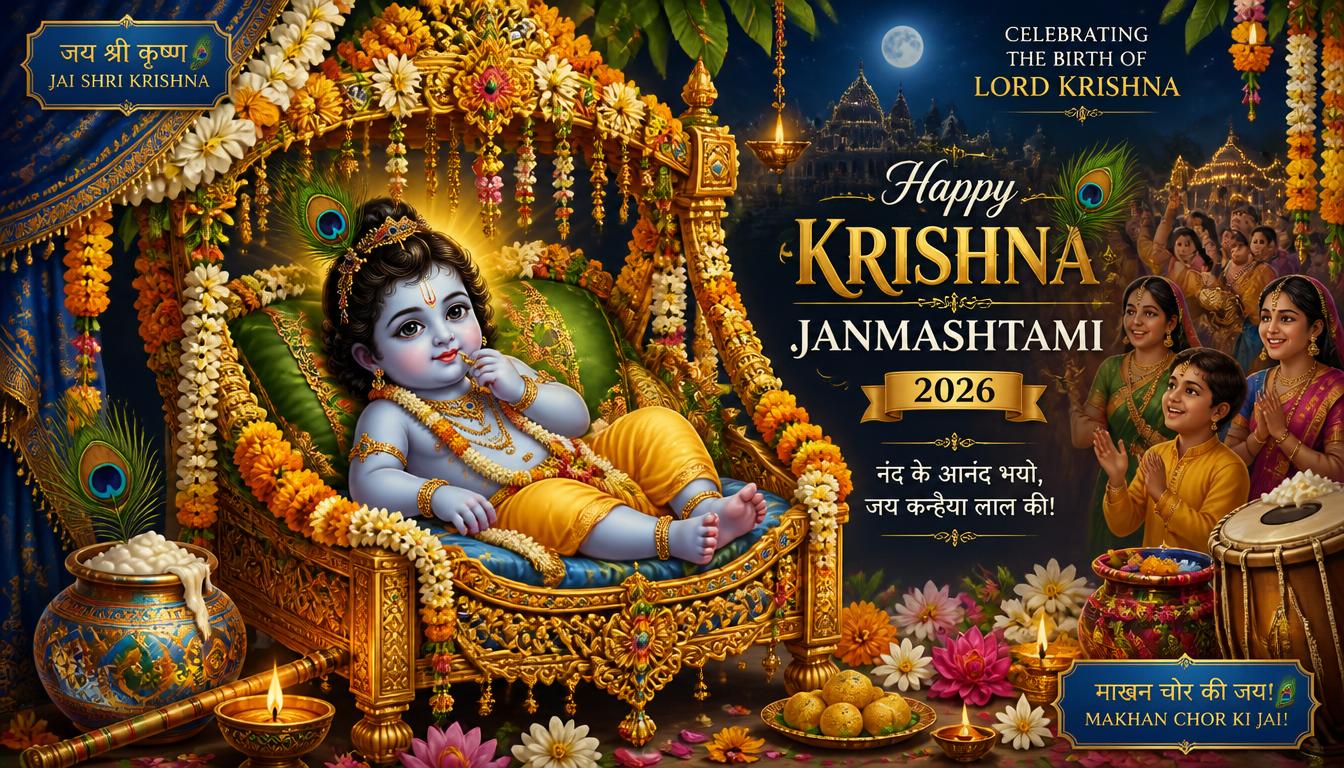
There are festivals that arrive with drums, lights and crowded streets, and then there are festivals that somehow arrive quietly inside the heart. Krishna Janmashtami 2026 belongs to the second kind, although yes, in many places the celebrations can get wonderfully loud too.
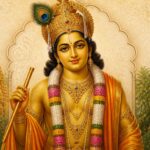
It is a sacred occasion remembering the birth of Lord Krishna, a divine figure loved not only as the Supreme Being but also as the mischievous child who stole butter, the friend who stood beside Sudama, the beloved of Radha, and the guide who spoke profound wisdom through the Bhagavad Gita.
In 2026, devotees observing the commonly followed calendar will celebrate Krishna Janmashtami on Friday, September 4.
The festival marks the birth of Krishna on the eighth lunar day, or Ashtami, of the dark fortnight of the month associated with Bhadrapada.
The exact midnight worship period depends on location, so people should check their local panchang rather than blindly copying a time from another city, because even a few minutes can change.
But Janmashtami is not simply about knowing a date and staying awake until midnight. It is about remembering dharma, devotion, courage, compassion and the strange but beautiful idea that divine wisdom can appear in the most difficult circumstances.
The story begins in a prison cell in Mathura and somehow travels all the way into homes, temples, songs, dances and family memories. That journey is what makes this festival feel alive, year after year.
So, when is Krishna Janmashtami 2026? The principal observance is Friday, September 4, 2026. According to location-specific panchang calculations, the Ashtami period and Nishita Kaal can extend around midnight into September 5, which is why some calendars display late-night timings differently.
This isn’t really a contradiction; Hindu festival dates depend on lunar tithis, sunrise and local astronomical calculations.
For example, the panchang calculation for Lahore lists Krishna Janmashtami on September 4 and gives a Nishita Puja period extending around midnight into September 5.
Multan also observes the festival on September 4, while its local midnight worship period is slightly different. So, for anyone planning a Janmashtami puja, local timing is the sensible choice, not a random social-media graphic.
The word Janmashtami itself carries the basic idea: Janma means birth and Ashtami refers to the eighth lunar day.
Devotees remember Krishna’s divine birth as an incarnation of Lord Vishnu, traditionally understood as a response to the rise of tyranny and adharma.
In the larger spiritual meaning, the festival reminds people that righteousness can appear even when circumstances look terribly dark.
The significance of Krishna Janmashtami reaches beyond the historical or mythological account of one birth. Krishna’s life represents several dimensions of spiritual thought: devotion, duty, wisdom, friendship, love and the responsibility to act when injustice becomes too powerful.
His teachings in the Bhagavad Gita especially place great importance on performing one’s duty without being trapped by the fruits of action, which is a lesson that still feels oddly modern.
The festival is also associated with the victory of good over evil and the restoration of dharma. In the traditional story, Krishna was born to Devaki and Vasudeva, while the cruel ruler Kamsa feared a prophecy concerning Devaki’s child.
That fear shaped the entire beginning of Krishna’s earthly story, but fear, as the story eventually shows, doesn’t get the final word.
For devotees, Janmashtami can also become a personal day of reflection. A person may ask, “Where am I acting from anger? Where do I need courage?
What duty have I been avoiding?” Those questions are perhaps less decorative than flowers and lamps, but they may be the real beginning of Bhakti.
The Krishna birth story begins in Mathura, where Devaki and Vasudeva were imprisoned by Kamsa. According to tradition, Kamsa had learned that Devaki’s eighth child would become the cause of his downfall.
His response was cruel, and the family suffered deeply because of his fear. Then, on the sacred night of Krishna’s birth, the story takes its extraordinary turn.
Krishna appeared to Devaki and Vasudeva in divine form, and Vasudeva was instructed to carry the newborn across the Yamuna toward Gokul.
Imagine the scene as it has been remembered for generations: darkness, rain, a father carrying a divine child, and a river standing between danger and safety. It has the texture of a story, yes, but for devotees it is also sacred history within their religious tradition.
In Gokul, Krishna was raised by Yashoda and Nanda, and this is where the terrifying prison story slowly transforms into the much warmer world of Bal Krishna.
Butter theft, playful mischief, village friendships and childhood adventures become central to the beloved image of Krishna. The Supreme Soul, in these stories, is also the little child who somehow manages to get everyone into trouble. Quite a personality, honestly.
One reason Krishna remains such a powerful figure is that people encounter him differently. To some, he is Gopala, the protector of cows and the playful child of Gokul.
To others, he is Govinda, the divine guide, or the teacher of the Bhagavad Gita. In devotional traditions, Krishna may be approached through Prema Bhakti, meditation, singing, prayer or loving service.
The image of Laddu Gopal is especially dear in many homes. Families may dress the small Krishna idol in colourful clothes, prepare tiny ornaments, place him in a decorated jhula, and offer food with great affection.
The ritual can look simple from outside, but inside the home it often becomes a family event where grandparents, parents and children all have their own little job.
Then there is Radha Krishna, whose devotional symbolism has inspired poetry, music, painting and countless stories.
The relationship is commonly understood through the language of divine love and devotion rather than ordinary romance alone. In Raas Leela, Krishna’s divine play becomes a way of expressing the soul’s longing for the divine, which is why the imagery carries such spiritual weight.
A traditional Krishna Janmashtami celebration may begin with preparation long before midnight. Homes and temples are cleaned, devotional spaces are decorated, flowers are arranged and a small cradle may be prepared for the newborn Krishna. Some families create tiny Krishna footprints, known as Krishna padam, leading toward the altar or shrine.
Janmashtami fasting is another important practice, although fasting traditions vary between families and communities. Some devotees observe a strict nirjala fast, while others follow a phalahar fast and consume fruits, milk or permitted foods.
Since religious practice varies, people should follow their family or community tradition and consider their own health rather than treating fasting like a competition.
As midnight approaches, devotional energy becomes stronger. The Nishita Puja is traditionally connected with the believed time of Krishna’s birth, and devotees may perform Abhisheka, offer Panchamrit, sing Krishna bhajans, ring bells and perform Aarti.
The atmosphere can shift from quiet prayer to celebration within minutes, which is one of the charming things about Janmashtami.
A home celebration does not need to look like a temple procession. A clean prayer space, a Krishna image or idol, flowers, Tulsi leaves, fruits, milk and simple offerings may be enough according to one’s tradition.
Panchamrit is traditionally prepared using ingredients such as milk, curd, ghee, honey and sugar, though exact recipes differ from household to household.
After the worship, Janmashtami prasad is shared with family and others. Butter, mishri, milk sweets, fruits and other sattvic preparations are commonly associated with Krishna offerings.
The important part isn’t creating an enormous feast for social media; it is offering food with sincerity, then sharing it with gratitude. Thats where the sweetness actually lives.
If you are wondering how to celebrate Krishna Janmashtami at home, start with simplicity. Clean the prayer area, decorate it with flowers or fabric, place the Krishna idol or image, and prepare the offerings beforehand so the midnight worship does not become a kitchen emergency. A little planning makes the night much more peaceful.
During the evening, family members can read from the Bhagavata Purana, listen to Krishna’s birth story, chant a Krishna mantra, sing bhajans or simply sit together in prayer.
Children can be encouraged to make small decorations or prepare a paper cradle. They remember these little activities much longer than they remember a perfectly arranged table, usually.
At the time of worship, devotees may bathe the idol according to their tradition, including Panchamrit Abhisheka, dress Krishna in clean clothes, offer flowers and Tulsi, perform Aarti, and place the bhog before the deity.
Specific puja vidhi varies, so those following a particular Vaishnava tradition should use the instructions of their spiritual teacher or community.
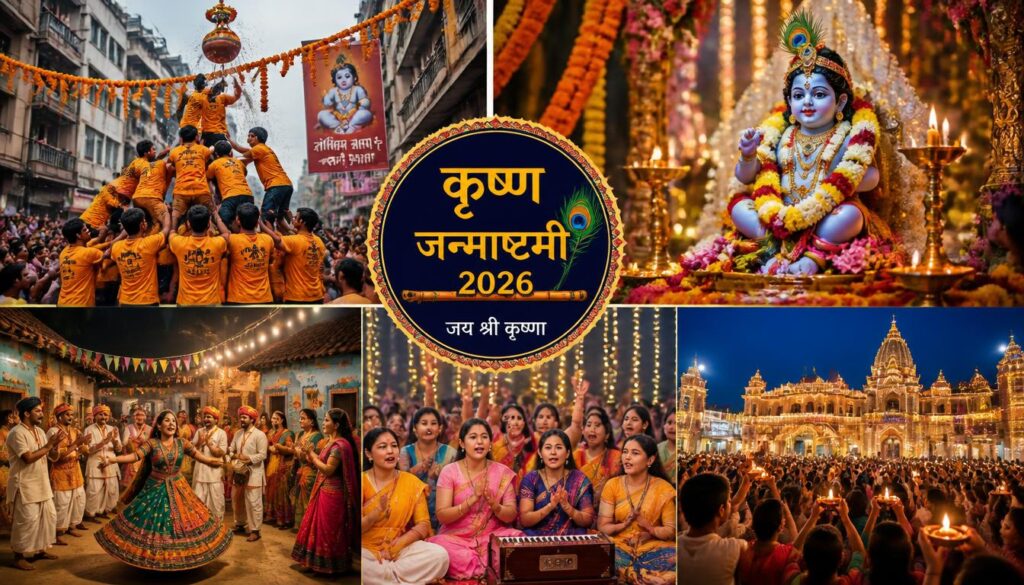
The beauty of Janmashtami celebrations in India is that there isn’t one single way to celebrate. In Mathura, associated with Krishna’s birthplace, and Vrindavan, associated with his childhood and devotional traditions, celebrations can become enormous public religious occasions.
Bhajans, dramatic performances, temple rituals and Krishna’s birth enactments create an atmosphere that is hard to describe without sounding slightly poetic.
Gokul and the wider Braj region have their own distinctive traditions, with devotional performances and celebrations connected to Krishna’s childhood.
Barsana, too, carries a strong Radha-Krishna devotional identity. For pilgrims, visiting these places around Janmashtami can be deeply moving, although large crowds mean travel should be planned carefully.
In Maharashtra, Janmashtami is famously connected with Dahi Handi. Groups known as Govinda teams form human pyramids to reach and break a suspended pot, often filled with curd or another symbolic offering.
The event is energetic, competitive and highly communal, turning a devotional tradition into something that looks almost like an entire neighbourhood has decided to become one very determined climbing machine.
South India brings further variations. Udupi, home of the Sri Krishna Matha tradition, and Guruvayur, famous for the Guruvayur Sree Krishna Temple, are important centres of Krishna devotion.
In parts of Tamil Nadu and Kerala, families may draw Krishna padam near entrances, creating little footprints that symbolically show Krishna entering the home.
In Odisha, Krishna devotion naturally intersects with the region’s rich Vaishnava traditions and the wider religious world surrounding Lord Jagannath.
Meanwhile, ISKCON temples worldwide often organise large kirtans, dramas, devotional singing and prasad distribution, making Janmashtami a festival that now reaches far beyond the Indian subcontinent.
Dahi Handi is one of the most recognisable public traditions connected with Krishna. The story draws from Krishna’s childhood reputation for stealing butter and curd with his friends.
The hanging pot becomes a playful symbol of that mischievous childhood, while the human pyramid represents teamwork and collective effort.
The tradition is particularly associated with Maharashtra, where Govinda groups train and organise themselves for public events.
Today, Dahi Handi can include music, competitions and large gatherings, but at its heart remains the memory of Bal Krishna, the butter-loving child who apparently believed that anything placed too high was simply an invitation to climb.
Chanting is an important part of many Janmashtami rituals. Some devotees recite the Hare Krishna Mahamantra, while others chant names or mantras associated with Krishna. Repetition can help create a focused devotional atmosphere, especially during a night when the mind is otherwise tempted to wander everywhere.
The well-known Hare Krishna Mahamantra is traditionally chanted as:
Hare Krishna, Hare Krishna, Krishna Krishna, Hare Hare
Hare Rama, Hare Rama, Rama Rama, Hare Hare
Another widely known devotional mantra is Om Namo Bhagavate Vasudevaya, associated with devotion to Krishna as Vasudeva. Different traditions may use additional prayers such as Krishna Ashtakam, Krishna Chalisa or other devotional texts.
The purpose of mantra chanting is not merely to collect repetitions like points on a scoreboard. For many devotees, the practice is about remembrance, concentration and surrender.
A few sincere minutes can sometimes feel more meaningful than an hour performed only because somebody said you should.
The spiritual significance of Janmashtami is deeply connected with the idea of divine presence appearing during a period of darkness.
Krishna’s birth takes place under threatening circumstances, yet the story moves toward protection, growth and the eventual defeat of Kamsa. That contrast gives the festival much of its emotional power.
Krishna’s later teachings emphasise Karma Yoga, Jnana Yoga and Bhakti Yoga, offering different approaches to spiritual life.
The Bhagavad Gita discusses action, knowledge, devotion, discipline and the nature of the self. Janmashtami therefore provides an opportunity not only to celebrate Krishna’s birth but also to revisit the wisdom associated with his teachings.
Many devotees describe the festival in terms of inner peace, divine grace, purification of mind and renewed devotion.
These should be understood as spiritual beliefs rather than guaranteed worldly outcomes. A festival cannot magically remove every difficulty from life, but it can give someone a moment to pause, pray and face those difficulties with a different heart.
Sometimes the simplest wish is the one that gets remembered. You don’t need a giant paragraph to wish someone well on Janmashtami; a sincere sentence carrying Krishna’s name and a little warmth can do the work beautifully, even if the grammar isn’t wearing a suit.
Friendship has its own Krishna connection, especially through the beautiful story of Krishna and Sudama. Their relationship is often remembered as an example of affection that does not measure friendship through wealth, status or convenience.
So, yes, Janmashtami is actually a pretty lovely excuse to message an old friend you haven’t spoken to in months.
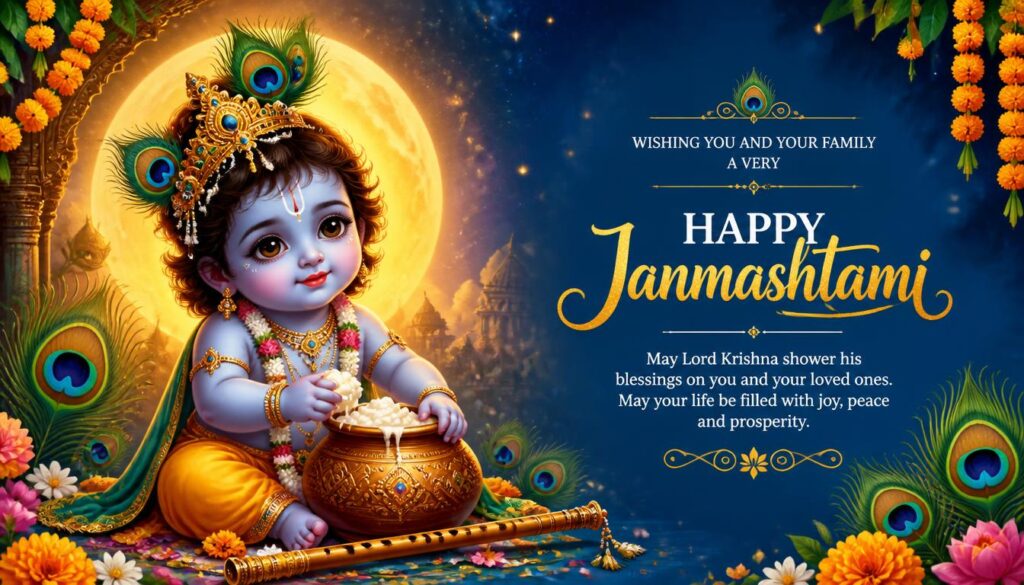
A social-media wish works best when it sounds human rather than like it was assembled by twelve different greeting-card websites.
Keep it short, warm and easy to share, because nobody wants to read a philosophical thesis while scrolling through WhatsApp at midnight.
Krishna’s childhood stories are full of mischief, so every Janmashtami message does not have to sound like a temple inscription.
A little humour can be lovely when it remains respectful, and honestly, Krishna himself was hardly famous for being boring.
There is something naturally poetic about Krishna: the flute, the moonlit night, Vrindavan, the Yamuna, Radha, the cows of Gokul and the quiet devotion of countless generations. These wishes are suitable when you want something a little more emotional and less ordinary.
A good message becomes much stronger when you add one tiny personal detail. Instead of sending the same greeting to everybody, mention something that belongs specifically to that person:
their family, a shared memory, a difficult year they overcame, or a hope they have been carrying for a long time. It takes maybe thirty seconds, but suddenly the message feels like it came from you.
For parents or grandparents, you might mention family blessings and togetherness. For a close friend, a playful Krishna reference can work beautifully.
For a spiritual teacher or elder, a respectful wish focused on devotion and divine grace may feel more appropriate. And for a public social post, keep it inclusive and simple rather than making claims about what every Hindu must believe.
You can also personalise a wish by mentioning a meaningful place such as Mathura, Vrindavan, Gokul or Braj, especially if the recipient has visited those places.
A line about a childhood Janmashtami memory can be even better: perhaps the tiny Krishna idol somebody dressed every year, the midnight Aarti everyone waited for, or the first Dahi Handi event a child ever watched.
If you’re celebrating at home, consider creating a small Krishna corner rather than trying to recreate a giant temple. A decorated jhula, flowers, lights, a Krishna image and a few traditional offerings can transform an ordinary room surprisingly quickly.
Children can make paper peacock feathers, tiny footprints or simple decorations, and yes, they will probably make a mess. Let them.
A family can also spend part of the evening reading the Krishna birth story, watching a devotional performance, singing bhajans or discussing one teaching from the Bhagavad Gita. This turns the festival into something more meaningful than food and decoration alone. The celebration becomes an experience that children can actually understand.
Another lovely idea is community sharing. Prepare simple prasad, visit a temple if appropriate, donate food, help someone who is struggling, or spend time with elderly relatives who may otherwise be alone. Devotion becomes especially beautiful when it moves from the prayer room into ordinary acts of kindness.
There is no single fasting rule that every devotee follows in exactly the same manner. Some observe a strict fast, some consume fruits and dairy products, and others follow specific traditions prescribed by their family or religious community. The timing for ending the fast can also vary according to local panchang calculations and tradition.
For example, the Lahore calculation lists a September 4 observance and a local Nishita Puja around midnight, while the Multan calculation similarly places Janmashtami on September 4 but gives a different local timing.
This is why Janmashtami fasting rules and Parana times should be checked for the location where the person is actually observing the festival.
People with health conditions, young children, older adults and anyone taking regular medication should not treat extreme fasting as a test of devotion.
Religious practice can be adapted responsibly, and following one’s tradition with wisdom is far better than harming the body simply to prove sincerity.
Krishna Janmashtami 2026 will be observed on Friday, September 4, 2026, according to the commonly followed panchang calculations for Pakistan and much of India. The exact midnight puja timing varies by location.
Tradition holds that Lord Krishna was born around midnight, so devotees perform the main birth celebration during the Nishita period. The midnight worship symbolically welcomes Krishna into the world and into the hearts of devotees.
According to Hindu tradition, Krishna was born in Mathura, to Devaki and Vasudeva. His birthplace is traditionally associated with the Shri Krishna Janmabhoomi area.
Krishna was raised in Gokul by Yashoda and Nanda after Vasudeva carried the newborn child away from Mathura. His childhood stories are among the most beloved parts of Krishna tradition.
Nishita Puja refers to the special worship performed around the middle of the night during Janmashtami. Because the exact Nishita period depends on location, devotees should consult a local panchang for accurate timing.
Dahi Handi is a festive tradition associated especially with Maharashtra in which groups form human pyramids to reach and break a suspended pot. It draws inspiration from stories of Krishna’s childhood butter and curd stealing.
Common offerings may include Panchamrit, milk, curd, butter, mishri, fruits, sweets and other sattvic foods. Traditions vary, so families generally follow the practices of their community.
Devotees may chant the Hare Krishna Mahamantra, Om Namo Bhagavate Vasudevaya, or other Krishna prayers according to their tradition. Sincerity and devotion are more important than trying to perform a huge number of repetitions.
Radha Krishna devotion is deeply associated with divine love and Prema Bhakti. Radha is regarded in many traditions as an embodiment of the highest devotion toward Krishna, and their stories form a major part of devotional literature and culture.
No. ISKCON Janmashtami celebrations and other Hindu communities observe the festival in many countries around the world. Temples and community groups outside India may organise kirtans, dramas, prayers, midnight celebrations and prasad distribution.
Janmashtami 2026 will be celebrated on Friday, September 4, 2026. The festival marks the divine birth of Lord Krishna and is traditionally observed with prayers and midnight worship.
The Janmashtami date in 2026 is Friday, September 4. Devotees observe fasting, perform puja, sing devotional songs, and celebrate Krishna’s birth around midnight.
Janmashtami 2026 in India will be observed on Friday, September 4, 2026. Exact fasting and Nishita Puja timings may differ by city according to the local Hindu calendar.
Krishnashtami 2026 falls on Friday, September 4, 2026. It is another name commonly used for Janmashtami, the festival celebrating the birth of Lord Krishna.
The Janmashtami date 2026 is September 4, Friday. Devotees traditionally celebrate the occasion with fasting, Krishna puja, bhajans, and a midnight birth ceremony.
The most beautiful thing about Krishna Janmashtami may be that it can mean something slightly different to every person. For one devotee, it is a night of fasting and prayer. For another, it is the joyful image of Bal Krishna in a decorated cradle. For a child, it might be dressing up like Krishna. For a grandmother, it might be remembering Janmashtami celebrations from fifty years ago. For someone going through a difficult season, it may simply be a reminder that darkness is not the end of the story.
The story of Krishna begins in darkness but does not remain there. It moves from Mathura to Gokul, from fear to courage, from childhood mischief to spiritual wisdom, and from a single sacred night into a tradition carried by millions of people. Thats perhaps why the festival continues to feel surprisingly fresh after so many generations.
As Krishna Janmashtami 2026 arrives on September 4, may the celebration be more than decoration, fasting or a midnight photograph. May it encourage kindness, patience, courage, devotion and a little more understanding of the people around us. May every prayer become an opportunity to become gentler, every bhajan a moment of remembrance, and every shared Janmashtami prasad a small act of love.
Happy Krishna Janmashtami 2026! May Lord Krishna bless every home with peace, wisdom, compassion, courage and divine grace. Radhe Radhe!