Physical Address
304 North Cardinal St.
Dorchester Center, MA 02124
Physical Address
304 North Cardinal St.
Dorchester Center, MA 02124

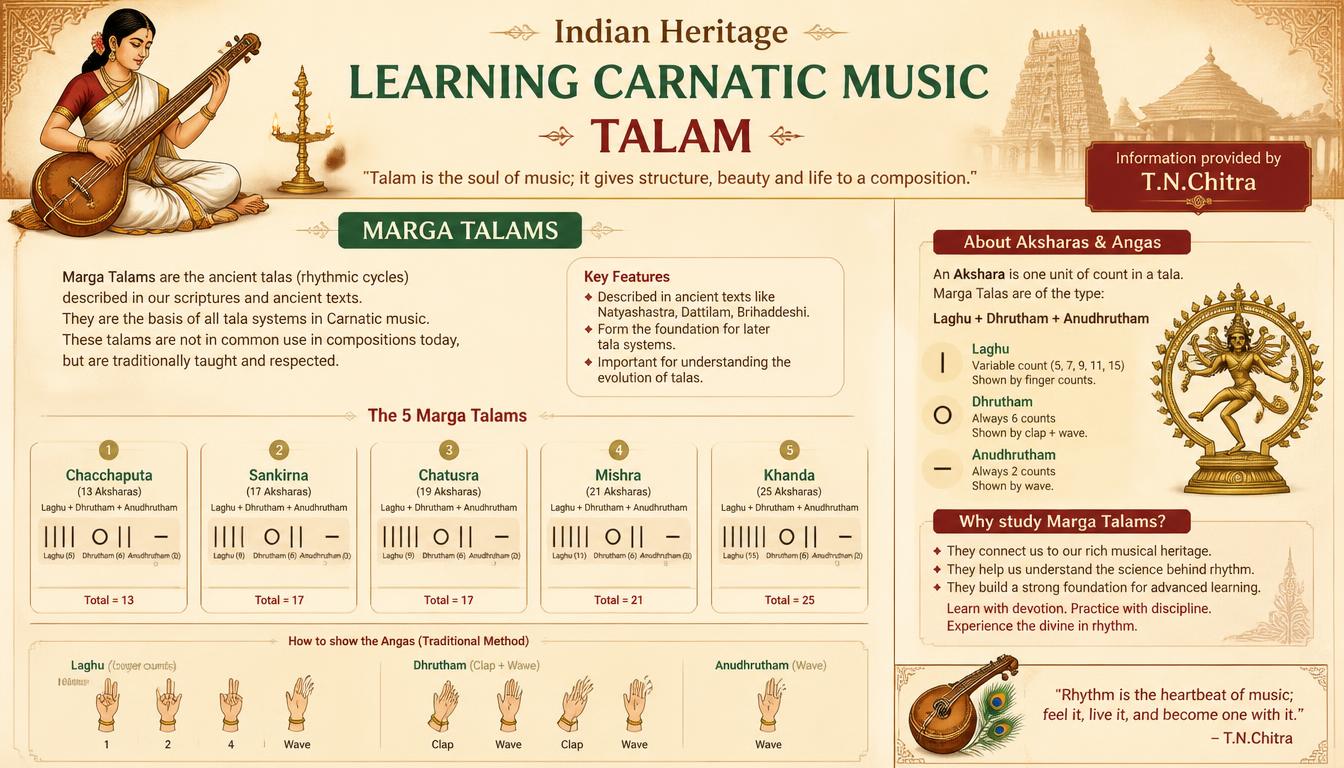
Indian music has a curious way of making time audible. A second is no longer just a second when a hand falls for a beat, fingers begin counting, and a composition quietly settles into its rhythmic home. This becomes especially fascinating when learning about Marga Talams, an ancient and sophisticated part of the broader Tala system.
Within Carnatic music, melody may catch the ear first, but rhythm gives that melody somewhere to live. Talam, also written as Tala, organises musical time into recognizable cycles. The hands mark what the ears eventually learn to feel, and slowly an invisible mathematical design becomes almost physical.
The study of Marga Talas takes us deeper than the commonly practised tala patterns heard by many students today. Here we encounter unusual Angams, extended hand actions, different numbers of Aksharams, and an older rhythmic vocabulary. It can look slightly intimidating first time round, but there is a lovely logic hiding inside it.
This exploration of Learning Carnatic Music, particularly Talam – Marga Talams, follows the traditional concepts associated with this subject and information attributed to T.N. Chitra. More importantly, it explains what these terms actually mean and how they fit into the wider heritage of Indian rhythm.
A Talam is essentially a rhythmic framework used to organise a musical composition. Rather than treating rhythm as an endless line of beats, Indian music arranges time into repeating cycles with identifiable parts.
That distinction matters quite a lot. A learner isn’t merely keeping a steady beat like a clock sitting on a wall. They are recognising where a cycle starts, how its internal sections are divided, and exactly when it returns home again.
The physical actions used to maintain rhythm in Carnatic music can include a beat, finger counting, and particular hand movements. These visible actions help musicians keep track of the otherwise invisible rhythmic structure.
This makes the Carnatic tala system both mathematical and physical. You can calculate it, hear it, clap it, show it with your hands, and after enough practice, simply feel where you are inside the cycle. Strange how much information one small hand movement can carry.
Marga Talams belong to an ancient system of rhythmic organisation and are known for using more elaborate rhythmic units than those generally encountered in basic modern Carnatic lessons. The word is also encountered as Marga Talas, with both expressions referring to this older tala tradition.
The Marga tala system includes familiar tala components as well as additional tala angams. These extra elements allow considerably more elaborate rhythmic structures to be formed.
That is why someone exploring Marga talam in Carnatic music soon encounters terminology beyond the usual beginner’s vocabulary. Names such as Guru, Plutham, Kakapadam, Krshyai, Sarpini, and Pathakam suddenly enter the room, and yes, the room becomes rather crowded.
But these aren’t decorative Sanskrit terms placed around music for historical charm. Each one communicates information concerning duration, action, or the construction of a rhythmic unit.
Studying them offers a window into an ancient tala system in which musical time was described with extraordinary precision.
Traditional discussions of Indian rhythm may distinguish Marga Talas from Desi Talas or Desi Talams. Understanding this distinction is useful because tala traditions developed across different periods, practices, and regional musical environments.
Marga traditions are associated with older theoretical systems and elaborate rhythmic organisation. Desi traditions developed through regional and practical musical usage, contributing their own rhythmic forms to India’s enormous musical vocabulary.
One shouldn’t imagine the history of tala as a neat shelf where one system disappeared and another instantly replaced it. Musical traditions don’t usually behave so politely. Concepts evolve, practices overlap, terminology survives, and musicians reinterpret inherited ideas over generations.
The result is an astonishing Indian music heritage in which rhythm reflects both continuity and change.
To understand a tala structure, we need to understand its Angams. An angam may be thought of as a constituent rhythmic unit or limb within the larger tala.
Students of Carnatic music are often familiar with Laghu, Drtham, and Anudrtham. These play important roles in tala construction and in the practical system of hand gestures used while maintaining rhythm.
Laghu involves a beat followed by finger counting. Its duration can vary according to the jaathi being used, which is one reason the relationship between Angams and Jaathis is important in the study of tala.
Drtham is commonly represented by a beat followed by turning or waving the hand. Anudrtham is represented by a single beat.
Marga traditions introduce further angams and actions. This makes their rhythmic language broader and, for a beginner, quite a bit more adventurous.
Three especially important names in the study of Marga tala angams are Guru, Plutham, and Kakapadam.
The Guru angam is represented through one beat followed by the counting of seven fingers. It creates an extended rhythmic unit and demonstrates how physical actions are being used to represent musical duration.
The Plutham angam combines one beat with one Krshyai and one Sarpini. Instead of being understood as a simple clap alone, therefore, its identity comes from a sequence of actions.
Kakapadam expands this idea further. The Kakapadam angam consists of one beat + one Krshyai + one Sarpini + one Pathakam.
Written down, these sequences can resemble instructions for an unusual hand dance. In practice, however, each gesture helps account for time. The body becomes a sort of rhythmic notation system, which is pretty beautiful when you think of it.
Krshyai is one of the distinctive movements encountered while studying the extended angams of Marga Talas.
In Krshyai movement, the hand is waved towards the left. The movement represents four aksharams.
So Krshyai isn’t merely an expressive wave. Direction and duration both matter. The gesture has rhythmic information built directly into it.
This is one of the most interesting qualities of hand gestures in tala. A movement that appears visually simple can stand for a precisely defined quantity of musical time.
If Krshyai travels one way, Sarpini provides another directional action. In Sarpini movement, the hand is waved towards the right.
Like Krshyai, Sarpini represents four aksharams.
Remembering the two as opposite directional movements can make the terminology easier for a learner: Krshyai moves towards the left, while Sarpini moves towards the right.
When these movements occur inside something like Plutham, they aren’t independent decorations. They form part of the angam itself and therefore contribute directly to its duration and rhythmic identity.
Pathakam adds another gesture to the vocabulary of the Marga tala system.
For Pathakam movement, the hand is raised vertically. This action also accounts for four aksharams.
The relationship is therefore straightforward:
These movements help explain why Marga tala descriptions can initially seem considerably more complicated than ordinary beat counting. Rhythm is being encoded through a vocabulary of actions rather than through identical repeated claps.
The word Aksharams is central to understanding rhythmic duration. In this context, an aksharam functions as a unit used to account for time within the rhythmic framework.
For someone beginning Carnatic music learning, it is tempting to think only in terms of beats. Yet aksharams in Carnatic music allow us to discuss how long particular angams and actions occupy within a tala.
This becomes especially useful with Marga elements. If Krshyai, Sarpini, and Pathakam each represent four aksharams, their inclusion changes the total rhythmic span of the angam containing them.
Consider Plutham. It contains a beat along with Krshyai and Sarpini. Kakapadam goes further by including Pathakam too. Thus, adding a gesture is also adding measured rhythmic duration.
The mathematics and movement aren’t separate here. They shake hands, more or less literally.
Modern learners often begin with manageable exercises and commonly used talas, so complicated talas can feel like a sudden jump into deeper water.
The difficulty comes partly from memory. A musician must understand the sequence, know what each angam represents, remember the associated movement, and continue following the musical composition at the same time.
Then comes another challenge: feeling the rhythmic cycle rather than mechanically performing movements.
That difference is crucial. A learner may correctly make every gesture yet still not possess a strong internal sense of Carnatic rhythm. Real fluency develops when the cycle begins to feel natural, almost as though the composition itself is pulling the hands towards the next action.
This takes practice. Quite a bit of it, sometimes.
References to 108 Talas reveal just how expansive Indian rhythmic thought can become. Tala isn’t a tiny collection of standard beat patterns but a broad theoretical and practical field containing many rhythmic possibilities.
For beginners, this shouldn’t become a reason to panic over memorising 108 names tomorrow morning.
It is more useful to see the 108 talas in Carnatic music as evidence of the depth with which Indian musicians and theorists explored time. Different combinations of rhythmic components can generate structures of remarkable variety.
That variety also tells us something about traditional Carnatic music. Rhythm was not treated merely as accompaniment beneath melody. It was developed as an intellectual and artistic system in its own right.
The real fascination of Marga Talams emerges when individual components begin forming larger complex tala patterns.
Imagine rhythm not as a row of identical boxes but as architecture. One portion may be short, another extended. One action involves fingers, another sends the hand left, another right, and another vertically upward.
Yet all these actions belong to one organised rhythmic design.
This creates traditional tala patterns capable of supporting highly structured musical thought. Such systems show why tala is often described as cyclical rather than merely sequential. After moving through its components, the rhythm eventually returns to its beginning.
That return is musically powerful. Listeners may not consciously calculate every unit, but performers know where that rhythmic home sits.
A discussion of complicated rhythmic traditions naturally brings Chandha Talam into view. It is associated with intricate rhythmic organisation and has an important connection with ancient Tamil music and poetic-musical traditions.
Chandha talam highlights a particularly interesting relationship between words and rhythm. The metre and syllabic organisation of poetic text can influence how rhythmic patterns are perceived and performed.
This reminds us that Tamil rhythmic patterns did not develop in isolation from language. Poetry, devotional expression, metre, melody, and rhythm could interact closely.
The study of ancient Tamil musical tradition therefore becomes more than an investigation of old compositions. It shows how communities organised sound, language, devotion, and time together.
Thiruppugazh provides a celebrated example of compositions associated with rich and varied rhythmic treatment. These devotional works attributed to Arunagirinathar are particularly admired for the rhythmic character created by their poetic metres.
A Thiruppugazh tala can demand careful attention because textual metre and rhythmic organisation interact in unusually interesting ways. The resulting patterns may feel very different from a simple repetitive beat cycle.
This makes Thiruppugazh valuable when thinking about complex rhythm and Chandha Talam. Words themselves seem to arrive carrying rhythmic fingerprints.
For a learner, encountering such compositions can initially feel like watching several clocks tick in different accents. Eventually the design becomes clearer, and that moment is deeply satisfying.
One beautiful feature of the Carnatic tala system is that rhythm becomes visible through the hands.
A beat, finger counting, waving hand, left hand movement, right hand movement, or raising hand vertically may all communicate rhythmic information depending on the system and angam concerned.
This physicality is useful pedagogically. Instead of staring constantly at written symbols, students embody the cycle. Their hands become reminders of where they are inside the composition.
With Marga Talas, this principle becomes even more elaborate through Krshyai, Sarpini, Pathakam, Guru, Plutham, and Kakapadam.
A good learner should therefore resist the urge to memorise definitions only. Perform the gestures slowly. Say their names. Count the aksharams. Then repeat until movement and duration start belonging to the same mental picture.
Students normally meet rhythm alongside progressive stages of Carnatic music learning. Early exercises such as Swaravali, Jantai Varisai, Dhatu Varisai, and Melsthayi Varisai develop control over swaras and movement through pitch.
Later exercises such as Alankaram are particularly valuable because melodic patterns are practised within tala frameworks. The student learns that swara and rhythm must cooperate rather than run separate lives.
Progression may continue through Gitam, Swarajathis, and Varnams, while concepts such as Gamakas introduce further melodic sophistication.
This broader process is sometimes discussed through Abhyasaganam, or the body of learning and practice material through which foundational skills are developed.
Understanding the Structure of Talam alongside these lessons gives the learner stronger rhythmic awareness. Even if advanced Marga Talams are not the first patterns practised, learning about them reveals the much larger historical landscape behind basic exercises.
One point worth keeping clear is that a tala is not understood merely by its name. Its angams and, where relevant, jaathi characteristics help determine its actual rhythmic organisation.
The study of Angams and Jaathis therefore explains why apparently small structural changes can alter rhythmic counting.
For instance, Laghu is particularly significant because its count depends upon jaathi. This creates multiple possibilities without needing to abandon the underlying structural principle.
Such concepts illustrate a recurring feature of Indian classical music: rules generate creativity rather than eliminate it. A defined structure becomes the frame within which numerous rhythmic designs can exist.
The importance of rhythm becomes obvious the moment a composition loses it. Melody may remain beautiful note by note, but without rhythmic organisation the intended musical shape can quickly become unstable.
Tala coordinates performer, accompanist, composition, and musical phrase. It provides reference points while allowing astonishing rhythmic imagination inside those boundaries.
In performance, musicians can explore increasingly intricate calculations and phrases while still returning correctly to the beginning of the rhythmic cycle. That return can produce moments of tremendous tension and release.
This is why tala and rhythm should never be treated as dry arithmetic. Mathematics explains part of what happens, but musical instinct gives those numbers breath.
The easiest way to approach Marga tala angams is slowly rather than attempting an entire complex sequence immediately.
First, understand each action independently. Practise Krshyai by moving the hand towards the left while recognising its four-aksharam duration. Practise Sarpini towards the right in the same manner, then practise Pathakam with the vertical hand action.
Next, study the larger angams.
For Guru, remember the beat and the counting of seven fingers. For Plutham, remember the sequence of beat, Krshyai, and Sarpini. For Kakapadam, extend that sequence with Pathakam.
Say the components aloud while practising. It may sound slightly silly in an empty room, but audible recall often makes complicated sequences far easier to retain.
After the movements become familiar, practise them against a steady internal pulse. Finally, observe how such rhythmic thinking relates to actual musical compositions rather than treating the gestures as a standalone hand exercise.
Why learn an ancient rhythmic system when contemporary students may spend much more time practising commonly performed talas?
Because music is not only a collection of things currently popular on stage. It is also a memory carried forward.
Studying Marga Talams, older tala patterns, and related terminology lets learners see the depth behind today’s practices. The concepts reveal generations of thought about rhythm, movement, duration, poetry, and performance.
This is an important part of Indian music heritage. Preservation doesn’t necessarily mean reproducing every ancient practice exactly as it existed centuries ago, which may not even be possible in every case. It means studying traditions carefully enough that their ideas aren’t flattened into a few familiar terms.
Information shared and documented by teachers and writers, including T.N. Chitra, contributes to this educational continuity. One learner reads, another practises, another teaches, and the old rhythm keeps walking into a new century.
A common mistake is trying to memorise every definition before understanding the physical action. Tala is embodied rhythm, so purely verbal memorisation can make the subject harder than it needs to be.
Another problem is performing gestures without counting their durations. A learner might correctly wave left for Krshyai yet fail to associate that action with its four aksharams.
Confusing Krshyai and Sarpini is also easy. A simple memory anchor helps: learn them as contrasting left and right actions rather than as two isolated definitions.
Most importantly, don’t rush. Complex tala patterns become understandable when broken into smaller rhythmic pieces. Speed can come later; clarity has to arrive first.
For quick revision, keep the essential relationships mentally connected:
Don’t treat this as the finish line, though. It is only a small map. Actual understanding develops when definitions become movements and movements become rhythm.
Marga Talams are ancient and complex rhythmic patterns used in Carnatic music, featuring special angams and structured hand movements.
Important Marga Tala angams include Guru, Plutham, Kakapadam, Laghu, Drtham, and Anudrtham, each representing a specific rhythmic structure.
Guru is a Marga Tala angam performed with one beat followed by counting seven fingers, creating an extended rhythmic unit.
Krshyai is a hand movement toward the left, Sarpini toward the right, and Pathakam involves raising the hand vertically; each represents four aksharams.
Marga Talams help preserve the ancient Indian rhythmic tradition and demonstrate the complexity and depth of the Carnatic tala system.
Read more: https://templetimingsdaily.com/gods-and-goddesses-muruga/
Marga Talams reveal an extraordinary side of Carnatic music. They show that musical time can be divided, counted, gestured, extended, combined, and eventually transformed into something that feels natural to the performer.
Through Guru, Plutham, Kakapadam, Krshyai, Sarpini, Pathakam, Laghu, Drtham, and Anudrtham, we discover a vocabulary in which hands and numbers speak together. Through Chandha Talam, Thiruppugazh, and connections with ancient Tamil music, we see rhythm meeting poetry, devotion, and cultural memory.
For anyone seriously Learning Carnatic Music, studying the tala structure beyond the most familiar cycles is worth the effort. Don’t worry if Marga Talams look like a forest of strange terms at first. Learn one movement, one angam, one rhythmic relationship at a time.
Eventually, the hands stop looking like they are merely counting.
They begin telling an old musical story — left, right, upward, beat by beat — and somewhere inside those measured Aksharams, a small but precious piece of Indian heritage keeps breathing.
I kept the supplied semantic terms natural rather than forcing every keyword repeatedly, and preserved the specific Guru, Plutham, Kakapadam, Krshyai, Sarpini, and Pathakam relationships you provided.