Physical Address
304 North Cardinal St.
Dorchester Center, MA 02124
Physical Address
304 North Cardinal St.
Dorchester Center, MA 02124

There are temples you visit because they are famous, and then there are temples people reach carrying questions they haven’t been able to answer for years. Sri Kalahasti Temple belongs strongly to the second kind. Standing close to the Swarnamukhi River in Andhra Pradesh, this ancient Shiva temple draws pilgrims seeking prayer, clarity, and relief from difficult phases of life.
Among the rituals performed here, Rahu Ketu Pooja is particularly well known. Devotees come to Srikalahasti for Rahu Ketu Dosha Nivarana Pooja, especially when an astrologer identifies Rahu Dosha, Ketu Dosha, Kaal Sarpa Dosha, or Naga Dosha in a horoscope. Some arrive worried about marriage delays, others about career obstacles, finances, childbirth, or simply that strange feeling that life keeps moving in circles.
If you’re planning Rahu Ketu Pooja at Sri Kalahasti Temple, knowing the practical details beforehand makes the visit far less confusing. Timings, tickets, booking, dress expectations, the pooja procedure, and what happens afterward are all worth understanding before you step into the temple queue.
Sri Kalahasteeswara Temple, also known as Sri Kalahastheeswara Swamy Vari Devasthanam, is dedicated to Lord Shiva. The presiding form of Shiva is associated with the Vayu Lingam, representing the element of air.
This makes Sri Kalahasti one of the celebrated Pancha Bhoota Lingas, the five Shiva temples traditionally associated with the natural elements. The temple is sometimes described as Dakshin Kailasam, or the Kailasa of the South, which gives you some idea of how deeply devotees value this place.
Alongside Sri Kalahasteeswara, devotees worship Goddess Gnana Prasunambika Devi. Yet, for many pilgrims, the temple has another powerful association: remedies connected with Rahu and Ketu, the two shadow planets of Vedic astrology.
Unlike ordinary physical planets, Rahu and Ketu represent the lunar nodes in astronomical terms. In traditional Rahu Ketu astrology, their positions in a natal chart are interpreted as having important karmic and psychological influences.
That is why rahu ketu pooja sri kalahasti has become such a familiar phrase among pilgrims from across India and abroad.
The Rahu Ketu Dosha Nivarana Pooja is a traditional ritual performed as an astrological remedy for difficult planetary combinations associated with Rahu and Ketu.
Depending on a person’s horoscope and tradition, the ritual may be suggested for Rahu-Ketu Dosha, Sarpa Dosha, Naga Dosha, or Kaal Sarpa Dosha. The interpretation varies between astrologers, so not everybody visiting Sri Kalahasti necessarily needs to perform the pooja.
Devotees commonly associate the ritual with prayers concerning:
The pooja shouldn’t be understood like a transaction where one ticket instantly fixes every problem. For devotees, its deeper value lies in prayer, surrender, discipline, and seeking Lord Shiva’s blessings while performing a traditional dosha nivarana ritual.
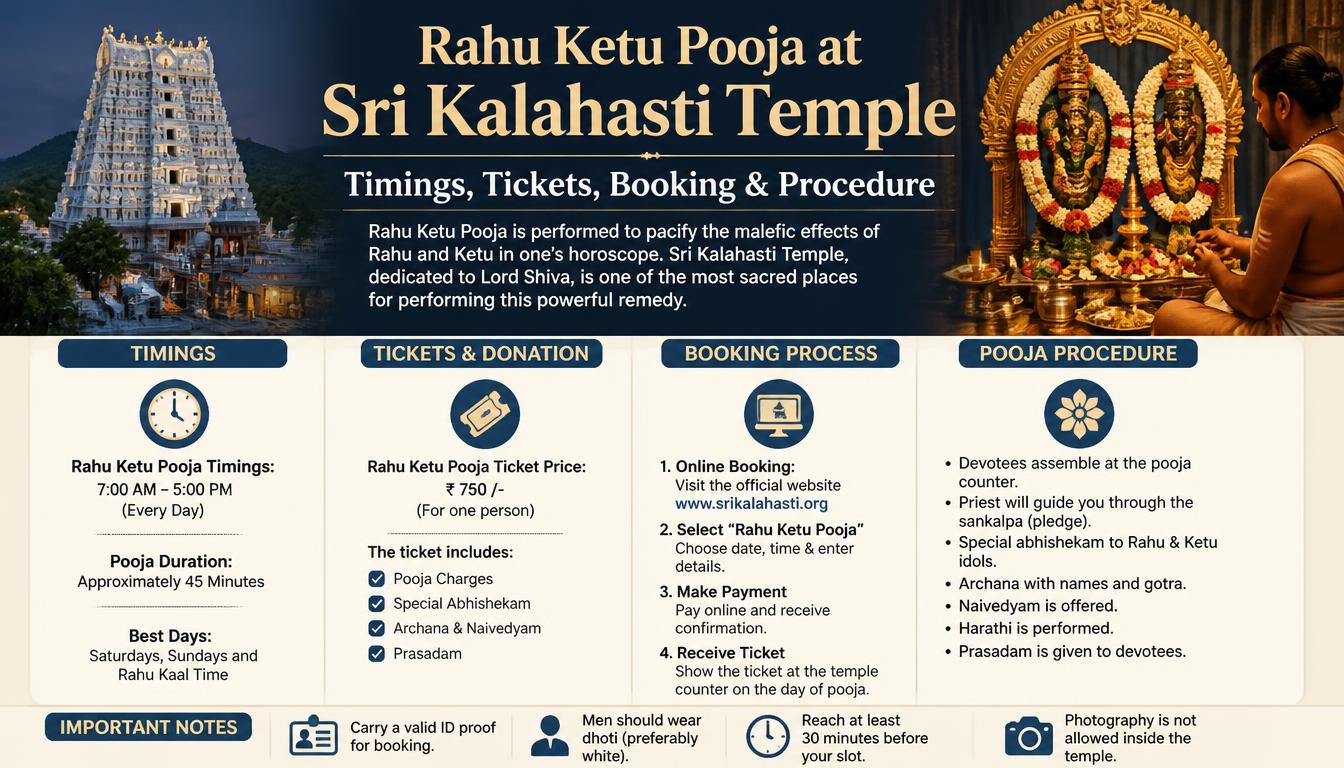
One of the first things pilgrims search for is Sri Kalahasti Rahu Ketu Pooja timings.
The pooja is generally conducted through much of the day, with commonly published timings running approximately from 6:00 AM to 5:00 PM. Different arrangements or batches may operate according to the temple’s schedule on that particular day.
Many pilgrims prefer morning pooja slots because the temple can become busier as the day moves on. Others deliberately choose a time connected with Rahu Kalam.
The exact operating schedule can change during festivals, special rituals, crowd-control arrangements, or temple administrative decisions. So, treat any online timing as planning guidance and verify the current schedule through official temple channels before travelling.
Unlike many Hindu ceremonies where devotees avoid Rahu Kalam, Rahu Kalam Pooja has special significance for people performing a ritual specifically connected with Rahu.
For this reason, some pilgrims intentionally select Sunday Rahu Kalam or Tuesday Rahu Kalam. These periods can naturally attract larger crowds too, so reaching the temple earlier than your intended slot is sensible.
Other days considered meaningful by different devotees include Amavasya, or New Moon Day, and one’s Nakshatra or birth star day.
The best time for Rahu Ketu Pooja, however, isn’t identical for everybody. Your astrologer may recommend a day based on your horoscope, planetary positions, nakshatra, or personal circumstances.
And sometimes, the most practical answer is simpler: perform the pooja when you can attend calmly and sincerely instead of chasing an “ideal” minute while stressed in traffic outside the temple.
Sunday and Tuesday are popular choices, particularly when devotees wish to perform the ritual during Rahu Kalam. Amavasya is another significant occasion and can bring considerably heavier crowds.
Some families plan their pilgrimage around their birth star, while others follow dates suggested by their astrologer. Special calendar periods such as Mahalaya Amavasya, Pitru Paksha, and particular festival days can also influence pilgrim numbers.
The temple may be especially busy around Navaratri, Vijaya Dashami, Vinayaka Chaturthi, Karthika month, and other important religious occasions.
If astrology is the reason for your visit, the best day for Rahu Ketu Pooja should ideally be decided according to the guidance you personally follow rather than choosing a date only because somebody on the internet called it lucky.
Another major planning question is the Rahu Ketu Pooja ticket price.
Ticket categories commonly reported for the ritual include price levels such as ₹500, ₹750, ₹1,500, ₹2,500, and ₹5,000, although available categories and prices can be revised by the temple administration.
Higher-priced categories may provide different seating locations, smaller groups, closer seating, or different arrangements for priest service and pooja participation. A more expensive ticket doesn’t mean the prayer itself becomes spiritually “stronger,” though. Thats worth remembering.
Depending on the category operating on your visit, you may encounter options described as a General Ticket, Special Ticket, VIP Ticket, Premium Ticket, or another designated seva category.
The pooja materials required for the official ritual are typically associated with the ticket arrangement or pooja kit. Before paying anybody outside the authorized system, confirm exactly what your official ticket includes.
Prices, names, inclusions, and availability may change, so pilgrims should verify the latest Sri Kalahasti Pooja ticket price through official channels or at authorized temple seva counters.
People travelling from another state naturally want to arrange everything before arriving, which makes Rahu Ketu Pooja online booking one of the most searched topics.
When online booking is offered for the required seva, use only the official Sri Kalahastheeswara Swamy Vari Devasthanam, AP Endowments Department, or authorized Andhra Pradesh temple booking channels.
The online booking process may require details such as the devotee’s name, number of persons, date, selected slot, and payment information. After successful booking, preserve the ticket receipt and any QR code or booking confirmation supplied.
Don’t trust random agents merely because their webpage appears first in Google. Temple ticketing details can change, and unofficial websites may show old prices or outdated booking procedures.
For a Sri Kalahasti online booking, checking the official system shortly before your travel date is far safer than relying on an old screenshot or blog post.
Same-day tickets may be available through the temple ticket counter or designated temple seva counter, subject to the day’s capacity and temple arrangements.
This option is useful for pilgrims who couldn’t complete online ticket booking beforehand. However, popular days can be extremely busy, particularly Sundays, Tuesdays, Amavasya dates, and festival periods.
Reach early if you’re relying on counter booking. Keep the necessary identification, payment method, and booking details ready rather than searching through your phone while the queue slowly moves behind you.
Where accepted, payment facilities may include cash or digital methods such as UPI payment, but availability shouldn’t be assumed at every counter.
For a first-time pilgrim, the ritual can initially look complicated. In practice, devotees are guided through the process, so you don’t need to arrive knowing every Sanskrit mantra.
After obtaining the correct ticket, you’ll generally proceed toward the assigned pooja hall or mandap. Depending on the ticket category and temple arrangements, worship may take place in designated spaces such as a Rahu-Ketu Mandap or another hall.
A pooja kit is provided or arranged according to the seva. Materials traditionally associated with the ritual can include symbolic Rahu-Ketu representations, flowers, camphor, betel leaves, rice, turmeric-related materials, and coconut, though the exact kit can vary.
The priest begins guiding devotees through the pooja ritual. Instructions may include the sankalpam, where personal devotional details such as gotra and nakshatra may be used according to the ritual practice.
Don’t panic if you don’t know every detail. Tell the priest or temple staff what information you have and follow their guidance.
Mantra chanting forms an important part of the ceremony.
The priest may guide worshippers through Rahu-Ketu Dhyana Mantras, Dhyana slokas, and other traditional mantra recitations. Depending on the ritual arrangement, prayers connected with Rahu and Ketu are performed while devotees make the instructed offerings.
Some devotional practices refer to Rahu beejaksharas, Ketu beejaksharas, 108 Rahu mantras, and 108 Ketu mantras. Shiva prayers such as Om Namah Shivaya are also deeply associated with worship at Sri Kalahasti.
You aren’t expected to pronounce everything like a Sanskrit scholar. Listen carefully, repeat when instructed, and keep your attention on the ritual rather than worrying about tiny pronunciation slips.
The ceremony generally progresses through prayer, offerings, mantra recitation, and concluding acts such as aarti or deeparadhana.
Once the pooja is completed, devotees generally proceed according to the temple’s prescribed route and instructions for Sri Kalahasti darshan.
Having Shiva darshan after the ritual is considered an important part of the pilgrimage by many devotees. You may also receive sacred items such as tirtham or vibhuti, depending on the temple’s current practice.
Avoid rushing out the moment the final mantra finishes. The darshan that follows is, for many pilgrims, the quietest and most meaningful part of the whole visit.
Some traditions also carry particular instructions about how ritual materials should be handled afterward. Follow the priest’s or temple’s directions rather than advice picked randomly from social media.
The actual duration depends on the crowd, ticket category, batch size, waiting period, and temple schedule.
Rather than planning your trip around an exact number of minutes, keep a generous buffer. Queueing, collecting the pooja kit, entering the mandap, performing the ritual, and completing darshan can turn a seemingly short ceremony into a longer temple visit.
This becomes especially important if you have a train, bus, or Tirumala darshan appointment later the same day.
A rushed pilgrimage isn’t very peaceful, no matter how perfectly you’ve timed Rahu Kalam.
Respectful traditional attire is the safest choice for the Rahu Ketu Pooja dress code.
Men commonly choose a dhoti, veshti, kurta-pajama, or other clean traditional clothing. Women may wear a saree, salwar-kameez, or another modest traditional outfit.
Some devotees avoid a black dress during the pooja according to personal or traditional beliefs. If you’re unsure what to wear for Rahu Ketu Pooja, simple, clean, modest traditional clothes are an easy choice.
Footwear must be left in the designated area before entering restricted temple spaces. Mobile phone restrictions and photography restrictions may also apply, particularly inside sacred areas.
Use the available locker counter or storage facility where required, and maintain silence inside the mandap while rituals are being performed.
A little preparation keeps the day from becoming unnecessarily messy.
The simplest Rahu Ketu Pooja rules are really about patience, respect, and following temple instructions.
Many pilgrims wonder whether the ritual is restricted to a particular gender or marital status.
Individuals and couples commonly visit Sri Kalahasti seeking Rahu Ketu remedies. The exact ritual participation rules can depend on temple procedures and individual circumstances, so devotees with a specific concern should confirm it with authorized temple staff.
Similarly, foreign and NRI devotees visit the temple as part of their spiritual journeys. Following the same temple entry guidelines, dress expectations, ticketing procedures, and sacred-space etiquette makes the experience much smoother.
For unusual personal circumstances, its always better to ask the temple than build your plan around a forum answer written ten years ago.
Sri Kalahasti Amavasya Pooja attracts particular interest because Amavasya has traditional significance in several forms of Hindu worship and astrology.
There is also a distinctive connection between Sri Kalahasti and eclipse worship. Unlike many temples that may follow different practices during a solar eclipse or lunar eclipse, Sri Kalahasti is traditionally noted for worship associated with eclipse periods.
Searches for Rahu Ketu Pooja during eclipse and Grahana Kala Abhishekam therefore become especially common around eclipse dates.
Eclipse-day procedures, however, are special-event matters. Never assume that ordinary daily pooja timings or ticket arrangements apply. Confirm the official schedule for that particular eclipse before travelling.
Astrologically, Rahu and Ketu are interpreted differently according to the houses, signs, conjunctions, and other planetary positions in an individual’s horoscope.
That is why one person may be advised to consider Rahu Ketu Pooja for marriage, while another approaches the ritual because of career instability, family worries, or childbirth concerns.
Devotees may pray for relief from marriage delay, childbirth delay, financial problems, or recurring career obstacles. But spiritual worship shouldn’t replace medical, financial, relationship, or professional help when those are needed.
Think of the pooja in its proper devotional setting: a prayer for guidance and grace, not a guaranteed substitute for practical action.
Read more: https://templetimingsdaily.com/sri-kalahasti-temple-darshan-timings/
Combining Tirupati to Sri Kalahasti travel is common among pilgrims visiting this part of Andhra Pradesh.
Sri Kalahasti is roughly 36 km from Tirupati, making a combined pilgrimage practical for many travellers. Road and rail connections are available, while local transport options depend on your arrival point and travel schedule.
Pilgrims completing TTD darshan or Tirumala darshan sometimes add Sri Kalahasti before or after Tirumala. If you’re doing both on one day, keep substantial time between bookings.
Traffic, queues, temple parking, queue gates, and unexpected crowding can happily destroy a timetable that looked beautiful in a spreadsheet.
A first Sri Kalahasti pilgrimage becomes easier when you plan the boring things before the spiritual things.
Check transportation, accommodation, ticket availability, and temple timings before leaving. Devasthanam accommodation or other local lodging may be worth considering when you intend to attend an early-morning ritual.
Families travelling with elderly devotees should ask about the currently available senior citizen queue or wheelchair facility, as accessibility procedures can change.
Carry only necessary belongings into the temple premises. Fewer bags means fewer locker worries, fewer security delays, and more attention left for the actual reason you came.
The Rahu Ketu Pooja timings are commonly stated as approximately 6:00 AM to 5:00 PM, with rituals conducted in batches or slots. Always verify the current temple schedule before visiting.
Commonly reported Rahu Ketu Pooja tickets range from around ₹500 to ₹5,000 across different categories. Prices and inclusions can change, so check the latest official tariff.
Many devotees specifically prefer Rahu Kalam for this ritual because the pooja concerns Rahu and Ketu. Sunday and Tuesday Rahu Kalam periods are particularly popular.
Yes, Amavasya is a popular day among devotees for Rahu-Ketu-related worship. Expect larger crowds and confirm the day’s temple arrangements beforehand.
Use authorized temple booking channels when Rahu Ketu Pooja booking is available online, or purchase eligible tickets through official temple counters according to current procedures.
Bring your ticket or booking confirmation, required identification, and personal details such as gotra and nakshatra if known. Follow temple instructions regarding additional materials.
A pooja kit or required ritual materials are generally arranged according to the seva procedure. Confirm the inclusions for your particular ticket rather than purchasing unnecessary kits from outside sellers.
Couples commonly visit Sri Kalahasti for the ritual. Follow the temple’s current instructions regarding seating, tickets, and participation for the number of persons attending.
Follow the priest’s directions, complete the recommended Shiva darshan, and handle any remaining pooja materials according to temple instructions.
Not necessarily. Depending on the temple’s current system, same-day tickets may be obtainable from authorized counters, subject to availability.
Rahu Ketu Pooja at Srikalahasti Temple is generally performed daily from 6:00 AM to 5:00 PM. Devotees should arrive early to complete ticket and pooja preparations.
Rahu Ketu Pooja is a sacred ritual performed to reduce the effects of Rahu-Ketu Dosha, Naga Dosha, and Kaal Sarpa Dosha and seek spiritual peace and blessings.
Poojas at Sri Kalahasti Temple are conducted throughout the day, while Rahu Ketu Pooja is available from around 6:00 AM to 5:00 PM.
Srikalahasti Temple offers different poojas and sevas at scheduled times, with Rahu Ketu Pooja performed daily between 6:00 AM and 5:00 PM.
Kalahasti Temple pooja timings vary depending on the seva or ritual. Rahu Ketu Pooja generally runs from 6:00 AM to 5:00 PM, with several slots available during the day.
Don’t turn your Sri Kalahasti visit into a race between Google Maps, Rahu Kalam, and your next train.
Give yourself time. Verify the latest Sri Kalahasti Temple pooja timings, booking availability, ticket cost, and dress requirements before travelling. Arrive early if visiting on Sunday, Tuesday, Amavasya, or another major religious date.
Most importantly, remember why the ritual exists within the devotional tradition. The mantras, sankalpam, offerings, Rahu and Ketu symbolism, and eventual darshan of Lord Shiva aren’t merely boxes to tick before heading back to Tirupati.
Rahu Ketu Pooja at Sri Kalahasti Temple brings together astrology, ancient Shiva worship, personal prayer, and centuries of pilgrimage tradition. For devotees dealing with Rahu-Ketu Dosha, Kaal Sarpa Dosha, Naga Dosha, or difficult planetary influences, the temple remains one of the best-known destinations for performing Rahu Ketu Dosha Nivarana Pooja.
Planning the practical side matters too. Understand the Sri Kalahasti Rahu Ketu Pooja timings, verify the current Rahu Ketu Pooja ticket price, use authorized channels for Rahu Ketu Pooja online booking, dress respectfully, and become familiar with the basic Rahu Ketu Pooja procedure before arriving.
Then, once the ticket is in your hand and the noise of planning has finally quietened, allow the pilgrimage to be what it was meant to be: a moment of prayer before the Vayu Lingam, a request for clarity before Lord Shiva, and perhaps a slightly lighter heart when you walk back outside.