Physical Address
304 North Cardinal St.
Dorchester Center, MA 02124
Physical Address
304 North Cardinal St.
Dorchester Center, MA 02124

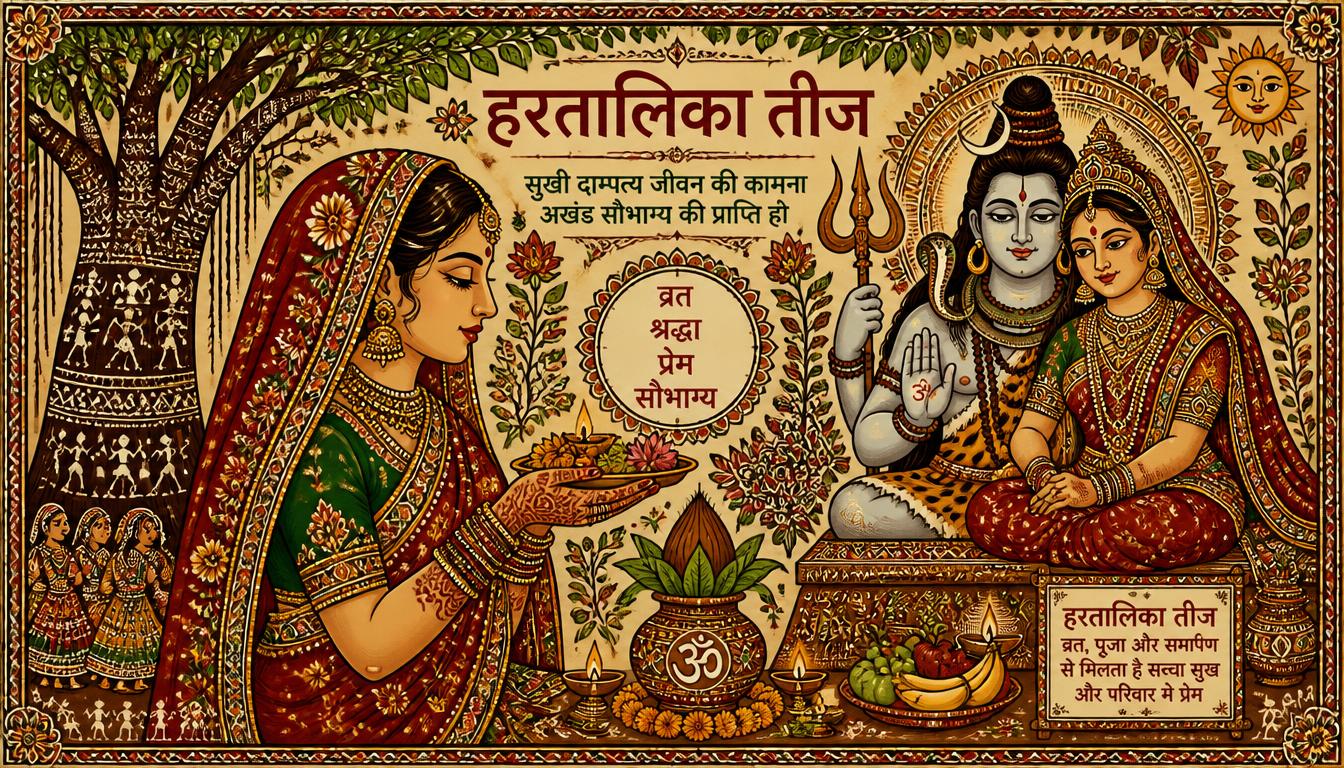
Some festivals arrive with drums and bright processions, while some arrive quietly, carrying a prayer in the heart. Hartalika Teej 2026 belongs to the second kind.
is a festival where devotion feels deeply personal, where women dress beautifully, prepare for Hartalika Puja, remember the determination of Goddess Parvati, and ask for blessings that cannot really be measured in money or material things.
In 2026, Hartalika Teej will be observed on Monday, September 14, 2026, during Bhadrapada Shukla Paksha Tritiya. The date is consistent across regional Panchang listings, although exact Hartalika Teej puja time varies by location. For example, the listed morning puja muhurat for Bahawalpur is 5:57 AM to 6:36 AM.
The festival is especially associated with Lord Shiva and Goddess Parvati, marital devotion, spiritual discipline, and prayers for
a happy family life. But there is something more human hiding beneath all the rituals: the wish to choose love freely, protect relationships, and keep faith even when life feels stubborn.
The Hartalika Teej 2026 date is Monday, September 14, 2026. According to the Hindu lunar calendar, the festival falls on Bhadrapada Shukla Tritiya, the third lunar day of the bright fortnight of Bhadrapada.
This is useful to remember because Teej is not simply a fixed-date festival on the Gregorian calendar. Its observance follows the lunar Hindu calendar, so the English date changes every year.
And yes, that is why checking a reliable local Panchang before planning the Hartalika Teej Vrat or puja is a sensible little step.
For 2026, the Tritiya Tithi begins on September 13 and ends on September 14, with local timings changing according to location.
A small overview can make the whole festival easier to understand before we wander into the story and rituals.
The observance is especially prominent in parts of North India, while related Gauri traditions are followed in southern regions under names such as Gowri Habba and Swarna Gowri Vratha.
The heart of Hartalika Teej significance is found in the devotion of Goddess Parvati toward Lord Shiva. According to the traditional legend, Parvati performed intense tapasya and spiritual austerities because she wished to have Shiva as her husband.
Her story isn’t really just about romance, though people often tell it that way. It is also about determination. Parvati did not casually wait for destiny to knock at the door; she devoted herself to her chosen path with extraordinary patience.
The festival therefore became associated with Shiva Parvati worship, marital devotion, and prayers for a harmonious married life.
Women observing the vrat may pray for their husband’s health, family happiness and lasting marital bonds, while unmarried women may also observe the festival in traditions that associate it with seeking an ideal life partner.
And perhaps that is why the festival still feels relevant after so many generations. A prayer made hundreds of years ago can somehow sound surprisingly modern when the prayer is simply, “May the life I build be peaceful and meaningful.”
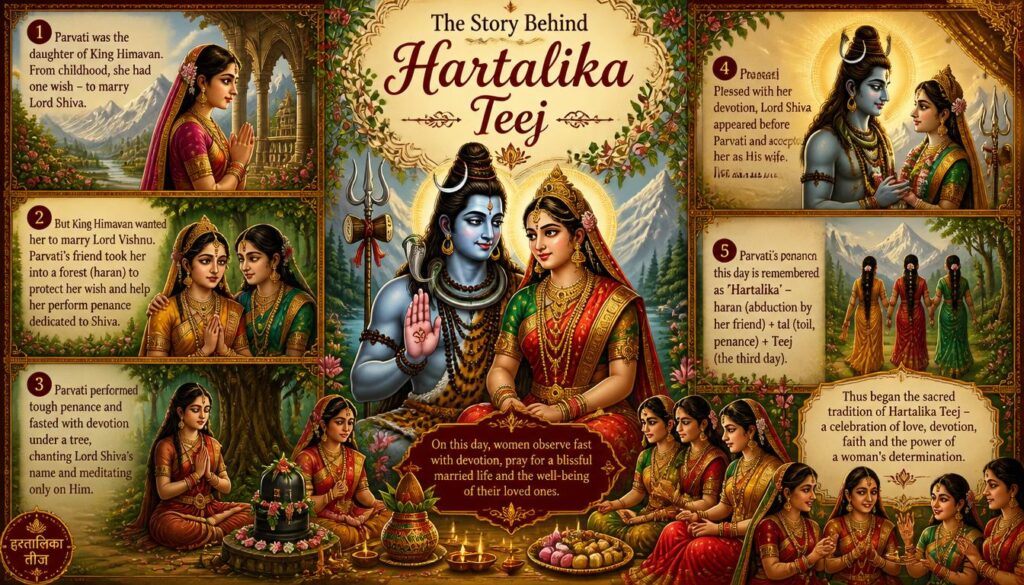
The Hartalika Teej story is one of the most memorable parts of the celebration.
Traditional accounts describe Parvati’s father as intending to marry her to Lord Vishnu. Parvati, however, had already devoted herself to Lord Shiva.
Her female friend understood her distress and took her away to a forest so she could continue her spiritual practice without being forced into a marriage she did not desire.
The name Hartalika is traditionally explained through the words Harat and Aalika, associated with taking away or carrying off and a female friend.
In the forest, Parvati continued her severe penance. Eventually, Lord Shiva accepted her devotion and became her divine consort.
That forest in the story is almost like a quiet room in a noisy world. No crowd, no celebration, no jewellery, just determination. The legend reminds devotees that genuine devotion is often patient, difficult and a little lonely before it becomes joyful.
The Hartalika Teej Vrat is traditionally considered a demanding devotional observance. Many women keep a Nirjala Vrat, meaning they abstain from both food and water for the prescribed period, although practices and personal observances can vary.
Fasting should always be approached with care. Religious practice is deeply personal, and anyone who is pregnant, unwell, elderly, taking medication, or otherwise unable to safely fast should follow appropriate medical and family guidance rather than treating extreme fasting as a test of devotion.
The deeper meaning of Hartalika Teej fasting is not simply hunger. It is discipline. Devotees use the fast as a way of turning attention away from ordinary distractions and toward prayer, worship and reflection.
The empty stomach is only one part of the story; the quieter mind is arguably the bigger one.
The exact Hartalika Teej Puja Vidhi can differ by region and family tradition, so there isn’t one universal checklist that every household must follow. Still, several practices are widely associated with the festival.
Devotees traditionally wake early, bathe and prepare themselves for the day’s worship. Clean clothes are worn, and the puja space is arranged with care.
In many traditions, temporary sand idols or clay representations of Lord Shiva and Goddess Parvati are prepared for worship. The simplicity of these idols is rather beautiful; sacredness does not always need expensive decoration.
Flowers, leaves, lamps, fruits and traditional offerings may be arranged around the idols. Women may also decorate their hands with mehndi and wear festive clothing.
The Shiva-Parvati idols are worshipped with prayers and offerings according to family or regional customs. The Hartalika Teej rituals often include flowers, incense, lamps, sacred water and devotional offerings.
The Hartalika Teej Vrat Katha is traditionally narrated or heard during the observance. The story of Parvati’s devotion gives the ritual its emotional and spiritual context.
Devotees may chant Om Namah Shivaya, along with prayers dedicated to Goddess Parvati. Some families also recite Shiva-related stotrams or other devotional texts.
The day is not merely about dressing up and taking photographs, though those photos will probably happen anyway. The central focus remains prayer, discipline, devotion and family blessings.
The timing and method of breaking the fast vary according to regional and family customs. Devotees should follow their local Panchang and established household practice.
There is no single worldwide Hartalika Teej puja time because Panchang calculations depend on location.
For example, the 2026 listing for Bahawalpur gives a morning Pratahkala Hartalika Puja Muhurat from 5:57 AM to 6:36 AM on September 14. The same date has different local puja windows in Karachi, Multan and other cities.
So, if you are preparing for the festival, don’t simply copy a puja time from a random social media post. Check the Panchang for your own city, because even a difference of location can change the muhurat.
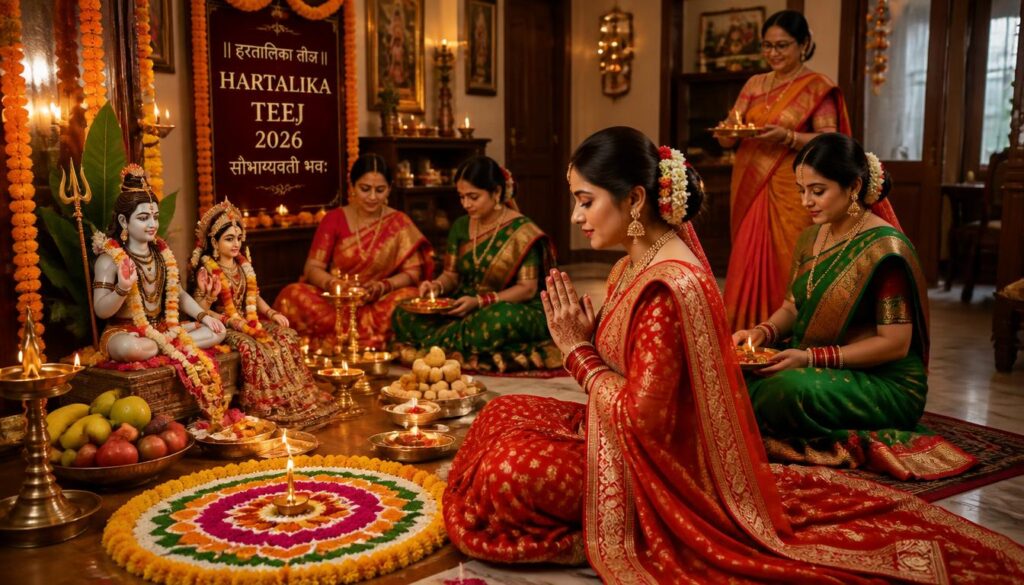
A home celebration can be simple without becoming less meaningful. In fact, sometimes a small puja room with flowers and a diya feels more intimate than a huge arrangement.
Families may clean the worship area, prepare the idols, decorate with flowers, light lamps and incense, and arrange traditional offerings. Women may wear sarees or other festive clothing, apply mehndi, exchange greetings and spend time discussing the Hartalika Teej story.
Some homes also organize evening devotional gatherings. The atmosphere can move from quiet prayer to laughter in about ten minutes, because family celebrations have never been very good at staying solemn for long.
The important thing is to preserve the devotional meaning rather than treating the celebration as only a fashion or social event.
One beautiful feature of Teej traditions is that they do not look exactly the same everywhere.
In Rajasthan, Uttar Pradesh, Madhya Pradesh, Bihar and Jharkhand, Teej celebrations can have a strong community and festive character. Women may gather together, sing traditional songs, decorate themselves, exchange gifts and observe the vrat.
In Karnataka, Andhra Pradesh and Tamil Nadu, related worship of Goddess Gauri is associated with Gowri Habba and Swarna Gowri Vratha. These traditions have their own regional character while sharing the broader devotional connection with Goddess Gauri/Parvati.
That variation is worth celebrating. A festival can travel from one region to another without losing its soul, while still picking up the accent, food, clothes and customs of each place.
Festival wishes don’t need to sound like they were printed on a greeting card in 1998. A few sincere words can carry much more warmth.
A festival wish for a husband can be devotional, romantic or wonderfully simple. It doesn’t have to sound overly poetic unless that’s your thing.
Elders often connect with the festival through tradition, memory and family. A respectful message can mean more than a grand gift.
Sometimes the perfect message is only one or two lines. Not every WhatsApp status needs to become a philosophical essay, thankfully.
There is room for romance in devotion too. After all, the festival itself remembers a divine union built around love and determination.
A little humour doesn’t reduce devotion. It just makes family WhatsApp groups considerably more entertaining.
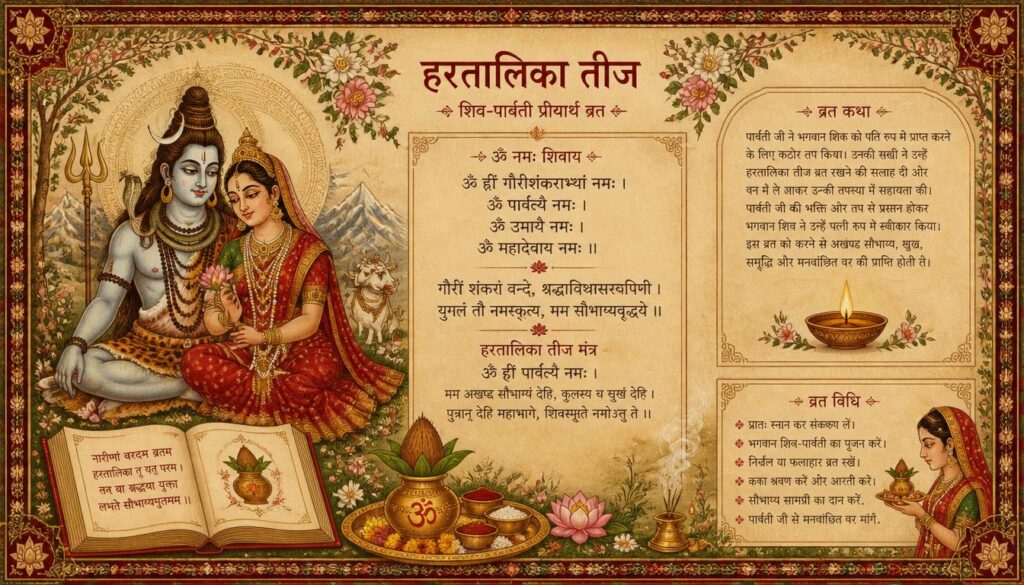
Devotees may include traditional Shiva mantras and Parvati mantras in their worship. One widely known Shiva mantra is Om Namah Shivaya, also called the Panchakshara mantra.
A simple devotional practice is to sit quietly before the Shiva-Parvati idols, light a diya and repeat the chosen mantra with attention rather than rushing through the words. Five peaceful minutes can sometimes feel more devotional than fifty distracted ones.
A commonly recited Shiva mantra is:
ॐ नमः शिवाय
Devotees may also use prayers dedicated to Goddess Parvati, according to their family tradition and the guidance of their priest or spiritual teacher. The point of a mantra is not merely pronunciation; devotion, concentration and intention are part of the practice.
Traditional beliefs associate Hartalika Teej spiritual benefits with devotion, marital harmony, family well-being and spiritual discipline. Women may pray for their husband’s health, long life and happiness, while others observe the festival as a personal expression of faith.
The idea of spiritual merit also appears in traditional Hindu devotional thinking, where fasting, worship and disciplined conduct are understood as ways of cultivating inner strength.
It is worth keeping the distinction clear, though: these are religious beliefs and devotional understandings, not scientifically measurable guarantees. A sincere festival can still be deeply meaningful without turning spirituality into a promise of specific worldly outcomes.
At its emotional centre, Hartalika Teej and Shiva Parvati are inseparable.
Shiva represents a powerful divine presence in Hindu tradition, while Parvati represents devotion, strength, determination and divine feminine energy. Their union is often remembered as a model of sacred partnership.
The festival’s message can therefore be read beyond marriage alone. It speaks about commitment, personal choice, patience and the courage to remain connected to one’s values.
That is probably why the story survives so strongly. People do not remember stories for centuries merely because they are old; they remember them because some part of the story still sounds like life.
People sometimes use Teej names interchangeably, but Hartalika Teej, Hariyali Teej and Kajari Teej are distinct festivals.
Hariyali Teej is associated with the monsoon season and occurs earlier, while Hartalika Teej falls in Bhadrapada Shukla Tritiya. Traditional calendars describe Hartalika Teej as one of the three major Teej festivals observed during Sawan and Bhadrapada.
Knowing the difference is useful, especially if you are writing social media posts or preparing puja materials. A beautiful message with the wrong festival name can become a very awkward family-group moment.
Some devotees choose to visit temples during the festival, particularly temples associated with Shiva, Parvati or other forms of the divine couple.
Places connected with major Shiva pilgrimage traditions, such as Kashi Vishwanath, Kedarnath, Trimbakeshwar and Mahakaleshwar, can hold special devotional significance for visitors, although a pilgrimage is certainly not required to observe Hartalika Teej.
For many families, the most important temple on the day may simply be the small prayer space at home.
A personalized wish usually feels better when it contains one real detail instead of five generic blessings.
Mention the person’s relationship to you, add a specific prayer, and finish with something natural. For example, instead of writing only “Happy Teej,” you could mention the family’s happiness, a couple’s journey together or the grandmother who has celebrated the festival for decades.
Try this simple structure:
Greeting + personal memory + blessing + heartfelt ending
A daughter might write about her mother’s devotion. A husband might mention his gratitude. A friend might remember childhood Teej celebrations. These tiny details turn a copied festival greeting into something that actually belongs to you.
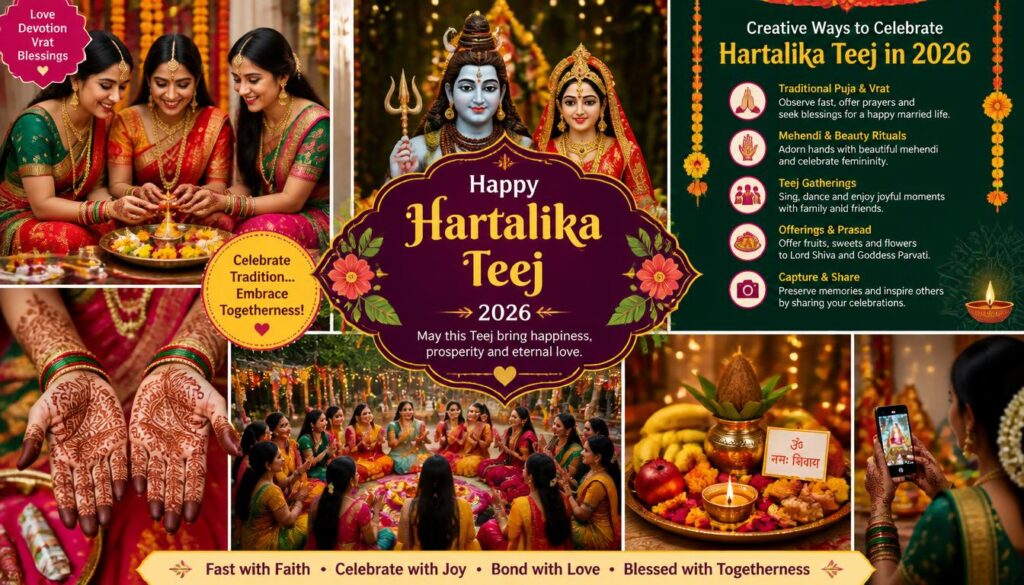
The festival can remain traditional while still feeling personal.
You could prepare a small home altar with flowers, create a handwritten prayer card, decorate the puja area together, record elders explaining the Hartalika Teej Vrat Katha, or preserve photographs of the family’s traditional rituals.
Young family members can also be taught why the festival is celebrated rather than simply being told to “dress up for Teej.” When children understand the story behind a tradition, the festival becomes something they carry forward instead of something they merely watch.
And perhaps record Nana or Dadi telling the story in their own words. Those imperfect little recordings can become priceless years later.
Hartalika Teej 2026 falls on Monday, September 14, 2026, during Bhadrapada Shukla Tritiya.
Hartalika Teej is a Hindu festival dedicated especially to the worship of Lord Shiva and Goddess Parvati, traditionally associated with devotion, fasting and prayers for marital and family well-being.
A Nirjala Vrat is a form of fasting in which devotees traditionally abstain from both food and water for the prescribed period. Practices vary, and health considerations should always be respected.
Temporary sand or clay idols of Shiva and Parvati are traditionally prepared for worship, symbolizing the sacred couple at the centre of the festival.
In some traditions, unmarried women observe the festival while praying for a suitable life partner and blessings associated with an ideal marriage. Customs differ by family and region.
The Hartalika Teej Vrat Katha recounts the traditional story of Goddess Parvati’s devotion and penance for Lord Shiva, including the role of her female friend in helping her avoid an unwanted marriage.
Offerings vary by regional and family tradition, but flowers, fruits, lamps, incense and other customary puja materials are commonly used.
No. The festival and related Gauri traditions are observed across different parts of India. In Karnataka, Andhra Pradesh and Tamil Nadu, related observances include Gowri Habba and Swarna Gowri Vratha.
Hartalika Teej 2026 will be celebrated on Monday, September 14, 2026. It is observed on Bhadrapada Shukla Tritiya.
Hartalika Teej 2026 falls on September 14, 2026. Women observe this sacred festival with fasting and prayers for marital happiness.
Haratalika Teej 2026 is on Monday, September 14, 2026. The festival is dedicated to the worship of Lord Shiva and Goddess Parvati.
The Hartalika Teej date in 2026 is September 14 (Monday). The festival is observed during Shukla Paksha Tritiya of the Bhadrapada month.
Hartalika Teej 2026 will be celebrated on September 14, Monday. Devotees observe the nirjala vrat and perform Shiva-Parvati Puja on this day.
Hartalika Teej 2026 is more than a date circled on a calendar. It is a living tradition built from devotion, memory, discipline, family and the enduring story of Goddess Parvati and Lord Shiva.
On September 14, 2026, homes will be decorated, women will prepare for the vrat, diyas will glow, prayers will be spoken and old stories will once again find new listeners. The exact ritual may change from one household to another, but the feeling underneath it remains remarkably familiar: the desire for love that lasts, families that stay connected, and a life guided by faith.
And perhaps that is the sweetest part of any festival. We inherit the rituals from those who came before us, then add a little piece of our own life to them.
If you are celebrating Hartalika Teej, share your favourite tradition, wish or family memory in the comments. Someone reading it may discover a beautiful custom they had never heard about before.
May this Hartalika Teej bring Shiva-Parvati blessings, family prosperity, marital happiness, spiritual peace and countless reasons to smile. Happy Hartalika Teej 2026. 🙏
Postscript: The date above is based on current Panchang listings for 2026; exact puja muhurat should be checked for the devotee’s specific city because local timings differ.