Physical Address
304 North Cardinal St.
Dorchester Center, MA 02124
Physical Address
304 North Cardinal St.
Dorchester Center, MA 02124


There are some journeys that begin with a ticket, and there are others that begin much earlier, somewhere quietly inside the heart. A Jyotirlinga pilgrimage often belongs to the second kind.
You may start by searching for the 12 Jyotirlingas names and locations, checking train routes or wondering how many days a complete yatra could take.
But somewhere between the first temple bell and the last evening aarti, the journey starts feeling less like travel and more like a conversation with something ancient.
The 12 Jyotirlingas in India are among the most revered sacred shrines associated with Lord Shiva. The word Jyotirlinga is traditionally understood through jyoti, meaning light, and linga, the symbolic form of Shiva.
In Hindu tradition, the Jyotirlingas represent Shiva appearing as an immeasurable pillar of divine light, a form without an easily discoverable beginning or end. It is a beautiful idea, really the divine not fitting neatly inside the boundaries we keep trying to give it.
These twelve sacred sites are spread across very different landscapes of India: the Arabian Sea coast, Himalayan mountains, river islands, ancient cities, forests and temple towns.
The Government of India has also recognized the twelve as the Dwadasa Jyotirlinga circuit in its tourism discussions. Tourism India+1
So, what are the 12 Jyotirlingas, where are they located, and why do millions of devotees dream of receiving their darshan? Let’s walk through them, slowly, as one would walk through a temple courtyard — no need to rush it.
A Jyotirlinga is not simply another name for a Shiva temple. India has countless ancient and beautiful Shiva temples, but twelve shrines are traditionally identified together as the Dwadasha Jyotirlingas.
Their names are preserved in the well-known Dwadasha Jyotirlinga Stotram, a Sanskrit devotional verse associated in tradition with the twelve sacred manifestations. The official Kashi Vishwanath portal also preserves the traditional verse naming the shrines. Shri Kashi Vishwanath
The central story behind the Jyotirlinga tradition comes from the familiar account of Shiva appearing as an endless column of light. Brahma and Vishnu, according to the story, sought to determine the limits of this extraordinary manifestation, but neither could find its beginning or end.
The symbolism is rather striking: human understanding keeps looking for an edge, while the divine is presented as something without one.
For pilgrims, therefore, darshan is not merely looking at a stone or entering an old building. It is an encounter with a sacred tradition that has survived through generations. Some visitors arrive with a very specific prayer. Others simply sit quietly for a few minutes and dont ask for anything at all.
The twelve shrines also create a remarkable sacred geography. They stretch from Somnath in Gujarat to Rameswaram in Tamil Nadu, and from Kedarnath in the Himalayas to Kashi Vishwanath in Varanasi.
The Ministry of Tourism describes the twelve as sacred abodes of Lord Shiva and has promoted them as part of India’s religious and cultural tourism landscape. Tourism India
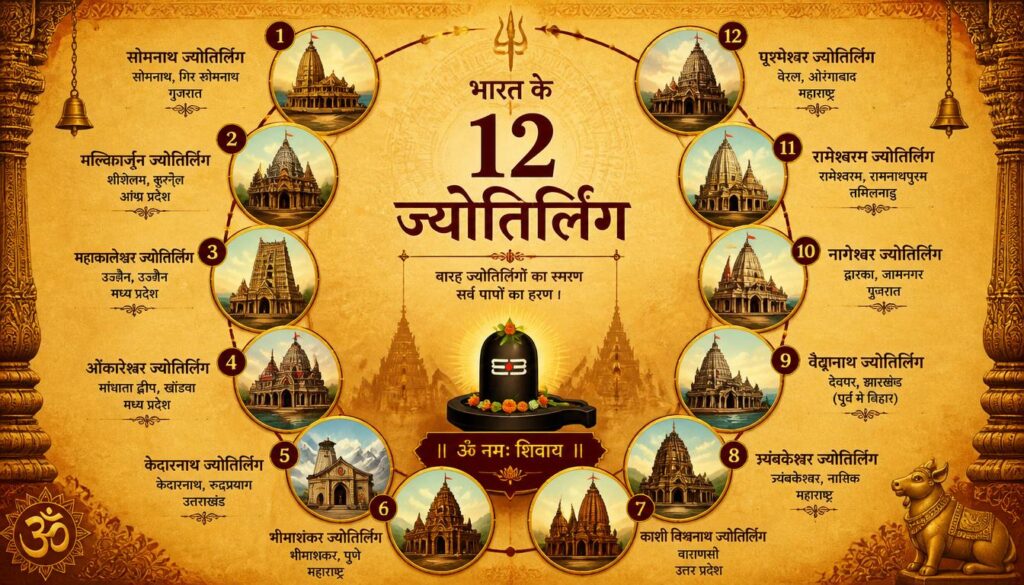
If you’re searching for a quick 12 Jyotirlingas list with states, the following table gives the traditional set and their commonly identified locations.
| Jyotirlinga | Temple/Place | State |
|---|---|---|
| Somnath | Prabhas Patan, near Veraval | Gujarat |
| Mallikarjuna | Srisailam | Andhra Pradesh |
| Mahakaleshwar | Ujjain | Madhya Pradesh |
| Omkareshwar | Mandhata/Omkareshwar | Madhya Pradesh |
| Kedarnath | Kedarnath | Uttarakhand |
| Bhimashankar | Bhimashankar, near Pune | Maharashtra |
| Kashi Vishwanath | Varanasi | Uttar Pradesh |
| Trimbakeshwar | Trimbak, near Nashik | Maharashtra |
| Vaidyanath/Baidyanath | Deoghar | Jharkhand |
| Nageshwar | Dwarka region | Gujarat |
| Ramanathaswamy | Rameswaram | Tamil Nadu |
| Grishneshwar | Ellora region | Maharashtra |
The Ministry of Tourism lists the same twelve sacred names, although some place identifications and spellings vary across traditional and modern sources. TTourism India
That variation matters particularly for Vaidyanath and Nageshwar, where different traditions and locations have been proposed. So, if you are planning a pilgrimage and encounter two different answers online, dont immediately assume one website has made a mistake. The question of identification has genuine traditional complexity.
The Somnath Jyotirlinga Gujarat is traditionally placed at Prabhas Patan near Veraval, overlooking the Arabian Sea. There is something almost cinematic about arriving here: the temple rises beside the sea while the horizon seems to carry on forever, which fits rather nicely with the idea of an infinite divine light.
Somnath is deeply woven into the historical and religious memory of western India. The shrine has been destroyed and rebuilt at different points in history, making its story about much more than architecture. It is also about continuity the ability of a sacred place to remain meaningful even when history around it becomes turbulent.
For a first-time pilgrim, Somnath can feel like an ideal opening chapter to a Jyotirlinga yatra. The sound of the sea, temple rituals and the vast open sky create a mood that is difficult to manufacture. You just stand there for a while, and somehow the itinerary becomes less important.
The Mallikarjuna Jyotirlinga Srisailam is located in Andhra Pradesh and is associated with the sacred hill region of Srisailam.
Here, the worship of Shiva as Mallikarjuna is closely connected with the worship of Goddess Parvati in the form of Bhramaramba, making the site particularly significant for devotees who revere both Shiva and Shakti.
Srisailam is surrounded by forests and dramatic natural scenery, so the pilgrimage does not feel confined to the temple walls. The road itself becomes part of the experience.
You pass through changing landscapes, and by the time the temple appears, the mind has already slowed down a little.
This is one reason a spiritual journey is different from an ordinary tourist trip. You may remember the road, the prasadam, a conversation with another pilgrim or even the smell of flowers near the entrance years later. Funny how memory works like that.
The Mahakaleshwar Jyotirlinga Ujjain is one of the most famous Shiva shrines in Madhya Pradesh. Ujjain itself is an ancient sacred city, and Mahakaleshwar occupies an especially important place in its religious landscape.
Mahakal is associated with Shiva as the Lord beyond time and death, giving the shrine a distinctive spiritual character. Among the many traditions surrounding the temple, the Bhasma Aarti is particularly famous and attracts devotees who wish to witness this early-morning ritual.
A visit to Mahakaleshwar can feel intense rather than merely peaceful. There are bells, chants, queues, flowers, ash, lamps and a sense that the city has been waking up to Shiva for centuries. For someone doing their first Jyotirlinga darshan, Ujjain can be unforgettable.
If the Bhasma Aarti is part of your plan, check the temple’s current official arrangements well ahead of time, because access procedures and timings can change. A pilgrimage itinerary written two years ago isnt necessarily your itinerary today.
The Omkareshwar Jyotirlinga Madhya Pradesh stands on or around Mandhata island in the Narmada River, and the landscape gives this pilgrimage destination a special visual identity.
The name Omkareshwar is traditionally connected with the sacred syllable “Om,” and the island’s geography has long been associated with that spiritual symbolism. Nearby, Mamleshwar is also an important Shiva shrine, and pilgrims commonly include both sacred places in their visit.
Here, the river is not merely scenery. The Narmada is itself revered, and the combination of river, island, temple bells and evening lamps creates an atmosphere that is remarkably gentle. Sometimes the best part of a temple visit is the ten minutes after darshan, when nobody in your group knows what to say — and nobody really needs to.
The Kedarnath Jyotirlinga Uttarakhand is perhaps the shrine that most dramatically demonstrates how varied the 12 Jyotirlingas in India really are.
Located high in the Himalayas, Kedarnath is surrounded by enormous mountain landscapes that can make even a crowded pilgrimage route feel strangely intimate.
Kedarnath is also among the most demanding Jyotirlinga destinations from a travel perspective. Weather, altitude, seasonal access and physical fitness all matter.
The temple is not a casual stop on a road trip, and pilgrimage planning here needs more care than simply booking a hotel.
The northernmost location of the Jyotirlinga circuit is traditionally associated with Kedarnath, while Rameswaram represents the southern end. The Ministry of Tourism has specifically highlighted this remarkable geographic spread. Tourism India
A pilgrim once described a Himalayan temple journey to me as “walking with your body while your mind learns patience.” It sounds simple, but perhaps that is exactly why it stays with you.
The Bhimashankar Jyotirlinga Maharashtra is situated in the Sahyadri region and is associated with the origin of the Bhima River. Compared with some of the more urban Jyotirlinga destinations, Bhimashankar offers a stronger feeling of forest and mountain landscape.
The surrounding biodiversity adds another layer to the visit. A pilgrimage here can easily become a meeting point between religious heritage and nature travel, especially for families who want something more than a temple-only itinerary.
Maharashtra is particularly important in any Jyotirlinga temple list, because several of the traditionally recognized shrines are located in the state. The Ministry of Tourism has highlighted Trimbakeshwar, Bhimashankar and Grishneshwar among Maharashtra’s prominent Jyotirlinga shrines. Tourism India
Go slowly around Bhimashankar. The forest deserves a little attention too, not just the temple timetable.
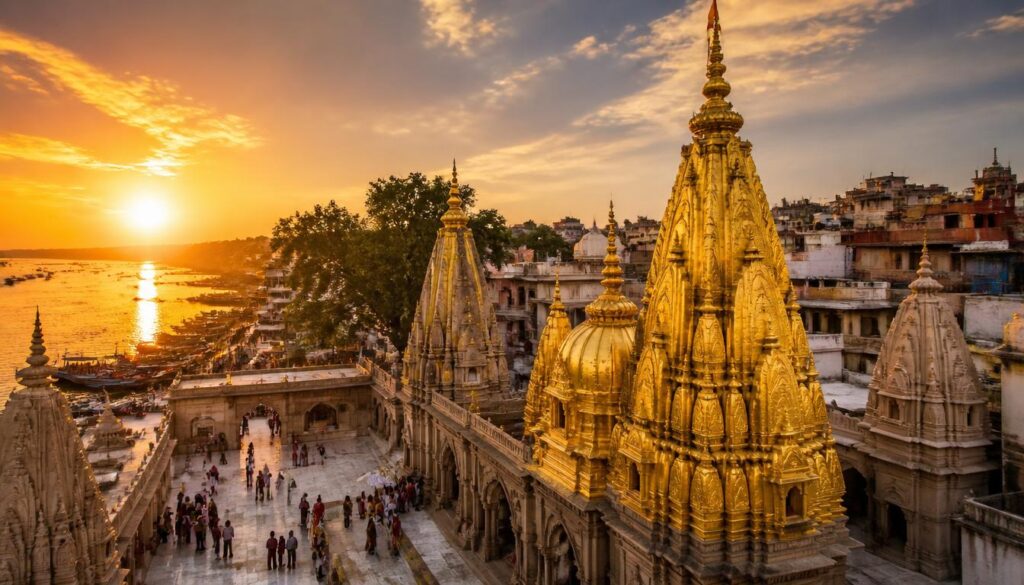
The Kashi Vishwanath Jyotirlinga stands in Varanasi, one of India’s most famous sacred cities. Here the temple is inseparable from the larger spiritual identity of Kashi, where the Ganga, ghats, narrow lanes, music, rituals and Shiva worship seem to overlap into one enormous living tradition.
The official Varanasi district website identifies Kashi Vishwanath as one of the twelve Jyotirlingas and describes the temple as a major Shiva shrine on the western bank of the Ganga. Varanasi District
The temple has undergone reconstruction and change through history. The present structure is associated with Ahilyabai Holkar’s rebuilding in the eighteenth century, and the modern Kashi Vishwanath Corridor has significantly changed access around the temple area. Kashi Darshan
For many pilgrims, Kashi Vishwanath darshan is not just one stop on a list. It feels like entering a city that has been performing its own prayer for centuries. Even the lanes seem to have opinions, which is a very Kashi sort of thing.
The Trimbakeshwar Jyotirlinga Nashik is located near Trimbak in Maharashtra, close to the source region of the Godavari River. The shrine is therefore connected not only with Shiva worship but also with the sacred geography of one of India’s major rivers.
The temple’s traditional architecture and surrounding pilgrimage culture make Trimbakeshwar an important stop for devotees travelling through western India. Nashik itself is also a major religious destination, so the temple can be incorporated into a broader pilgrimage itinerary.
For travellers building a Jyotirlinga route map, Trimbakeshwar is one of the easier shrines to pair with other Maharashtra destinations. That geographical clustering can make a multi-temple yatra considerably more practical.
The Vaidyanath Jyotirlinga, also called Baidyanath, is traditionally associated with Deoghar in Jharkhand. The name Vaidyanath is connected with Shiva as the divine physician or healer, giving the shrine an especially comforting symbolism for many worshippers.
Deoghar receives large numbers of pilgrims, particularly during the month of Shravan, when the wider region becomes intensely associated with Shiva devotion and the Kanwar pilgrimage tradition.
There is an important detail for serious researchers: the identification of Vaidyanath among the twelve has been contested by different traditions, with Parli Vaijnath in Maharashtra also associated with the claim. Even the Government of India’s tourism answer has reflected variations in how the site is identified. Tourism India+1
So when creating a complete list of 12 Jyotirlingas, it is more responsible to mention the traditional variation than pretend the discussion does not exist. Pilgrimage is ancient; search-engine certainty is rather new.
The Nageshwar Jyotirlinga Dwarka tradition places the shrine in the Dwarka region of Gujarat. It is associated with Shiva as Nageshwar and forms part of the western Indian sacred landscape that also includes Somnath.
Nageshwar can be particularly meaningful when included in a wider Gujarat pilgrimage, allowing travellers to combine Shiva worship with the sacred traditions surrounding Dwarka and other coastal destinations.
There is also a longstanding identification debate surrounding Nageshwar, with other places, including Aundha Nagnath in Maharashtra and Jageshwar in Uttarakhand, having been associated with the name in different traditions.
This is one of those areas where a Jyotirlinga travel guide should distinguish between widely followed pilgrimage practice and historical or textual interpretation. Wikipedia
In other words, dont let a disagreement over geography distract from the devotion that makes these places meaningful.
The Ramanathaswamy Jyotirlinga Rameswaram carries the sacred atmosphere of India’s far south. Located on Rameswaram island in Tamil Nadu, the temple is traditionally connected with the Ramayana and the worship of Shiva by Rama.
The Ramanathaswamy Temple is also renowned for its enormous corridors and distinctive Dravidian temple architecture. Walking through them is an experience in itself; the repeated pillars create a perspective that seems to continue long after your eyes have given up counting.
Rameswaram is traditionally regarded as the southernmost of the twelve shrines, while Kedarnath occupies the northern Himalayan end. Tourism India
For families, this can be one of the most memorable stops because the pilgrimage naturally combines mythology, architecture, ocean landscapes and temple rituals. It feels like several chapters of Indian cultural history decided to meet in one place, somehow.
The Grishneshwar Jyotirlinga Ellora is located near the famous Ellora cave complex in Maharashtra. Its proximity to Ellora makes it especially valuable for travellers interested in both pilgrimage and India’s architectural heritage.
Grishneshwar is traditionally counted as the twelfth of the twelve Jyotirlingas. The temple’s location also makes it relatively convenient to combine with a visit to the remarkable rock-cut caves nearby, creating a journey that brings together religion, art, history and architecture.
The result is a lovely reminder that Indian pilgrimage has rarely existed in a little box marked “religion.” Sacred places often sit inside wider landscapes of sculpture, music, food, storytelling, trade and local memory. That mix is part of what makes temple travel so rich.

The spiritual significance of the 12 Jyotirlingas lies in their association with Shiva’s infinite, radiant form. Each shrine has its own local mythology, rituals, festivals and cultural personality, yet all are connected through the larger Jyotirlinga tradition.
For devotees, the pilgrimage may represent many things at once: seeking blessings, fulfilling a vow, expressing gratitude, remembering ancestors, beginning a new phase of life or simply spending time in sacred surroundings.
It is important, though, to describe spiritual benefits respectfully rather than as guaranteed outcomes. Religious traditions may hold that Jyotirlinga darshan brings purification, blessing or spiritual merit, but these are matters of faith and devotion rather than something measurable like a train journey.
Perhaps that is why people return. They are not always looking for proof. They are looking for meaning.
Planning the full 12 Jyotirlinga yatra is very different from visiting one temple during a weekend. The shrines are spread across India, and the journey involves mountains, long road transfers, flights, trains, crowded temple towns and seasonal considerations.
A sensible Jyotirlinga pilgrimage itinerary should be designed around geography rather than blindly following the traditional verse order. The traditional order is spiritually and culturally important, but it is not necessarily the most efficient modern travel route.
One practical approach is to group temples regionally:
This does not mean there is one universally “best route.” Your starting city, transport budget, available leave, temple opening seasons and physical ability should decide the route.
A Jyotirlinga tour can be completed in stages too. There is absolutely no spiritual rule saying you must conquer all twelve in one heroic sprint. Sometimes visiting two or three carefully is far more meaningful than racing through eight with a phone permanently showing the next train.
There is no single best time to visit Jyotirlingas, because the twelve temples exist in radically different climates.
For Kedarnath, seasonal access is a major consideration because of its Himalayan location. For coastal Gujarat and Tamil Nadu, summer heat can be significant. Monsoon conditions can affect road travel in Maharashtra and other regions. Major festivals can create enormous crowds but also offer an exceptionally powerful devotional atmosphere.
October to March is often a comfortable broad planning window for many parts of India, but it should not be treated as a universal rule for every shrine. Always verify current temple opening dates, weather, crowd conditions and official darshan arrangements before travelling.
For festival periods, the question is really what you want from the journey. If your priority is quiet exploration, choose less crowded dates. If you want to experience the thunder of collective devotion, a major festival can be unforgettable though your feet may have a slightly different opinion.
A first-time pilgrim can easily become overwhelmed by the practical side of temple travel. Crowds, queues, footwear rules, photography restrictions, offerings and special darshan systems differ from place to place.
Before visiting, check the current official temple information rather than relying on an old blog post. Temple timings and entry systems can change, especially during festivals, security changes or major renovations.
Keep clothing modest and comfortable, carry only what is permitted inside, and leave plenty of time for security checks. If travelling with elderly family members or children, don’t build an itinerary that leaves no breathing room.
And perhaps most importantly, dont measure the success of a pilgrimage by the number of temples you manage to tick off.
The real purpose of a spiritual journey is not to defeat a map.
For practical pilgrimage planning, a few small preparations can prevent surprisingly large headaches.
These things sound boring until you are standing outside a temple at 5 a.m. discovering that the rule you didnt check actually matters.
A simple 12 Jyotirlingas list gives you twelve names. A genuine pilgrimage guide should give you something more: a sense of why those names matter.
Somnath introduces the journey beside the sea. Mallikarjuna brings Shiva and Shakti into a forested hill landscape. Mahakaleshwar places Shiva in ancient Ujjain and connects devotion with the mystery of time. Omkareshwar brings river and sacred sound together.
Kedarnath places the pilgrim among Himalayan heights. Kashi turns a temple visit into an encounter with an entire sacred city.
Bhimashankar and Trimbakeshwar bring the forests and rivers of Maharashtra into the story. Vaidyanath adds the symbolism of healing. Nageshwar carries the western coastal tradition onward. Rameswaram reaches the far south, while Grishneshwar stands beside one of India’s extraordinary concentrations of rock-cut heritage.
The official Kashi Vishwanath portal describes the twelve as a distinctive sacred cluster and notes their varied settings, including coastal, riverine and mountainous environments. Shri Kashi Vishwanath
That variety is perhaps the real beauty of the circuit. The twelve do not look the same, sound the same or sit in the same kind of landscape. Yet the thread of Shiva connects them.

Before beginning your Jyotirlinga yatra, write down why you are going.
Not a formal sentence, necessarily. Just something honest.
Maybe you are travelling because your parents always wanted to go. Maybe you made a promise during a difficult year. Maybe you have recently started a new chapter and want to mark it with a sacred journey.
Or perhaps you simply want to stand somewhere ancient and remember that your own worries, however loud today, are only one small moment in a much larger story.
Families can also make the pilgrimage meaningful for younger travellers by telling the stories behind each shrine instead of turning the journey into a checklist.
Ask children what they notice about the temple architecture. Let grandparents share family traditions. Keep a small travel journal with one memory from every temple.
One pilgrim may remember the darshan. Another remembers tea outside the temple. Someone else remembers getting lost in a lane and meeting a helpful stranger.
All of it becomes part of the yatra.
Read more: https://templetimingsdaily.com/shrinathji-temple-nathdwara-timings-today/
The traditionally recognized twelve are Somnath, Mallikarjuna, Mahakaleshwar, Omkareshwar, Kedarnath, Bhimashankar, Kashi Vishwanath, Trimbakeshwar, Vaidyanath/Baidyanath, Nageshwar, Ramanathaswamy and Grishneshwar.
The Government of India also lists these twelve as the Dwadasa Jyotirlinga circuit, while noting them under varying modern place names and spellings. Tourism India
Maharashtra is commonly identified as having three of the traditionally recognized twelve: Bhimashankar, Trimbakeshwar and Grishneshwar.
Madhya Pradesh and Gujarat each have two, while the remaining shrines are spread across Andhra Pradesh, Uttarakhand, Uttar Pradesh, Jharkhand and Tamil Nadu.
“Jyotirlinga” is traditionally interpreted as a linga of light, with jyoti meaning light. The concept is associated with Shiva’s manifestation as an infinite pillar of divine radiance.
No. The traditional order of the names and a practical modern Jyotirlinga route are two different things. Since the temples are spread across India, travellers usually organize the journey according to geography, transport connections, weather and available time.
Yes. There are longstanding differences in tradition regarding the identification of some shrines, especially Vaidyanath and Nageshwar.
Deoghar in Jharkhand is widely followed for Vaidyanath, while other traditions identify Parli Vaijnath; Nageshwar is commonly associated with the Dwarka region, while other sites have also been proposed. Sanatan+1
Certainly, but family travel requires more realistic pacing. Elderly travellers and children may need additional rest, and mountain destinations such as Kedarnath require particular attention to weather, altitude and physical demands.
Start with the basics: understand the Jyotirlinga locations, group destinations geographically, verify current temple timings, arrange transportation and accommodation, and keep flexible time for delays. A pilgrimage should leave room for prayer, not only punctuality.
The 12 Jyotirlingas are sacred Shiva shrines located across India, traditionally representing Lord Shiva in his divine form of infinite light.
The twelve are Somnath, Mallikarjuna, Mahakaleshwar, Omkareshwar, Kedarnath, Bhimashankar, Kashi Vishwanath, Trimbakeshwar, Vaidyanath, Nageshwar, Ramanathaswamy and Grishneshwar.
Maharashtra has three traditionally recognized Jyotirlingas: Bhimashankar, Trimbakeshwar and Grishneshwar.
Jyotirlingas are revered as manifestations of divine light and are considered highly sacred places for Shiva worship, prayer and darshan.
October to March is generally comfortable for many destinations, but the ideal time varies because temples such as Kedarnath have seasonal access.
The 12 Jyotirlingas in India are often presented as a list, but a list cannot capture the sound of bells at dawn, the glow of lamps beside a river, the first sight of Himalayan peaks, the salt air around Somnath or the crowded lanes leading toward Kashi Vishwanath.
It also cannot capture what happens inside a person during a long journey.
Perhaps that is why the Jyotirlinga pilgrimage has endured. It takes the devotee across distances that are physical, cultural and emotional. You move from Gujarat to Andhra Pradesh, Madhya Pradesh to Uttarakhand, Maharashtra to Uttar Pradesh, Jharkhand to Tamil Nadu.
Different languages surround you. Different foods appear. Different architectural traditions unfold. Yet the same sacred name, Shiva, keeps returning.
For some, the destination is darshan. For others, it is the silence afterwards.
If you’re preparing your own yatra, don’t worry about making it perfect. Make it sincere. Check the practical details, respect the traditions of each temple, leave some empty space in your itinerary and let the journey surprise you a little. Thats often where the best memories hide.
The twelve Jyotirlingas are twelve sacred points on the map, yes but they are also twelve invitations to pause, remember, pray and look beyond the hurried rhythm of everyday life.
And maybe that is the finest way to understand a pilgrimage: you begin by travelling toward a temple, and somewhere along the road, you discover that the journey has also been travelling toward you.
For further verification and current pilgrimage information, the Government of India’s tourism material and official Kashi Vishwanath information are useful starting points. Tourism India+1
If you’d like, I can also turn this into a more strongly SEO-optimized 2,500–3,000-word version with a meta title, meta description, featured-snippet answers, FAQ schema-style questions, and a stronger keyword distribution.