Physical Address
304 North Cardinal St.
Dorchester Center, MA 02124
Physical Address
304 North Cardinal St.
Dorchester Center, MA 02124

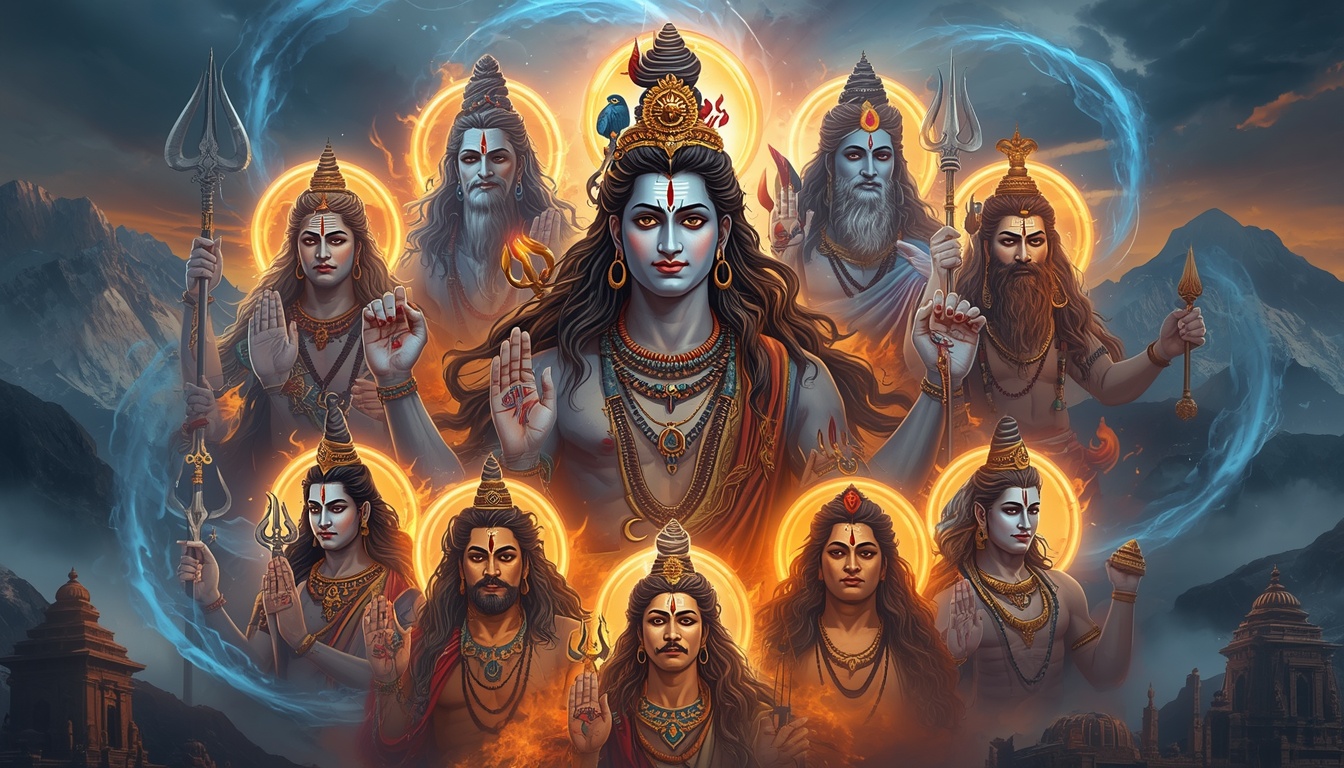
There is something powerful about the name Rudra. It does not simply point toward anger or destruction, as people sometimes assume. In the Vedic tradition, Rudra represents a force that can shake what is stagnant, remove what is harmful, and open the way for transformation. That is why the 11 Rudra Avatars of Lord Shiva, also known as the Ekadasha Rudras, hold such a meaningful place in Hindu spiritual thought.
The Rudras can be understood as different expressions of Lord Shiva’s cosmic energy. Each form carries its own symbolism, qualities, powers, and spiritual lesson. Some represent strength and protection, while others are connected with knowledge, peace, purification, existence, or transcendence.
Different scriptures and regional traditions sometimes give slightly different names, descriptions, or interpretations of the Rudras. The list discussed here follows a commonly circulated Puranic tradition that includes Kapali, Pingal, Bheem, Virupaksha, Vilohita, Shasta, Ajaapada, Ahirbudhnya, Shambhu, Chand, and Bhava.
The 11 Rudra Avatars are traditionally known as the Ekadasha Rudras, meaning the eleven Rudra manifestations. The concept appears across Vedic and Puranic literature, although the exact list can vary between texts and traditions.
The word Rudra is associated with a powerful divine force connected with transformation, dissolution, healing, and fierce protection. In the Vedas, especially in hymns associated with Rudra and later traditions of Shiva, this divine force is both fearsome and benevolent.
Rather than seeing the eleven forms as eleven completely separate gods, many devotees understand them as different expressions of one supreme Shiva consciousness. One form may emphasize courage, another wisdom, another peace, while another represents the destruction of negativity.
This makes the spiritual significance of 11 Rudras much deeper than simply memorizing eleven names.
The origin of the Ekadasha Rudras is described differently across Hindu scriptures and traditions. In Puranic narratives, Rudra manifestations are sometimes connected with the cosmic order established by Brahma, while other accounts emphasize Shiva’s eternal nature rather than a single historical beginning.
The Shiva Purana, along with other Puranic and Vedic traditions, provides important context for understanding Rudra worship. The concept is also connected with the broader tradition of Shatarudriya and the famous Sri Rudram, where Rudra is praised through many names and attributes.
The number eleven itself has an important symbolic role. The eleven Rudras can be contemplated as expressions of different cosmic and inner forces. In this sense, Rudra is not only somewhere in the heavens; the symbolism can also be understood as a spiritual journey taking place within a person.
Fear becomes courage. Confusion becomes wisdom. Attachment becomes detachment. Destruction becomes transformation.
That is the strange beauty of Rudra symbolism.
Kapali Rudra is associated with the word Kapala, meaning skull. The skull is not merely a frightening symbol; it represents death, impermanence, ego destruction, and spiritual detachment.
Kapali reminds a devotee that everything material eventually changes. Wealth, physical beauty, status, relationships and even the body are temporary. This realization can sound harsh, but spiritually it can become liberating.
The imagery of cremation grounds associated with Shiva traditions reinforces this teaching. Instead of running away from mortality, the spiritual seeker learns to understand it.
Kapali therefore represents fearlessness in the face of death and change. His symbolism encourages people to release unnecessary ego and develop inner courage.
The deeper lesson is simple, though not always easy: when attachment becomes weaker, spiritual freedom becomes stronger.
Pingal Rudra is connected with solar energy, radiance, vitality, and life-force. The symbolism of the Sun represents energy that illuminates, activates, and sustains life.
Pingala is also associated in yogic traditions with the Pingala Nadi, one of the subtle energy channels discussed in yoga philosophy. It is traditionally linked with active, dynamic and solar qualities.
This form of Rudra can therefore be contemplated as a symbol of Prana, vitality, health, movement, and determination.
The Sun rises without asking whether anyone is ready for morning. That little cosmic habit makes it a rather good metaphor for discipline.
Spiritually, Pingal Rudra reminds a person to develop energy that is purposeful rather than restless. Strength becomes meaningful when it is directed toward Dharma.
Bheem Rudra represents supreme strength, courage, protection, and physical as well as spiritual power. The word Bheem itself carries the sense of something formidable and mighty.
In artistic and devotional traditions, this Rudra form may be associated with powerful weapons such as the trident or Gada, emphasizing his warrior-like nature.
Bheem Rudra is particularly meaningful when devotees are facing fear, adversity, uncertainty, or obstacles. His symbolism suggests that protection does not always mean avoiding difficulty. Sometimes it means becoming strong enough to pass through it.
Traditions involving Bheem Rudra Homa also reflect the desire for spiritual protection and removal of negative influences.
The important spiritual message is not simply, “Become powerful.” It is, “Use strength responsibly.”
Virupaksha Rudra is strongly associated with the third eye, spiritual vision, and multidimensional awareness.
The name is often interpreted in connection with unusual or extraordinary vision. In Shiva symbolism, the third eye represents a level of awareness beyond ordinary perception.
This form can therefore symbolize intuition, spiritual insight, vigilance, and deeper knowledge.
Traditional descriptions may associate Virupaksha with numerous divine weapons and attributes, including the Khadaga, Shula, Damru, Ankusha, Sarpa, Chakra, Gada, Akshamala, Khetaka, Khatvanga, Shakti, Parashu, and Kapala.
These objects carry different meanings in iconography, but collectively they suggest that divine awareness can take many forms.
Virupaksha teaches that seeing is not always the same as understanding. The physical eyes observe the world; spiritual awareness attempts to understand what lies beneath it.
Vilohita Rudra is associated with a reddish appearance and the powerful symbolism of fire.
Fire has a fascinating place in Hindu spirituality. It can destroy, but it can also purify. Through Agni, offerings are traditionally carried into the sacred realm during many Vedic rituals.
Vilohita therefore represents purification, transformation, spiritual awakening, and the burning away of negative karma.
The symbolism does not necessarily mean that every difficulty is punishment for past actions. Rather, it can be understood as an invitation to transform harmful tendencies.
Like a fire changing raw material into something new, spiritual practice can change fear into courage and ignorance into awareness.
The Pinaka, bow, and arrow associated with Shiva imagery can further symbolize focused spiritual intention.
Shasta Rudra, sometimes written in variant traditions as Shastra, represents the qualities of a divine teacher, wisdom, righteousness, and guidance.
This form is connected with Dharma, meaning righteous living and responsible conduct. Shasta symbolism reminds devotees that spiritual power without wisdom can easily become destructive.
Knowledge is not merely collecting information. It should change how a person lives.
The imagery associated with this form can include a book and water pot, symbols that naturally connect with learning, purity, discipline, and spiritual knowledge.
Some traditions also connect the name Shasta with Hari Hara Putra, reflecting a broader sacred tradition surrounding divine sonship and the union of Hari and Hara.
The deeper lesson is beautifully practical: a spiritual guide does not simply tell us what to believe; the guide helps us understand how to live.
Ajaapada Rudra, also spelled Ajapaad, carries associations with transcendence, stability, and the eternal.
The imagery of a one-legged stance can symbolize extraordinary yogic stability. Standing firmly on one foot is difficult physically, but spiritually it becomes a metaphor for remaining steady while circumstances constantly move around us.
The name is also associated with ideas such as the unborn, formless, and eternal presence.
References connected with the Rig Veda and later spiritual interpretations make Ajaapada especially interesting for those exploring the relationship between Vedic Rudra and later Shiva traditions.
Ajaapada teaches stability. Life may change its weather every other day, but spiritual discipline asks the seeker not to lose the inner center.
Ahirbudhnya Rudra is one of the more mysterious forms among the eleven Rudras.
The name is associated with the imagery of a cosmic serpent and the depths of the cosmic ocean or primordial waters. Serpent symbolism in Hindu traditions can represent hidden energy, mystery, transformation, and forces existing beneath ordinary awareness.
Ahirbudhnya can therefore be contemplated as a representation of hidden cosmic powers, subconscious forces, and the mysterious foundations of creation.
Traditional beliefs may also connect this form with protection from natural calamities, storms, negative influences, the Evil Eye, black magic, and certain planetary doshas.
These associations should be understood within their religious and cultural context rather than treated as scientific claims.
Spiritually, Ahirbudhnya invites us to look beneath the surface. Not everything important announces itself loudly.
The name Shambhu is closely associated with auspiciousness, peace, benevolence, and happiness.
Shambhu Rudra represents a gentler dimension of Shiva, reminding devotees that divine power is not always fierce. Sometimes the greatest strength appears as compassion.
Shambhu is associated with inner peace, blessings, domestic harmony, marital bliss, and the origin of life.
The lotus is an appropriate symbol for this spiritual quality because it grows from muddy water while remaining beautifully distinct from it.
In devotional iconography, the Vara Mudra can represent generosity, blessing, and the granting of spiritual or material boons.
Shambhu’s lesson is particularly relevant in everyday life. A person can be powerful without being harsh, knowledgeable without being arrogant, and spiritually serious without losing kindness.
Chand Rudra, with spelling variants such as Chanda in some traditions, represents fierce protection, wrathful energy, and the destruction of evil.
This is the Rudra form that speaks to the instinct to defend what is sacred and righteous.
His symbolism is connected with adversity, obstacles, battles, guardianship, and victory over negative forces. Traditional iconography may include weapons such as the Khvanga and noose.
The fierce appearance of this form should not automatically be interpreted as uncontrolled anger. In a spiritual context, fierce energy can represent disciplined action against injustice, ignorance, fear, or destructive tendencies.
There is a difference between anger that controls a person and courage that refuses to surrender to evil. Chand Rudra represents the latter ideal.
The final form in this commonly used list is Bhava Rudra.
The word Bhava is associated with existence, becoming, life, and cosmic manifestation. This makes Bhava particularly connected with creation, fertility, prosperity, abundance, and the experience of being alive.
The symbolism of the five elements—earth, water, fire, air, and space or ether—fits naturally into this understanding of existence.
Everything we experience through the physical world can be contemplated through these elemental principles.
Bhava Rudra therefore presents a beautiful counterpoint to the destructive aspect of Rudra. Shiva is not only associated with dissolution; the Rudra tradition can also point toward creation, existence, transformation, and liberation.
This form can also be connected devotionally with Lord Hanuman, especially in traditions that explore deeper relationships between Shiva and Hanuman.
When the 11 forms of Lord Shiva are viewed together, they create a much larger spiritual picture.
Kapali teaches detachment. Pingal represents vitality. Bheem represents strength. Virupaksha points toward spiritual vision. Vilohita represents purification. Shasta gives wisdom. Ajaapada teaches stability. Ahirbudhnya reveals hidden power. Shambhu offers peace. Chand protects against destructive forces. Bhava represents existence and abundance.
Together, these qualities reflect the many dimensions of Shiva spiritual energy.
The Rudras can therefore be approached not merely as mythological characters but as symbols for qualities that a person may cultivate during a spiritual journey.
Fearlessness, discipline, compassion, wisdom, courage, awareness, purification and devotion all become part of the same journey.
One of the most interesting ways to understand the Rudras is through the balance between creation, preservation, and destruction.
Destruction in the Shiva tradition does not always mean absolute annihilation. Often, destruction makes transformation possible.
An old habit must sometimes end before a better one can begin. Ignorance must be removed for knowledge to appear. Ego must become smaller for compassion to grow.
This is why Rudra symbolism is closely connected with cosmic balance.
The universe is not presented as a frozen object. It moves, changes, dissolves, recreates and transforms. The Rudras symbolically participate in this immense process.
Some traditions also discuss the 11 Rudranis or Shaktis associated with the Rudras. These feminine powers represent complementary dimensions of divine energy.
Names found in traditional lists can include Dhi, Vritti, Usana, Urna, Niyuta, Sarpis, Ila, Ambika, Iravati, Svadha, and Diksha, although lists and interpretations can differ.
The idea is significant because Shiva and Shakti are often understood as complementary principles. Divine power is not represented only through masculine imagery.
The Rudranis can be associated symbolically with wisdom, nurturing, transformation, fertility, compassion, spiritual knowledge, and feminine energy.
In Shaivism, this relationship between consciousness and energy becomes one of the most profound themes of spiritual philosophy.
Devotees may honor Rudra through various forms of Shiva worship, including Rudra Puja, Ekadasha Rudra Puja, Rudrabhisheka, meditation, Homa, and recitation of sacred hymns.
During Rudrabhisheka, devotees may offer substances such as water, milk, curd, honey, and ghee over a Shiva Lingam, accompanied by sacred chants and prayers.
The exact ritual procedure varies according to tradition, temple, lineage, and family practice.
The most famous textual tradition associated with Rudra worship includes Sri Rudram, which contains the Namakam and Chamakam. Devotees may also recite the Mahamrityunjaya Mantra, Rudra Gayatri Mantra, Shiva Panchakshari Mantra, and other Sanskrit stotras.
The familiar chant “Om Namah Shivaya” remains one of the best-known Shiva mantras and is used by devotees across many Shaiva traditions.
Read more: https://templetimingsdaily.com/ekadashi-2026-dates/
Devotees may turn toward Rudra worship for many spiritual reasons, including a desire for divine protection, inner strength, purification, peace, courage, removal of negativity, and spiritual awakening.
It is important, however, to understand such benefits primarily within the framework of religious faith and spiritual practice. A ritual should not be treated as a guaranteed replacement for professional help, practical action, or responsible decision-making.
The deeper value of worship often comes from devotion itself.
A person sits quietly, repeats a sacred name, offers water, listens to Vedic hymns, or performs meditation. For a few moments, the noise of ordinary life becomes quieter. Sometimes that quietness is the blessing people were searching for all along.
The tradition of Rudra worship contains several important mantras and hymns.
Sri Rudram is among the most important Vedic prayers connected with Rudra. It is traditionally associated with the Yajurveda and is widely recited in Shiva temples and Vedic rituals.
The Mahamrityunjaya Mantra is another famous mantra associated with Shiva devotion and is traditionally recited as a prayer for protection, healing, liberation, and spiritual well-being.
The Shiva Panchakshari Mantra, “Om Namah Shivaya,” is especially central to Shaivite devotion.
Other devotional works include Rudrashtakam, Rudra Suktam, and various Sanskrit stotras.
For beginners, understanding the meaning of a mantra can make the practice feel much more personal than simply repeating unfamiliar sounds.
The symbolism of Rudra becomes especially prominent during Maha Shivaratri and the sacred month of Shravan or Sawan.
During these periods, devotees may visit Shiva temples, perform Rudrabhisheka, offer bilva leaves, chant “Om Namah Shivaya,” observe fasting according to personal and traditional practice, and spend time in meditation.
The spiritual atmosphere around Shiva temples during these occasions can be deeply moving. Bells ring, lamps glow, devotees carry water for the Shiva Lingam, and sacred chants continue through the temple spaces.
For many families, these rituals are not merely religious events. They are inherited traditions, connecting grandparents, parents, and younger generations.
The greatest value of studying the Rudra names and meanings may come when the symbolism moves beyond scripture and enters everyday behavior.
Kapali can remind us not to become trapped by ego.
Pingal can encourage discipline and healthy vitality.
Bheem can inspire courage when life becomes difficult.
Virupaksha can remind us to look beyond appearances.
Vilohita can teach us to turn painful experiences into transformation.
Shasta can encourage learning and Dharma.
Ajaapada can teach steadiness.
Ahirbudhnya can remind us that the subconscious and unseen dimensions of life deserve attention.
Shambhu teaches compassion and peace.
Chand reminds us to stand firmly against destructive behavior.
Bhava reminds us to appreciate existence itself.
That makes the significance of Ekadasha Rudras surprisingly practical. These ancient symbols can become mirrors through which a person examines their own character.
The commonly cited 11 Rudras are Kapali, Pingal, Bheem, Virupaksha, Vilohita, Shasta, Ajaapada, Ahirbudhnya, Shambhu, Chand, and Bhava. Different Hindu scriptures and traditions may provide different lists or spellings.
They are commonly understood as different manifestations or expressions of Rudra/Shiva. The precise theological interpretation can vary between Hindu traditions and scriptures.
Ekadasha means eleven, while Rudras refers to manifestations associated with Rudra. Thus, Ekadasha Rudras means the eleven Rudra forms.
Bheem Rudra is especially associated with strength, courage, protection, and powerful warrior energy.
Shambhu Rudra is strongly associated with peace, benevolence, happiness, compassion, blessings, and harmony.
Kapali symbolizes impermanence, death, ego destruction, fearlessness, and spiritual detachment. The skull imagery reminds devotees that worldly existence is temporary.
Rudrabhisheka is a form of Shiva worship in which devotees ceremonially bathe or offer sacred substances to a Shiva Lingam while reciting prayers and mantras. Procedures vary by tradition.
Rudra appears prominently in the Vedas, including traditions connected with the Yajurveda and Sri Rudram, while later Puranic literature expands the mythology and symbolism surrounding Shiva and the Rudras.
The 11 Rudra names are Kapali, Pingal, Bheem, Virupaksha, Vilohita, Shasta, Ajapaad, Ahirbudhnya, Shambhu, Chand, and Bhava.
In Hindi, the 11 Rudra names are कपाली, पिंगल, भीम, विरूपाक्ष, विलोहित, शास्ता, अजपाद, अहिर्बुध्न्य, शंभु, चंड, and भव.
The 11 Rudras, or Ekadasha Rudras, are divine manifestations of Lord Shiva, each representing a distinct cosmic power and spiritual quality.
The name Rudra is associated with meanings such as “the one who roars” or “the fierce one,” and it represents Shiva’s powerful, protective, and transformative nature.
The 11 Rudras are sacred forms of Lord Shiva described in Hindu traditions, symbolizing different aspects of divine energy, protection, transformation, and cosmic balance.
The 11 Rudra Avatars of Lord Shiva are much more than eleven names to memorize for a religious article or festival quiz. They form a symbolic landscape of strength, wisdom, transformation, protection, peace, existence, and spiritual awakening.
From the fearlessness of Kapali to the vitality of Pingal, the strength of Bheem, the vision of Virupaksha, the purification of Vilohita, the wisdom of Shasta, the stability of Ajaapada, the hidden power of Ahirbudhnya, the compassion of Shambhu, the fierce protection of Chand, and the cosmic existence represented by Bhava, every form offers a different doorway into Shiva symbolism.
Perhaps that is why the Rudra tradition continues to remain meaningful after so many centuries.
Rudra is fierce, but not simply frightening. Rudra destroys, but destruction can create room for something better. Rudra represents power, yet that power can lead toward compassion and peace.
For a devotee, studying the Ekadasha Rudras can therefore become more than learning mythology. It can become an inward journey—one where fear slowly becomes courage, confusion becomes awareness, and attachment gives way to a deeper sense of freedom.
And somewhere in that journey, the ancient prayer Om Namah Shivaya stops feeling like only a mantra. It begins to feel like a quiet reminder that transformation, though sometimes uncomfortable, is also one of the oldest forms of grace.
Agar chaho to main isi article ka SEO title, 130-character meta description, slug, primary keyword, secondary keywords aur FAQ schema questions bhi isi topic ke according bana deta hoon.