Physical Address
304 North Cardinal St.
Dorchester Center, MA 02124
Physical Address
304 North Cardinal St.
Dorchester Center, MA 02124

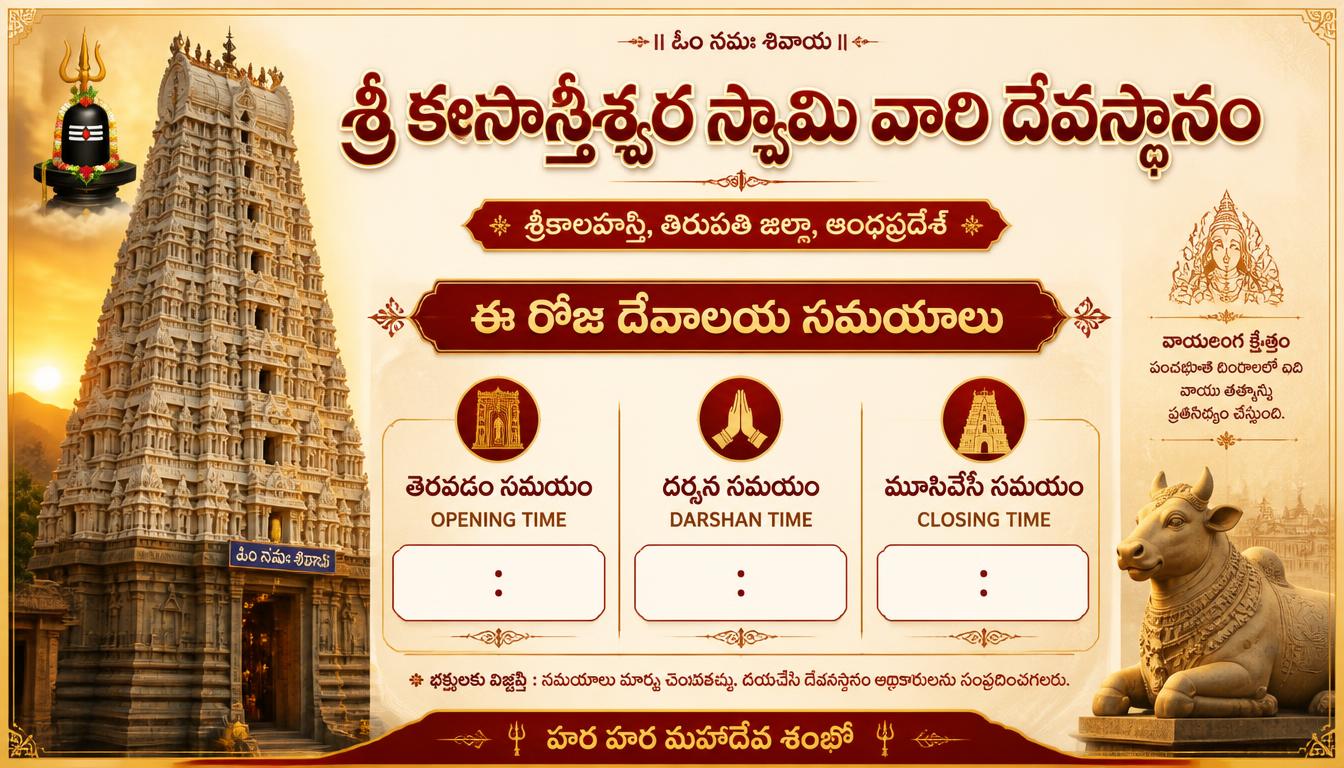
A visit to Sri Kalahasteeswara Temple rarely feels like an ordinary stop on a travel plan. You may arrive watching the clock, wondering about the next darshan window,
but somewhere between the stone corridors, ringing bells, burning lamps, and the quiet sight of devotees waiting for Lord Shiva, time starts feeling a little less important.
Still, knowing the correct Sri Kalahasteeswara Temple timings today can save you from reaching during a ritual break or finding a much longer queue than expected.
Located in Srikalahasti, Andhra Pradesh, this ancient Shiva temple is among India’s celebrated Pancha Bhuta Sthalams. Here, Lord Shiva is associated with Vayu, or the Air element, giving the shrine its special identity as the Vayu Sthalam.
For most visitors, the practical questions come first: What is the temple opening time? When does darshan begin? What is the temple closing time? And when should you arrive for the famous Rahu Ketu Puja?
This guide brings those details together so your temple visit feels less rushed and a bit more peaceful.
The usual Sri Kalahasteeswara Temple timings extend from early morning until night. The temple generally opens around 5:00 AM and closes around 9:00 PM, although actual access to particular areas, rituals, and darshan can vary during the day.
The commonly followed darshan windows are:
These opening and closing times should be treated as normal-day guidance rather than a promise for every calendar date. Festival day timings, special rituals, temple administration decisions, and exceptionally large crowds can change the working temple schedule.
That matters especially during Maha Shivaratri, Brahmotsavam, Karthika Masam, eclipse-related observances, and other important days in the Hindu calendar.
If your trip depends on one particular seva or a tight travel connection, checking the day’s schedule with temple authorities before travelling is a sensible idea.
The Sri Kalahasteeswara Temple darshan timings are designed around worship and the temple’s regular ritual cycle. Although people often search for one continuous time slot, actual temple life moves through darshan, pooja, abhishekam, offerings, and short periods when access may be controlled.
Morning darshan timings are particularly attractive if you prefer a calmer spiritual atmosphere. The air is cooler, the day has barely begun, and the temple complex slowly fills with the sound of prayers. It can feel wonderfully unhurried, even when there are already devotees around.
The evening darshan timings, commonly extending until around 9:00 PM, offer a different mood. Lamps begin glowing brighter against the old stone, evening worship takes over, and the temple develops that unmistakable night-time devotional character.
Visitors making a Sunday afternoon visit should be a little more careful about the schedule. Instead of assuming every hour between opening and closing is equally suitable for darshan, plan around the stated daily darshan schedule.
During busy periods, arriving earlier than your preferred darshan time is usually wise.
For travellers building an itinerary around Tirupati and Srikalahasti, the easiest figures to remember are 5:00 AM for opening and 9:00 PM for closing on a usual day.
However, Sri Kalahasti opening time doesn’t necessarily mean every seva begins at that exact minute. Likewise, Sri Kalahasti closing time shouldn’t be interpreted as permission to arrive at 8:59 PM and expect a comfortable complete visit. Temples, rather inconveniently for our perfectly organised spreadsheets, have rituals of their own.
Arrive with some breathing room.
Early morning is excellent for visitors interested in morning worship, while evening can be beautiful for devotees hoping to experience Sandhya Aarti, Deeparadhana, or other evening rituals according to the day’s arrangements.
The night ritual and closing procedures may also affect entry toward the end of the day.
Darshan is only one part of worship at this sacred temple. Throughout the day, different forms of daily pooja, daily rituals, aarti, abhishekam, and seva offerings form the rhythm of the shrine.
Ritual names visitors may encounter include Praat Aarti, Uchikala Pooja, Sandhya Aarti, and Shayan Aarti. Devotees may also enquire about Rudrabhishekam, Vayu Abhishekam, Archana, Vedic abhishekam, and other special rituals.
The exact aarti timings and pooja timings can differ from ordinary darshan hours, so someone specifically coming for a particular ritual shouldn’t rely only on the general temple opening hours.
During worship, sacred lamps, sometimes including pure ghee lamps, become part of the devotional setting. Deeparadhana and forms such as Panchatatva Deeparadhana hold their own religious meaning and aren’t simply extensions of tourist visiting hours.
For a devotee, that distinction is quite important.
One reason Sri Kalahasteeswara Temple is so widely known is the Rahu-Ketu Puja. Pilgrims travel from different parts of India specifically to perform this ritual, traditionally associated with remedies concerning Rahu and Ketu and certain serpent planet doshas in Hindu astrological belief.
The commonly referenced Rahu Ketu puja timings extend through much of the daytime, often approximately 6:00 AM to 5:00 PM, with worship conducted in sessions according to temple arrangements.
Still, don’t treat that broad window as one fixed appointment schedule.
The Rahu-Ketu ritual can involve Sankalpam, and devotees may be asked for details such as their name and Gotram for Name and Gotra Sankalpam. Procedures depend on the seva arrangement selected at the temple.
Searches for Rahu Ketu pooja Srikalahasti, Rahu Ketu puja ticket, and Rahu Ketu puja price are extremely common because different categories or arrangements may have different fees.
For that reason, verify the current puja fee and available Rahu-Ketu Puja Pass at an authorized temple counter, official booking source, or the temple office rather than trusting an old price quoted on a random travel page.
Astrological beliefs may influence when individual devotees prefer to perform the ritual, but the temple’s operating schedule and instructions ultimately determine practical access.
Visitors generally encounter options such as General Darshan and paid or Special Darshan, depending on the temple’s current arrangements.
General or free darshan is suitable for pilgrims who aren’t concerned about waiting longer. During quieter periods, the difference in wait time may be modest; on crowded religious days, it can become much more noticeable.
Priority darshan or Special Darshan arrangements, when available, may offer a more organised or faster queue. The current darshan price should always be confirmed through an official counter or authorized booking channel.
This is particularly important because searches for Sri Kalahasti darshan ticket price and Sri Kalahasti special darshan ticket can bring up old information.
If you prefer walk-in darshan, arriving early can help. A queue that looks harmless at sunrise can become an entirely different creature once buses and pilgrim groups begin arriving.
Ordinary entry arrangements and paid seva arrangements shouldn’t be confused with each other. A devotee may be able to enter for General Darshan without purchasing the same type of ticket required for a specific puja or seva.
For Srikalahasti temple ticket booking, use recognized temple booking facilities or official counters whenever possible.
If you intend to perform Rahu-Ketu Puja, Rudrabhishekam, Archana, abhishek, or another seva, enquire separately about the applicable seva fee, reporting time, ticket conditions, and permitted entry areas.
Some ceremonies can be conducted in designated spaces or an inner puja room, and buying a seva ticket does not necessarily mean every area of the temple becomes accessible.
Keep the ticket with you until the ritual or darshan is completed. Tiny slips of paper have an almost supernatural talent for disappearing exactly when someone at a counter asks for them.
For an ordinary-day visit, early morning is one of the most comfortable choices.
Arriving close to the beginning of the morning darshan period gives you a better chance of avoiding the heavier daytime crowd. It also leaves plenty of time for darshan, pooja enquiries, temple prasadam, and exploring the surroundings without constantly checking your phone clock.
Late afternoon and early evening are another appealing option, especially for visitors who enjoy evening worship and illuminated temple spaces.
Weekends, auspicious dates, and major religious occasions can bring considerably longer queues. During Maha Shivaratri Srikalahasti celebrations, for example, the temple can experience high crowd levels and extended religious activity.
So the “best” hour isn’t identical for everyone. A traveller seeking quick darshan may choose early morning; a devotee interested in a specific ritual should plan around its scheduled time instead.
Normal daily temple timings aren’t always applicable during festivals.
Maha Shivaratri is among the most significant celebrations connected with Lord Shiva, and Srikalahasti becomes especially active around this period. Brahmotsavam Srikalahasti is another major occasion when pilgrim numbers and ritual activity can increase substantially.
Karthika Masam, the annual temple festival, and other special occasions can also bring changes to visitor timings, queue arrangements, and seva schedules.
Traditionally significant Solar Eclipse and Lunar Eclipse days may involve special religious procedures too. Temple customs surrounding eclipse days shouldn’t be guessed from ordinary opening hours because arrangements can depend on the religious and astrological calendar.
Before visiting on an important festival date, verify the special timings.
It is one of those small checks that can prevent a surprisingly large travel headache.
The temple’s importance reaches far beyond its daily timetable.
Sri Kalahasteeswara Swamy is worshipped here in connection with Vayu, making Srikalahasti the celebrated Vayu Sthalam or air element Shiva temple among the Pancha Bhoota Stalam tradition.
The Pancha Bhuta concept connects Shiva shrines with the five fundamental elements of nature. Srikalahasti represents air, which gives the shrine a distinctive place within the Pancha Bhuta Sthalams.
This spiritual association is one reason pilgrims don’t view Lord Shiva temple Srikalahasti as merely another historic temple on a South Indian itinerary.
People come for darshan, certainly, but also for prayer, ancestral family traditions, astrological rituals, and experiences passed quietly from one generation to another.
That history follows you through the temple complex in a way photographs can’t quite reproduce.
After worship, devotees may receive or purchase temple prasadam according to current arrangements.
In Hindu worship, prasada means more than ordinary food. It is an offering associated with divine blessing, and many families carry it home to share with relatives who couldn’t make the pilgrimage.
Visitors may also encounter Vibhuti, or sacred ash, alongside other sacred offerings connected with Shiva worship.
Depending on the particular ritual, offerings such as Panchamrit or abhishek prasadam may be associated with an abhishekam.
Availability isn’t identical for every seva or every day, so ask temple staff rather than assuming a particular offering is included with your ticket.
The temple is situated in Srikalahasti, Andhra Pradesh, historically associated with Chittoor District Andhra Pradesh, and lies within practical travelling distance of Tirupati.
When searching maps, use Sri Kalahasteeswara Temple address, Sri Kalahasti temple location, or Sri Kalahasti/Srikalahasti rather than relying on references to similarly named Shiva temples elsewhere.
This distinction matters because online searches sometimes mix information from temples across Tamil Nadu, Kurnool, Guntur District, Tirupati, and other South Indian locations.
Likewise, references to Akasha Ganga Road, Tirumala, ISKCON Tirupati Temple, or Japali Anjaneya Swamy Temple concern other pilgrimage locations around the broader Tirupati region, not the entrance address of Sri Kalahasteeswara Temple itself.
Check your temple map before starting the trip. It sounds ridiculously simple, yet it prevents a lot of last-minute confusion.
Visitors wondering how to reach Srikalahasti temple have several transport choices.
Srikalahasti has rail connections, making the railway a convenient option for many pilgrims. Travellers can also arrive by bus, taxi, or private vehicle from Tirupati and surrounding cities.
For those travelling by air, the nearest practical airport option is generally in the Tirupati region, followed by road travel to Srikalahasti.
If you’re combining Tirupati and Sri Kalahasti in one pilgrimage, avoid packing too many temples into an unrealistically tight timetable. Traffic, queue length, ritual timings, and travel between locations can easily stretch a neat two-hour plan into something much longer.
A relaxed itinerary tends to make a spiritual trip feel like a pilgrimage rather than a race.
There are various options for accommodation near Sri Kalahasteeswara Temple, ranging from straightforward pilgrim-oriented stays to hotels.
Staying close to the shrine is particularly useful when you’re planning an early-morning puja. You can wake up, get ready, and reach the temple without beginning the day with a long drive.
When choosing hotels near Srikalahasti temple, look beyond room price. Walking distance, vehicle access, parking availability, check-in hours, and recent guest feedback can matter just as much.
Visitors continuing onward to Tirupati may instead prefer accommodation there, depending on the rest of their itinerary.
A respectful traditional outfit is the safest choice when visiting this Hindu temple.
The current Srikalahasti temple dress code should be followed wherever specific restrictions are communicated by temple staff. Clothing should generally be modest and suitable for a place of worship.
For Srikalahasti parking, availability and convenience can change with crowd levels. On festival days, expect greater traffic around approach roads and allow extra time between parking your vehicle and reaching the temple entrance.
Visitors requiring accessibility assistance should enquire with the temple office about available arrangements. Historic temple architecture isn’t always as straightforward to navigate as a modern public building.
Also pay attention to restrictions concerning mobile phones, footwear, photography, bags, and belongings. Even if you find beautiful temple photos online, that doesn’t automatically mean photography is allowed everywhere inside the complex.
Crowd planning deserves more attention than people usually give it.
On an ordinary weekday, your experience can be relatively manageable. On weekends, auspicious dates, and major festivals, Srikalahasti temple crowd conditions may change rapidly.
Try reaching before your ideal darshan slot rather than exactly at it. Carry only what you actually need and keep tickets or booking details easily accessible.
Families travelling with children or elderly relatives should be especially conservative with their schedule. A theoretically short queue can feel rather long when somebody is tired, hungry, or standing in warm weather.
And don’t schedule your train five minutes after your predicted darshan completion. Temples do not negotiate with railway timetables, unfortunately.
A little preparation can make the day dramatically smoother.
These are small things, but pilgrimage days are often made peaceful by small things.
Read articul: https://templetimingsdaily.com/raksha-bandan/
If Srikalahasti is part of a larger South Indian spiritual journey, several other temples may appear in your research.
The Tirupati region includes places such as ISKCON Tirupati Temple and Japali Anjaneya Swamy Temple, while travellers planning much broader itineraries may encounter temples including Palani Murugan Temple, Achanta Ramalingeswara Swamy Temple, and Ahobilam Narasimha Swamy Temple.
They should not, however, be confused with Sri Kalahasteeswara Temple when checking opening hours or booking details.
Every temple follows its own ritual calendar and visitor schedule.
If your primary purpose is Srikalahasti darshan or Rahu-Ketu worship, complete that visit comfortably first and treat additional temples as separate destinations rather than squeezing everything into one impossible day.
On normal days, the temple generally operates from around 5:00 AM to 9:00 PM, with specific darshan and ritual periods during the day. Special days and festivals may follow different arrangements.
Common Srikalahasti darshan timings include a morning period of approximately 6:00 AM to 1:00 PM and an evening period of approximately 4:00 PM to 9:00 PM. Visitors should verify the day’s schedule before travelling.
The usual Sri Kalahasti temple opening time is around 5:00 AM. Individual poojas and darshan services may begin at different times.
The usual Sri Kalahasti temple closing time is around 9:00 PM. Arriving well before closing is recommended so you have sufficient time for darshan.
The Rahu Ketu Puja is generally performed during daytime hours, commonly across a broad window of approximately 6:00 AM to 5:00 PM. Exact sessions and availability should be checked with authorized temple sources.
Yes, General Darshan is commonly available, while paid or Special Darshan arrangements may also be offered. Queue duration depends heavily on the day and crowd.
General temple entry and specific paid darshan or seva arrangements are different things. Verify the latest Sri Kalahasti temple entry fee, Special Darshan charges, and individual seva fees through official temple channels.
Early morning is usually a practical choice for devotees wanting cooler weather and potentially lighter crowds. Festival days and weekends can remain busy even in the morning.
It can. Maha Shivaratri Srikalahasti involves major religious activity and large numbers of devotees, so special darshan, worship, and crowd-control arrangements may replace the normal routine.
The temple is located in Srikalahasti, Andhra Pradesh, India, within easy travelling distance of Tirupati and historically associated with Chittoor district.
Knowing the Sri Kalahasteeswara Temple timings today may begin as a practical search, but a good visit needs more than simply knowing when a gate opens. Understanding darshan timings, Rahu Ketu Puja timings, ticket arrangements, festival schedules, crowd patterns, dress expectations, and transport can turn an uncertain trip into a much calmer pilgrimage.
On an ordinary day, remember the broad schedule: the temple opening time is around 5:00 AM, morning darshan is commonly around 6:00 AM to 1:00 PM, evening darshan around 4:00 PM to 9:00 PM, and the closing time is generally around 9:00 PM. Verify these timings for the actual date of your visit, especially if you’re travelling for a particular seva.
Most importantly, leave a little empty space in your schedule.
At a temple dedicated to Lord Sri Kalahasteeswara, where Vayu itself carries spiritual symbolism, rushing from counter to queue to taxi rather misses something. Arrive with enough time to stand quietly, hear the bells, receive prasadam, and experience the place without staring constantly at the clock.
After all, knowing the temple timing gets you through the entrance. Giving yourself time to actually be there is what makes the journey memorable.
I kept the main SEO entities natural rather than forcing every supplied keyword into unrelated sentences, and avoided inventing fixed ticket prices where rates can change.
Is this conversation helpful so far?