Physical Address
304 North Cardinal St.
Dorchester Center, MA 02124
Physical Address
304 North Cardinal St.
Dorchester Center, MA 02124

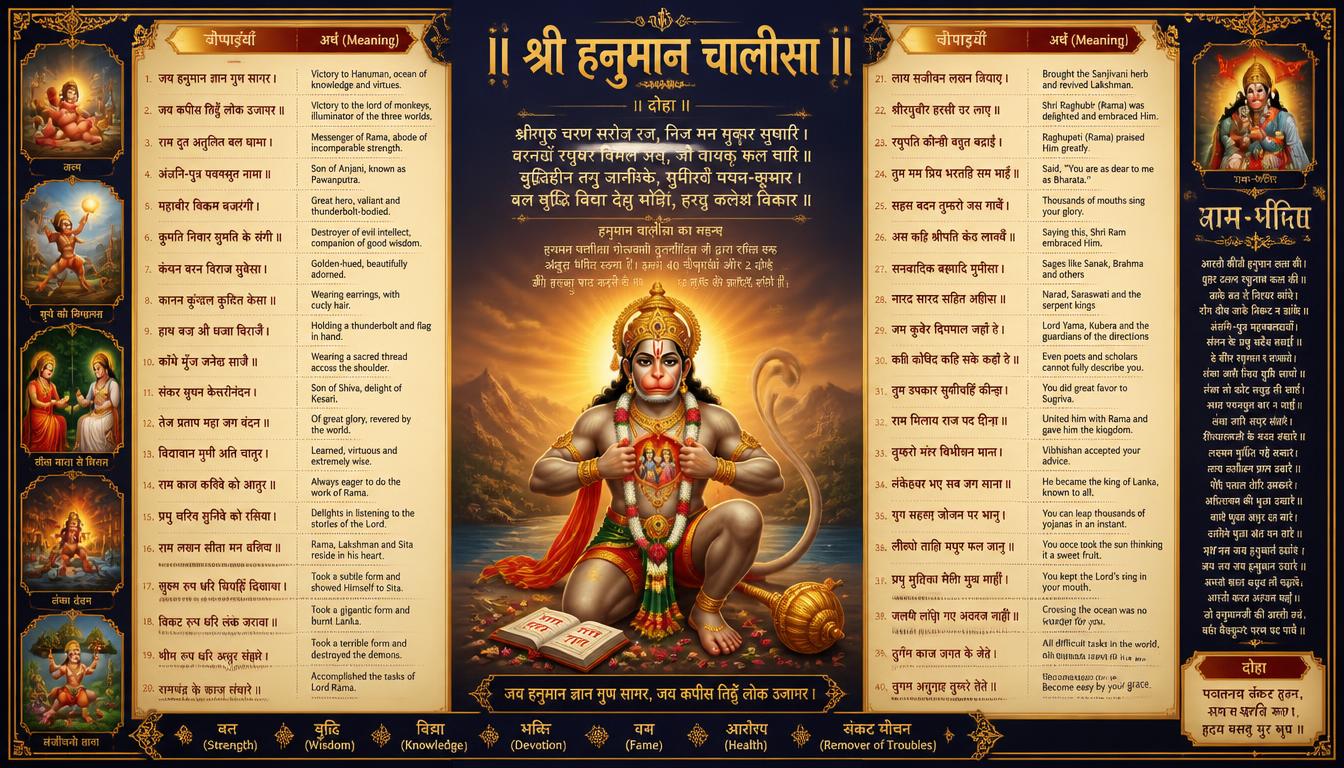
There are prayers we read with our eyes, and then there are prayers we slowly begin to feel in our hearts. Hanuman Chalisa belongs to the second kind. For millions of devotees, reciting the name of Lord Hanuman is not merely a religious routine; it is a quiet way of gathering courage when life feels a little too heavy.
The Shri Hanuman Chalisa praises Hanuman as a symbol of strength, wisdom, courage, devotion, intelligence, humility, and unwavering service to Lord Rama. Written by Goswami Tulsidas, this devotional hymn has remained deeply connected with Hindu worship for generations. It contains 40 Chaupais along with an opening and closing Doha.
For Telugu-speaking devotees, reading the Hanuman Chalisa in Telugu or understanding its meaning in Telugu can make the verses much easier to connect with. The original composition is traditionally associated with Awadhi, while Telugu, Hindi, and English versions are widely used today for reading, learning, and devotional practice.
This guide presents the Hanuman Chalisa full text along with a simple English explanation of its meaning, significance, and devotional themes.
The Hanuman Chalisa is a famous devotional hymn dedicated to Hanuman, also known as Bajrangbali, Anjaneya, Pavanputra, Anjaniputra, Mahaveer, and Ramdoot. The word “Chalisa” refers to forty, representing the forty Chaupais in the main body of the hymn.
The verses describe Hanuman’s extraordinary strength, but they also repeatedly return to something even more important—his complete devotion to Rama. His power is never presented as something for personal pride. Instead, it becomes useful because it is placed in the service of Rama Bhakti.
That is one reason this prayer continues to feel relevant even today. A person may read it seeking courage, peace, protection, confidence, or simply a few quiet minutes away from the noise of everyday life.
Shri Guru Charan Saroj Raj, Nij Man Mukur Sudhari
Barnau Raghubar Bimal Jasu, Jo Dayaku Phal Chari
Meaning:
After cleansing the mirror of my mind with the dust of my Guru’s lotus feet, I describe the pure glory of Lord Rama, who grants the four goals of life.
Buddhiheen Tanu Jaanike, Sumirau Pavan Kumar
Bal Buddhi Vidya Dehu Mohi, Harahu Kalesh Vikar
Meaning:
Knowing myself to be lacking in wisdom, I remember Pavan Kumar, Hanuman. I pray for strength, intelligence, and knowledge, and ask him to remove suffering and negative thoughts.
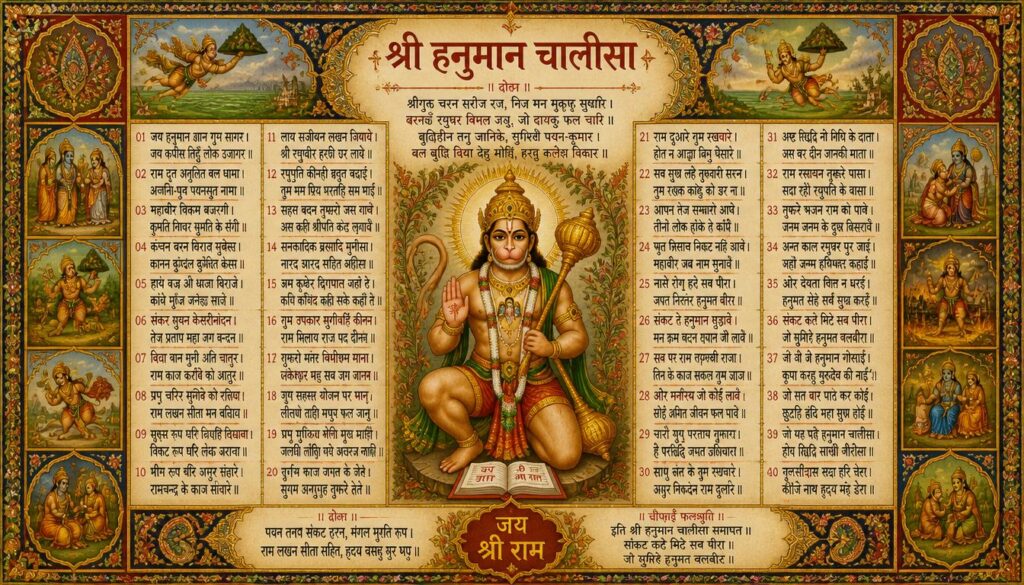
Jai Hanuman Gyan Gun Sagar
Jai Kapis Tihun Lok Ujagar
Meaning:
Victory to Hanuman, the ocean of knowledge and virtues. Glory to the lord of the Vanaras whose greatness shines throughout the three worlds.
Ram Doot Atulit Bal Dhama
Anjani Putra Pavan Sut Nama
Meaning:
Hanuman is the messenger of Lord Rama and the embodiment of incomparable strength. He is known as the son of Anjana and the son of the wind.
Mahaveer Vikram Bajrangi
Kumati Nivar Sumati Ke Sangi
Meaning:
The great warrior, Bajrangi, removes harmful thoughts and supports wisdom and good understanding.
Kanchan Baran Biraj Subesa
Kanan Kundal Kunchit Kesa
Meaning:
Hanuman has a radiant golden complexion and a beautiful appearance, adorned with earrings and curly hair.
Hath Vajra Aur Dhwaja Biraje
Kandhe Moonj Janeu Saje
Meaning:
He carries the powerful Vajra and a flag, while a sacred thread rests upon his shoulder.
Shankar Suvan Kesari Nandan
Tej Pratap Maha Jag Vandan
Meaning:
Hanuman is associated with Lord Shiva and is the son of Kesari. His divine brilliance and glory are honored throughout the world.
Vidyavan Guni Ati Chatur
Ram Kaj Karibe Ko Aatur
Meaning:
Hanuman is learned, virtuous, and extremely intelligent. He is always eager to complete the work entrusted to him by Lord Rama.
Prabhu Charitra Sunibe Ko Rasiya
Ram Lakhan Sita Man Basiya
Meaning:
He delights in listening to the stories and deeds of the Lord. Rama, Lakshmana, and Sita live within his heart.
Sukshma Roop Dhari Siyahin Dikhava
Bikat Roop Dhari Lanka Jarava
Meaning:
Hanuman took a tiny form when he appeared before Sita, and later assumed a terrifying form to burn Lanka.
Bhim Roop Dhari Asur Sanhare
Ramachandra Ke Kaj Sanvare
Meaning:
Taking a mighty form, Hanuman defeated demons and successfully completed the tasks of Lord Rama.
Laye Sajivan Lakhan Jiyaye
Shri Raghubir Harashi Ur Laye
Meaning:
Hanuman brought the life-restoring Sanjeevani herb to save Lakshmana. Rama was overjoyed and embraced him.
Raghupati Kinhi Bahut Badai
Tum Mam Priya Bharat Hi Sam Bhai
Meaning:
Lord Rama praised Hanuman greatly and said that Hanuman was as dear to him as his beloved brother Bharat.
Sahas Badan Tumharo Jas Gaave
As Kahi Shripati Kanth Lagave
Meaning:
Even a thousand mouths could not fully describe Hanuman’s glory. Saying this, Lord Rama lovingly embraced him.
Sankadik Brahmadi Munisa
Narad Sarad Sahit Ahisa
Meaning:
Great sages, Brahma, Narada, Saraswati, and the divine serpent Shesha all praise the greatness of Hanuman.
Jam Kuber Digpal Jahan Te
Kavi Kovid Kahi Sake Kahan Te
Meaning:
Even Yama, Kubera, the guardians of the directions, poets, and scholars cannot completely describe Hanuman’s greatness.
Tum Upkar Sugrivahin Kinha
Ram Milaye Raj Pad Dinha
Meaning:
Hanuman helped Sugriva meet Lord Rama, which eventually helped Sugriva regain his kingdom.
Tumharo Mantra Vibhishan Mana
Lankeshwar Bhaye Sab Jag Jana
Meaning:
Vibhishana accepted Hanuman’s wise counsel and ultimately became the ruler of Lanka.
Jug Sahasra Yojan Par Bhanu
Leelyo Tahi Madhur Phal Janu
Meaning:
As a child, Hanuman saw the sun from a great distance and playfully considered it to be a sweet fruit.
Prabhu Mudrika Meli Mukh Mahi
Jaladhi Langhi Gaye Acharaj Nahi
Meaning:
Carrying Lord Rama’s ring, Hanuman crossed the ocean to reach Lanka. For one possessing such devotion and determination, this extraordinary achievement was possible.
Durgam Kaj Jagat Ke Jete
Sugam Anugrah Tumhare Tete
Meaning:
Difficult tasks can become easier through Hanuman’s grace and the courage inspired by his devotion.
Ram Duware Tum Rakhvare
Hot Na Aagya Binu Paisare
Meaning:
Hanuman is described as the guardian at the doorway of Lord Rama. The verse expresses the devotional belief that his grace is essential.
Sab Sukh Lahai Tumhari Sarna
Tum Rakshak Kahu Ko Darna
Meaning:
Those who seek Hanuman’s refuge are believed to receive peace and comfort. With such a protector, there is no reason to remain consumed by fear.
Aapan Tej Sanharo Aapai
Teenon Lok Hank Te Kanpai
Meaning:
Hanuman possesses such immense divine energy that the three worlds tremble at his powerful presence.
Bhoot Pishach Nikat Nahi Aavai
Mahaveer Jab Naam Sunavai
Meaning:
The name of Mahaveer Hanuman is traditionally believed to protect devotees from frightening and negative forces.
Nasai Rog Harai Sab Peera
Japat Nirantar Hanumat Beera
Meaning:
Devotees believe that remembering brave Hanuman can bring relief from suffering and provide spiritual strength during difficult moments.
Sankat Te Hanuman Chhudavai
Man Kram Vachan Dhyan Jo Lavai
Meaning:
Those who remember Hanuman with their mind, actions, and words are believed to receive strength to face difficult situations.
Sab Par Ram Tapasvi Raja
Tin Ke Kaj Sakal Tum Saja
Meaning:
Lord Rama, the great ascetic king, is supreme, and Hanuman faithfully carries out his divine tasks.
Aur Manorath Jo Koi Lavai
Soi Amit Jeevan Phal Pavai
Meaning:
A devotee who approaches Hanuman with sincere faith is believed to receive meaningful and beneficial results in life.
Charon Yug Partap Tumhara
Hai Parsiddh Jagat Ujiyara
Meaning:
Hanuman’s glory is celebrated throughout the four ages, and his fame continues to illuminate the world.
Sadhu Sant Ke Tum Rakhvare
Asur Nikandan Ram Dulare
Meaning:
Hanuman protects saints and righteous people, defeats evil forces, and remains deeply beloved by Lord Rama.
Ashta Siddhi Nav Nidhi Ke Data
As Var Dinh Janaki Mata
Meaning:
Mother Janaki is described as granting Hanuman the ability to bestow the eight Siddhis and nine forms of treasure upon devotees.
Ram Rasayan Tumhare Pasa
Sada Raho Raghupati Ke Dasa
Meaning:
Hanuman possesses the spiritual essence of devotion to Rama and remains eternally devoted to serving Raghupati.
Tumhare Bhajan Ram Ko Pavai
Janam Janam Ke Dukh Bisravai
Meaning:
Devotional worship of Hanuman is traditionally believed to lead a devotee toward Lord Rama and help release the heart from accumulated sorrow.
Ant Kaal Raghubar Pur Jai
Jahan Janma Hari Bhakt Kahai
Meaning:
The devotee expresses the wish to reach Rama’s divine abode at the end of life and, if born again, remain a devotee of the Divine.
Aur Devta Chitt Na Dharai
Hanumat Sei Sarva Sukh Karai
Meaning:
The verse emphasizes focused devotion to Hanuman and expresses the belief that such devotion brings spiritual contentment and happiness.
Sankat Kate Mite Sab Peera
Jo Sumirai Hanumat Balbeera
Meaning:
Remembering the powerful and courageous Hanuman is traditionally believed to help overcome difficulties and suffering.
Jai Jai Jai Hanuman Gosain
Kripa Karahu Gurudev Ki Naain
Meaning:
The devotee praises Hanuman repeatedly and asks him to show compassion like a revered spiritual teacher.
read more: https://templetimingsdaily.com/krishna-janmashtami-2026/
Jo Sat Bar Path Kar Koi
Chhutahi Bandi Maha Sukh Hoi
Meaning:
The verse describes repeated recitation as a devotional practice associated with freedom from difficulties and the attainment of deep spiritual happiness.
Jo Yah Padhe Hanuman Chalisa
Hoye Siddhi Sakhi Gaurisa
Meaning:
Those who recite the Hanuman Chalisa with devotion are traditionally believed to progress in their spiritual practice. Lord Shiva is invoked as the witness.
Tulsidas Sada Hari Chera
Keejai Nath Hriday Mah Dera
Meaning:
Tulsidas describes himself as an eternal servant of the Divine and asks Hanuman to make his heart a dwelling place.
Pavan Tanay Sankat Haran, Mangal Murti Roop
Ram Lakhan Sita Sahit, Hriday Basahu Sur Bhoop
Meaning:
O son of the wind, remover of difficulties and embodiment of auspiciousness, may you dwell within my heart together with Lord Rama, Lakshmana, and Sita.

The beauty of the Hanuman Chalisa is that it does not praise physical strength alone. Hanuman has extraordinary power, but his greatest quality is that he uses it for Rama’s service.
This gives the prayer a deeper message. Strength without wisdom can become destructive. Intelligence without humility can become pride. Devotion without action may remain only an emotion. Hanuman brings these qualities together through knowledge, courage, service, discipline, compassion, and bhakti.
For this reason, many people turn to Hanuman prayer when they need emotional strength or simply want to cultivate a more focused mind.
People often search for Hanuman Chalisa Telugu, Hanuman Chalisa in Telugu, Hanuman Chalisa Telugu lyrics, and Hanuman Chalisa with meaning because understanding the language can make devotional reading more personal.
The Chalisa is also widely available in:
If you are new to the prayer, an English meaning or Telugu explanation can be useful at first. Once the meaning becomes familiar, the original verses can be recited more naturally.
The phrase Hanuman Chalisa benefits is searched frequently, but it is important to understand these benefits in their proper context. Traditional beliefs should not be presented as guaranteed medical or supernatural results.
Some commonly associated devotional benefits include:
Hanuman represents fearlessness and determination. Reciting his name can serve as a reminder to face challenges rather than constantly running away from them.
A regular Hanuman Chalisa recitation gives the mind a structured period of concentration. The rhythm of the verses can become a peaceful part of a daily routine.
The stories reflected in the Chalisa portray Hanuman crossing the ocean, finding Sita, confronting powerful enemies, and carrying the Sanjeevani herb. These images naturally encourage a mindset of courage.
Hanuman is traditionally regarded as a powerful protector. Devotees may recite the Chalisa as a form of spiritual protection and reassurance.
The devotional tradition associates Hanuman with overcoming sankat, or difficulties. The prayer can inspire patience and determination while facing real-life obstacles.
Regular prayer can encourage reflection, humility, devotion, and a stronger connection with one’s spiritual values.
There is no universal requirement that the Chalisa must be read at one particular hour. Many devotees prefer morning or evening because those times can be quieter and more suitable for prayer.
Tuesday and Saturday are traditionally associated with Hanuman worship, so some devotees especially choose these days for Hanuman Chalisa chanting.
Others read it every day. The most useful routine is often the one you can actually maintain rather than choosing an ambitious schedule and abandoning it after a few days.
Some devotional traditions recommend reciting the Chalisa 7 times, 11 times, or other numbers. Such practices vary among families, temples, teachers, and regional traditions.
There is no need to turn devotion into a race. One sincere recitation with attention and understanding may be more meaningful for a beginner than repeatedly reading the words without knowing what they say.
If a particular guru or family tradition gives you a specific practice, you can follow it according to that tradition.
Correct Hanuman Chalisa pronunciation becomes easier when you listen to a reliable recitation and repeat slowly. Do not worry if the first few attempts feel awkward. Sanskritized or Awadhi devotional words can take time for new readers.
Start with a few lines. Learn their meaning. Then connect the sound with the meaning. After some practice, the rhythm begins to feel familiar almost on its own.
It can also help to keep the text in one consistent script instead of switching between multiple versions every day.
The Chalisa contains many references to the Ramayana, including Sita, Lakshmana, Sugriva, Vibhishana, Lanka, Sanjeevani, Ramdoot, and the service of Lord Rama.
These references are not random stories placed into a hymn. Together, they build a portrait of Hanuman as the ideal servant and devotee. He uses intelligence when intelligence is needed, strength when strength is required, humility when approaching Sita, and courage when confronting danger.
That combination is what makes Hanuman such a distinctive figure in Hindu devotional tradition.

If you are beginning a daily Hanuman Chalisa paath, keep it simple.
Choose a clean and quiet place. Sit comfortably. Take a few calm breaths before beginning. Read the verses without rushing. When you come across a line you particularly like, pause and think about its meaning for a few seconds.
You can also maintain a small devotional routine around the reading, such as lighting a traditional lamp if that is part of your family practice, offering prayers, or spending a few moments in silent meditation afterward.
The purpose is not to create a complicated ceremony. The purpose is to create a moment where the mind becomes less scattered.
Many readers search for Hanuman Chalisa PDF, Hanuman Chalisa Telugu PDF, Hanuman Chalisa PDF download, and Hanuman Chalisa audio because digital formats make devotional reading convenient.
A PDF can be useful for offline reading, while audio can help beginners learn pronunciation and rhythm. When choosing an online version, however, it is wise to check the text carefully because different websites can contain spelling or formatting mistakes.
For serious devotional practice, compare the text with a trusted printed prayer book, temple publication, or respected traditional source whenever possible.
You can download the Hanuman Chalisa Telugu PDF to read, chant, or keep it for offline use. The PDF contains the complete Hanuman Chalisa in Telugu script.
Sri Hanuman Chalisa in Telugu allows devotees to read and recite this sacred hymn in the Telugu script. It is dedicated to Lord Hanuman and praises his strength, devotion, and divine qualities.
Chalisa Telugu refers to the Hanuman Chalisa written in Telugu script for easy reading and chanting. It helps Telugu-speaking devotees understand and practice the hymn comfortably.
హనుమాన్ చాలీసా తెలుగు is the Telugu-script version of the sacred Hanuman Chalisa. Devotees can read, chant, and understand its verses in their familiar language.
హనుమాన్ చాలీసా PDF provides the complete hymn in a convenient digital format. You can download it for reading, daily chanting, printing, or offline devotional practice.
The Hanuman Chalisa has survived across generations not simply because it is an old devotional hymn, but because its central ideas remain remarkably human. Fear, uncertainty, weakness, responsibility, loyalty, courage, and the search for inner strength are not problems belonging to one century.
Hanuman’s story gives those struggles a spiritual shape. He reminds devotees that strength can exist alongside humility, intelligence alongside devotion, and immense power alongside complete service.
Whether you call him Lord Hanuman, Bajrangbali, Anjaneya, Pavanputra, Mahaveer, or simply Hanuman, the devotional message remains powerful: use your strength wisely, keep your mind steady, serve with sincerity, and do not allow fear to become the ruler of your life.
For someone beginning the prayer today, there is no need to make the first reading perfect. Read slowly. Understand the words. Let the rhythm become familiar. Over time, the Hanuman Chalisa lyrics may stop feeling like lines on a page and begin to feel like a quiet conversation between devotion and the heart.